
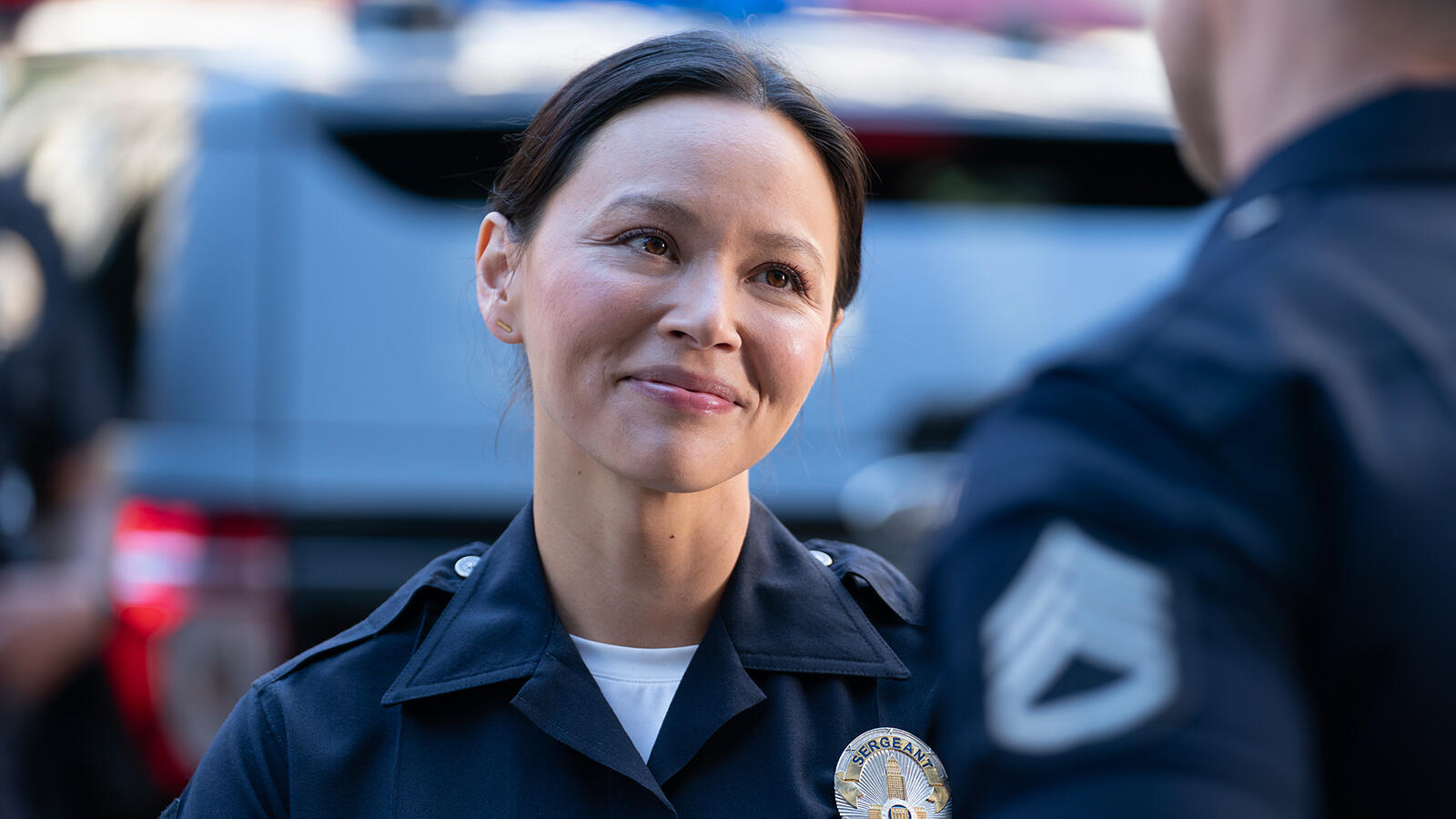
Melissa O’Neil, The Rookie
Disney/Mike Taing
[Warning: This story contains spoilers for The Rookie, Season 8, Episode 10, “His Name Was Martin.” Read at your own risk!]
Melissa O’Neil knows that Lucy Chen will never be the same on The Rookie. After taking a major step forward in her career by successfully passing the sergeant’s exam at the end of last season, Lucy has now been confronted with what O’Neil describes as “a cop’s worst nightmare”: killing a civilian in self-defense while working in the line of duty.
In Monday’s episode of the ABC police procedural drama, Lucy and Celina (Lisseth Chavez) were called as back-up to Westview Hospital, the abandoned former mental institution where Nolan (Nathan Fillion), Harper (Mekia Cox), and Miles (Deric Augustine) were checking on a clean-up crew that had lost contact with their supervisor. Much to their horror, Lucy and Celina discovered that the hospital had been overrun by poisoned members of the remediation crew, whose prolonged exposure to high doses of toxic chemicals at the worksite made them develop acute neurotoxicity and turned them into blood-thirsty “zombies.” (You read that right.)
With none of their teammates in sight, Lucy and Celina tried to contain the “zombies” — only to get separated while running away from them. While sequestering herself in a quiet tunnel of the building, Lucy was ambushed from behind by one of the poisoned crew members, whom she fought off and knocked out. She was then immediately attacked by another drugged man named Martin, who pinned her down and threatened her with a knife. Locked in a desperate struggle for survival, Lucy was forced to kill Martin in self-defense.
Lucy is certainly no stranger to violence as a police officer, but this is the first time that she will have to navigate the guilt of taking another life. “I don’t think it’s a stretch or a spoiler to say that we do see Lucy take accountability for what she’s done,” O’Neil says of her character, who is left severely traumatized in the wake of the hospital attack. “There’s so many ways that you could cut this up and say, ‘Oh, it was self-defense. I was trying to save my life.’ But ultimately, she did kill somebody. Lucy is the type of person who stands in her integrity and accepts how it’s going to affect her moving forward.”
Everything you need for spring TV:
In another first for The Rookie, creator/showrunner Alexi Hawley, who wrote and directed this episode, decided to release an extended cut (with a run time of 48 minutes) today after ABC originally asked him to cut the version that aired down to the standard 42 minutes. “He just liked it too much and decided to release an extended version for streaming so that fans could enjoy the more holistic director’s cut,” O’Neil confirms.
In a wide-ranging exclusive interview with TV Guide, O’Neil takes us behind the scenes of shooting that pivotal point in Lucy’s arc, and teases what that ending — where her character is last seen crying on the couch by herself — means for her personal and professional future.
By the end of this season, you will have played Lucy Chen for over 140 episodes. What has intrigued you about Lucy’s continued evolution, and what new layers were you able to find in the playing of the character this season as she takes a step forward both personally by moving in with Tim (Eric Winter) and professionally as a sergeant?
Melissa O’Neil: When you’ve been in somebody’s shoes for as long as I have with Lucy, I think there can be a fear as an actor that there might not be anything else to do or to say with that person. One of the joys of having started her journey as one of the proper original rookies is that she’s had so much room to grow. Last year we were seeing the start of [being a sergeant], and this year we get to see her in a proper sergeant capacity while also having her relationship finally blossoming to a place where the timing is right, where both of them are ready to dive in.
A thing that we’ve been dancing with for Bradford and Chen is the power dynamics being an obstacle for them. Obviously, there is still seniority, but it’s a lot different now because she has so much more time under her belt. [I’m interested] to see her juggling that not only interpersonally, but, as an individual, what does it look like when a woman is in a male-dominated profession with a position of seniority, responsibility, and leadership, and also balancing her love life in that working space as well?
I didn’t know at the beginning of the season that we were going to take the turn that we did midseason, so I’m very grateful that Alexi and the team continue to write for Lucy in a way that I get to expand myself as an actor, and we get to see her continue to be … traumatized. [Laughs.] I don’t know if that’s something that we’re all thrilled for, because I know over eight years she’s been through [a lot] already, but I also think that’s a part of being a police officer. A lot of people who are first responders see and experience things that are very difficult, even traumatizing, and yet they still put on their uniform and they return [to work]. It’s probably a big marker of what makes them who they are and why they are the ones in their profession.
Once you received the script for this week’s episode, what kinds of conversations did you have with Alexi about how you wanted to collectively approach this key part of Lucy’s arc?
O’Neil: I think we were at dinner, actually, when Alexi gleefully told me about what we were going to do with Lucy around this story. [Laughs.] A part of what I remember being very exciting to him and divergent from what she had experienced before was that it was the gristly, gritty, intimate way that [the death] happens, and that on top of everything, it’s somebody who is not being malicious because of their own volition. They’re unwell, and they are affected by something outside of them, and they’re not acting in their right mind. Her ultimately coming to blows [with this idea] that “it’s either going to be him or me” in that moment, and her making an instinctual choice out of necessity and then learning later about the circumstances around it, were contributing parts of the heartbreak for this aspect of the story.
It’s not so brief, but out of the percentage of what we’re telling in the episode, it’s a brief portion at the end. It is visceral and intense. I wanted to make sure that we were able to deliver it in a way that was as honest as possible. I think that what literally kept me up at night [laughs] preparing for it was just being in contemplation of the gravity of something like that for someone like her. I’ve played characters who have taken people’s lives rather frivolously, and she is not that person. She is the complete other end of the spectrum.
Accessing that part of you that cares so deeply is not difficult, but, at least for me, it was difficult to feel into, “How do you touch that in a way that is pure and honest without trying to manufacture it?” Ultimately, I just had to lean into trusting the beautiful stunt work that our stunt coordinator designed, the incredible work that my makeup artist Judy Yonemoto did, and the crazy set design that we built for that. The whole thing was traumatic.
What do you actually remember from the process of shooting that climactic scene where Lucy gets battered by her first attacker and then has to kill her second attacker in self-defense? Since you don’t have a frame of reference for those kinds of emotions in your own life, how did you prepare to get into that headspace?
O’Neil: The thing that was bizarre, if memory serves — and I might be wrong about this, but I don’t think so. I think we shot this out of sequence; we shot the aftermath before we actually shot the fight. So, in that way, the preparation for [this episode] was just really specific. I had earbuds, and I was listening to a song that I had found ad nauseam [called “Who Are You” by Mehro]. I really used music to help deliver me to an emotional environment that I thought Lucy might be inhabiting. The main thrust of it lyrically and sonically was just this questioning of, “Who are you when things get bad? Who are you when everything about what you know about yourself gets stripped away?” That question really helped to motivate the moments afterwards: “Who is she now? What happens now?” It helped to make that moment feel really alive.
I was very supported by the crew, because I walked on set and I looked so messed up from Judy’s makeup. Usually, we come onto set, and we’re so boisterous, alive and lively, and it was very funny. People turned [away from me] as I walked onto set that day, and everyone just got really quiet because I looked and felt so messed up. It was really a team effort — and I think that sometimes gets washed away. People don’t appreciate sometimes that, to help an actor access places like that, it really requires a whole bunch of people on set to just be mindful of the environment. We have such a supportive set that helps to facilitate being able to access that.
How long were you actually in the makeup chair with Judy to apply Lucy’s bruises?
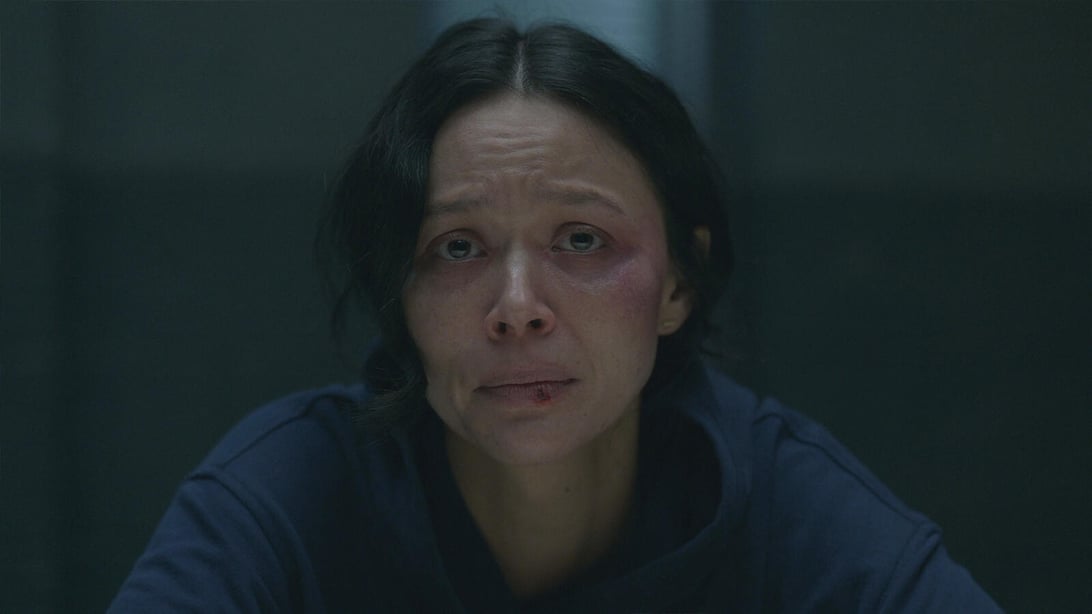
O’Neil: Not as long as we usually are for Lucy’s everyday makeup! Listen, I may or may not confirm that Judy and I do spend a portion of our time gossiping, OK? [Laughs.] We need that time together. But her regular everyday Lucy Chen look that she does takes a little over an hour. Judy really does her best to make people look makeup-less, like that makeup/no-makeup look. When it came to doing this, we didn’t put on any concealer. We let my skin be what it was. We wanted to make it look like she had been rubbing her eyes alongside the really gnarly abuse that she takes, especially with her head getting smashed on the grate like that. Judy does beautiful bruise damage work, so we painted that onto bare skin, and we didn’t cover any of the bags under my eyes. We just left it and amplified putting in redness around the nose. We wanted Lucy to look beat up and really lived-in.
From a character standpoint, can you give voice to what is going through Lucy’s head in the immediate aftermath of the attack? How did you want to play the shock and sadness that she feels over taking another person’s life, even if she committed that act in self-defense?
O’Neil: I actually don’t think there’s a lot going through her mind, in the sense that it’s a wash of noise. That’s how I perceived it. By the time that we were filming [the aftermath], I didn’t have a visual reference for what we would’ve gone through at that point. But that’s why that song was so useful to me, because it was this perpetual asking, “Who are you now, and who did you think you were?” She’s had her own bubble that’s been popped about who she thought she was. That feels really reminiscent of a lot of the things that you hear from first responders, because you can prepare all you want. But when push comes to shove, you want to rely on your training. Ultimately, you do want to live to see another day. Everyone does. That biological imperative to survive is going to override a lot of different things, especially when you’re in an impossible moment.
It’s such a blip of a line, but I love that they included Lucy considering the rest of her team, even while she was in the middle of going through her own processing with her watch commander and obviously her [romantic] partner. I love that in that moment, the second [Bradford] mentions the union rep, she’s like, “Right, Nolan!” She is able to consider the rest of her team outside of herself. I thought it was a really beautiful way to braid in her position and her orientation, even in a space of stress like that.
In that moment afterwards, especially on the couch, there’s this numbness. It reminds me of when people are going through something really traumatic, and they’re trying to keep it together. [The end of the episode is] the first moment that she’s finally alone. But after everything had happened, I think that’s when she was able to let it all fall apart. Even with costumes, we tried on a lot of different sweatsuit sets, and we really wanted her to look diminutive, to look small. I almost stole it because I was like, “This is so comfy.” [Laughs.] But I love that we chose that one to make her look — and especially later on the couch — mousy and diminished.
Melissa O’Neil, The Rookie
Hulu/Screengrab
At the end of that scene in the interrogation room with Nolan, there’s a haunting moment when Lucy, badly battered and bruised, looks directly into the camera. Did you personally make that choice to break the fourth wall, or was that written into the script?
O’Neil: I don’t think it was written. We did a few versions, and we brought the gaze pretty close to the Mapbox. Alexi directed for one [take] to just go right down the barrel. It surprised me to see it in the [final] cut, and I really liked it. It shocked me to be confronted in that way, and there’s so many questions that I felt being asked there. So many people are so invested in Lucy and feel a reflection of themselves in her, and I wonder what that was like for some of the people who feel that way to have a direct eye-to-eye moment.
There is a small detail that I picked up on when I first watched the episode — Tim calls Lucy “Officer Chen” rather than “Sergeant Chen” when he finds her after the attack. Some people think Tim was reverting back to his former training officer/rookie relationship with Lucy to snap her out of her daze; some think Tim using the wrong title was an oversight that no one on the creative team caught on the day. What was your interpretation of that choice?
O’Neil: The beautiful thing about art is that it is open for interpretation and discussion. I love that everybody pays such close attention to details like that. That moment feels reminiscent to me of when the station exploded [in Season 8, Episode 6], and Chen’s going in there [to save Bradford]. She shakes him, and she says, “Bradford!” She calls out to him by his name just to snap him back into it. I think about all of the times that we’ve spent training ourselves and responding to a certain moniker, or the way people are calling us — and in that moment, he’s not trying to get the attention of another lady that’s in charge there. He’s trying to speak to the person who is obviously really deep-seated in the back of her mind right now, because of everything that’s going on. He’s trying to snap her out of it. That’s how I perceived and responded to it.
What did you make of Tim’s decision to keep his distance from Lucy after the attack?
O’Neil: Bradford, to me, is a character who is not only trained very well, but has seen [that training] be useful in the field. So in moments of stress, he falls back onto it. Eric is a lovely, sensitive performer, and what I imagine would also happen for a character like Bradford is that there’s maybe an overcorrection [in that moment]. Because he’s the watch commander, he needs to do things by the book. And on top of it, he needs to very carefully do everything by the book because this is going to be under a microscope, because this is his partner. So I could see it potentially going a little bit more over the line, being more austere and maybe it coming off as cold, because of that overcorrection.
There are moments that I was able to see in the cut, where there’s a stolen glance over to check in [on Lucy] out of care. But, ultimately, he’s there in a position of supervision, and it would likely make things more difficult for everybody in the long run if she was to be seen as [being] given any special treatment or anything like that in the aftermath.
In the next episode, fittingly titled “Aftermath,” Lucy will return to work in the wake of her attack. How will the death of Martin continue to haunt Lucy going forward? How deeply into her guilt will we get in the back half of the season?
O’Neil: Without giving away too much, our show is quite well-known for having really intense things happen, and we also just continue on with our day [like nothing happened]. [Laughs.] I actually have come to understand this to be an interesting echo of what the profession is like; it feels like an interesting mirroring of the way the profession is. Crazy things happen, and we have to keep going. We have no choice because life is still moving, especially in a city like L.A.
That’s not to say that she won’t have to deal with and respond to the consequences of this [death]. There, of course, is fallout when somebody has died, especially in what could be argued as a wrongful death. I don’t think it’s a stretch or a spoiler to say that we do see Lucy take accountability for what she’s done. I think that’s important to acknowledge when a life is taken. There’s so many ways that you could cut this up and say, “Oh, it was self-defense. I was trying to save my life.” But ultimately, she did kill somebody. Lucy is the type of person who stands in her integrity and accepts how it’s going to affect her moving forward.
The cast is huge, and we have a lot of storylines to service. [Laughs.] A lot of really great stuff is still coming down the line. I think that we do look at [the death] more directly in the [immediate] aftermath. And after that, a lot of other things are going to be unfolding in the world of The Rookie with our gang. But even earlier in the season, when we saw Lucy in the hospital talking to that victim [in Episode 3], the wonderful thing about our show is that the writers do remember the history of all of our characters, of course, and find really creative ways to echo the long-term effects of those moments. So I hope that we’ll see it ripple forward more. Obviously, we all take care, as individuals, of our characters to layer the things in where it feels appropriate. But ultimately, if it’s not a part of the story, it would be silly to just do that in the background. [Laughs.]
More on Hulu:
Shifting gears a little bit, there was a point a few seasons ago when Lucy was considering freezing her eggs, because she wanted to keep the option of starting a family open. Do you know if Lucy actually went through with that?
O’Neil: I don’t know! I have no idea if she did or not, or if it maybe happened off-camera. I think there was an interview where someone asked [Eric and I] about that, and then they have us on camera talking about those two being pregnant or something, but I don’t think it’s a spoiler to say that the pregnancy thing is not happening this year. [Laughs.] It’s a bit soon!
But do you think Lucy has ever thought about taking that next step with Tim, or is she content with where she is right now?
O’Neil: You mean marriage and kids?
Yeah, but there’s also the professional side of her life. Lucy derives a key part of her identity from being a skilled police officer, and while she obviously would not give up her career to start a family, I’m not sure if she would ever want to take a step back from her job.
O’Neil: I agree. We’ve seen quite a few times where Lucy tries to integrate the heart and the considerations of the people that she loves. Obviously, when she was going undercover, that was a conversation of consideration, but it wasn’t an asking of permission. I do think that she has a lot of strong focus on her career, still. It’s interesting because even though I feel like everything that we’ve told this season about the two of them — them moving in, and the way that we’ve seen them relate to each other both at home and in the workspace — it does feel beautifully lived-in. They’re absolutely in the honeymoon phase of a relationship, but I can see the potential for them to be moving into that next step.
I want to end with a lighter question: There is a small subset of the Rookie fandom that cannot figure out, for the life of them, where the bathroom is in the “Chenford” house. Does the set that you guys shoot on actually have a bathroom?
O’Neil: That’s so interesting. There’s a part of me that wants to leave it mysterious. I’ll say this: There is a hallway that is open and could or could not lead to a bathroom. [Laughs.]
I obviously thought that there was a bathroom in the house, but some fans have gone as far as to draw a floor plan — and they can’t figure out where it is.
O’Neil: I think they’re just trying to get into the private bathroom space! [Laughs.]
The Rookie now airs Mondays at 10/9c on ABC. Episodes stream the next day on Hulu.