
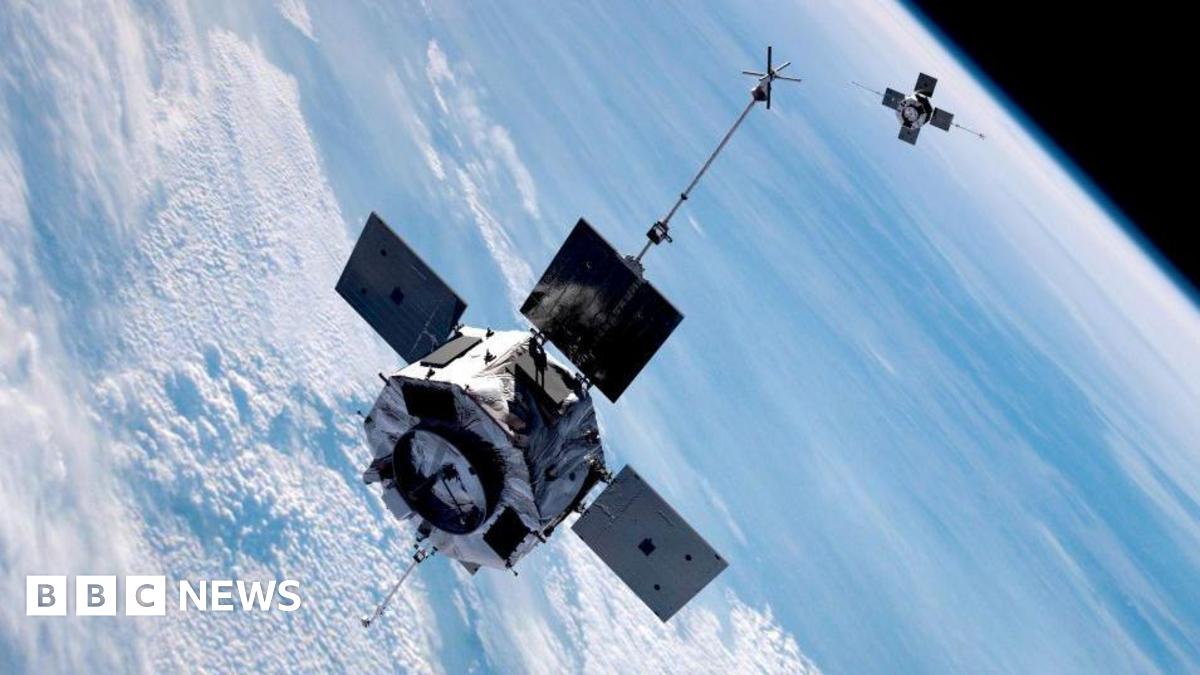
The spacecraft and its twin, Van Allen Probe B, were on a mission to gather unprecedented data on Earth’s two permanent radiation belts.
It was not immediately clear where in Earth’s atmosphere the satellite is projected to re-enter. The BBC has contacted Nasa for further detail.
NASA and the US Space Force has said it will monitor the re-entry and update any predictions.
The mission, which was originally designed to last two years, went on for almost seven. It ended after the spacecrafts ran out of fuel and were no longer able to orient themselves toward the Sun.
The probes flew through rings of charged particles trapped by Earth’s magnetic field from 2012 to 2019, in order to study how particles were gained and lost, per Nasa.
Those rings, called the Van Allen belts, shield Earth from cosmic radiation, solar storms and streaming solar wind, which are harmful to humans and can damage technology.
The mission made significant discoveries, including the first data that show the existence of a transient third radiation belt, which can form during times of intense solar activity, Nasa said.
Van Allen Probe B is not expected to re-enter the Earth’s atmosphere before 2030.