
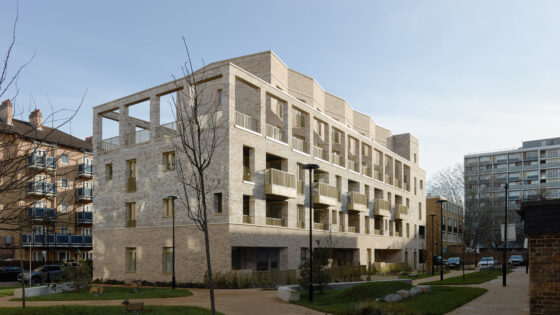
The awards were launched by the government in 1948 to promote good design in social housing and are now run by social enterprise Design for Homes. The RIBA has supported the awards since 1960, when they were opened up to also include the private market with the help of pioneering housing architect Eric Lyons.
In an email sent to the RIBA and seen by the AJ, HDA chief executive David Birkbeck accused the institute of failing to honour an informal agreement to promote the awards through its own channels. This followed the RIBA’s recent decision to switch from making an annual cash contribution to the awards to a benefit-in-kind, namely by promoting the awards on social media.
In the email, sent on 24 February, Birkbeck said that more than a month had passed since the RIBA made a verbal commitment to market the awards.
He argued that it was now too late for promotional material to have any effect on submissions, with five weeks having passed of the seven-week window for entries. The deadline for submissions closed yesterday (10 March).
‘It was a simple agreement,’ Birkbeck wrote. ‘It simply hasn’t been honoured.’
When the AJ asked the RIBA to confirm its commitment to the awards, it declined to do so, instead emphasising that no formal agreement existed with the HDA and that the institution was ‘mindful’ of the amount of marketing it shares with members.
‘The institute has a deeply ingrained belief that collaborating with potential competitors dilutes the brand’
The awards are supported by the Ministry of Housing, Communities and Local Government, while judges include the government’s chief planner, Joanna Averley.
An RIBA spokesperson said: ‘Our involvement with the Housing Design Awards has varied over the years, ranging from financial to marketing activity. While no formal agreement has been in place in recent years, we have remained open to promoting the awards through our channels where appropriate.
‘We are mindful of balancing the amount of promotional content we share with our members overall, including in relation to our own, growing awards programme. We are highly committed to initiatives that champion high-quality design, and recognise that the Housing Design Awards play an important role in highlighting excellence in the housing sector.’
Although no formal agreement is currently in place between the HDA, the website for the awards lists the RIBA as a promoter.
Speaking to the AJ, former RIBA president and housing architect Ben Derbyshire recounted making a ‘considerable effort’ to foster closer ties between the two organisations during his term from 2017-2019.
‘It would be a great pity if this relationship were not to continue’
Derbyshire suggested the RIBA might be distancing itself from the HDA because it views other awards as ‘competition’ to the institution’s own calendar of design honours.
‘As I recall from my time as RIBA president, the institute has a deeply ingrained belief that collaborating with potential competitors dilutes the brand,’ Derbyshire said.
‘In my view, RIBA’s global brand is further enhanced when seen amongst others who wish to be identified with a concern for design quality in housing as promoters of the Housing Design Awards.
‘Whatever the reason, it would be a great pity if this were not to continue.’
The RIBA’s own housing awards and Neave Brown award for affordable housing cost between £99 and £909 to enter, depending on the construction cost of the project. Entering the HDA costs a flat rate of £330, which can be increased up to a maximum of £495 in order to submit more project images.
Commenting on the possibility of the RIBA parting ways with the awards permanently, several HDA judges expressed disappointment, pointing out that the rift comes at a time when good housing is more in demand than ever. One judge said the prospect of the long-running relationship ending was ‘baffling’.
‘The goals of the Housing Design Awards and RIBA are aligned’
HDA judge and Howells partner Dav Bansal said: ‘The RIBA has been a long-standing sponsor of the awards since 1960 … championing better-quality housing – a mission that remains central to our purpose today.
‘Therefore, it is disappointing that this collaboration to support awards which promote innovation and research can no longer be sustained – particularly at a time when it is needed more than ever.’
Another HDA judge, Bell Phillips Architects co-founder Hari Phillips said: ‘The goals of the Housing Design Awards and RIBA are aligned, ie to promote and celebrate high quality architecture.
‘It is especially pertinent to shine a light on our best and most innovative housing at a time when the sector is under pressure to deliver the government’s ambitious housing targets.
‘I hope that the RIBA sees the benefit of this, that there is a reconciliation, and that they continue to support the Housing Design Awards. It would be utterly baffling if they don’t.’
After the deadline for submissions to the Housing Design Awards, judges will visit selected schemes in April through May, and the winner will be announced in the autumn.