
If you checked out the Archibald prize finalists back in 1983, one painting in particular might have caught your eye. Taking up seven feet of wall space, Dr Brown and Green Old Time Waltz is a psychedelic portrait of the then Greens leader, Bob Brown, rendered in rich colours and filled with hidden details: from faces smuggled into the trees to little green men walking around Brown’s feet.
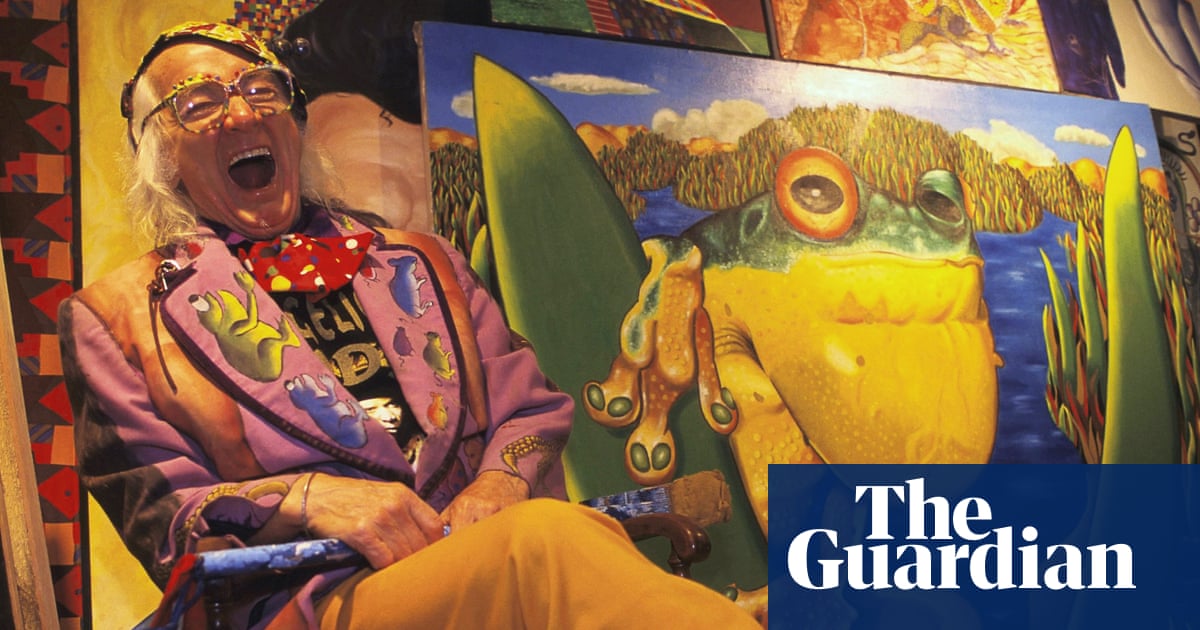
But just as noteworthy as the painting was the man standing next to it. Clad in hand-painted clothes, with painted false teeth in his mouth and a walking stick he didn’t really need in his hand, stood Harold “the Kangaroo” Thornton, the artist and self-described “greatest genius that ever lived”.
There was no risk of missing Thornton: he stood next to the painting every day the Archibald was open. “He became good friends with the art gallery staff,” says Philip Thornton, the artist’s nephew. “He really did want the recognition.”
Dr Brown and Green Old Time Waltz, 1983, oil on canvas
Recognition eluded Thornton during his lifetime. It still does. If you’ve heard of Thornton at all, it’s probably thanks to the portrait of Brown, even though he can count the likes of Martin Sharp and Ken Done among his admirers and friends – for his part, Done once helped Thornton out by paying for a crate of his paintings to be shipped around the world.
Thornton’s psychedelic works, marked by a mischievous sense of humour, always seemed primed to enter the mainstream. But even when surrealism became popular in Australia’s art world, Thornton never got his dues – or any money. “Maybe he was ahead of his time, maybe he was behind his time,” Done says. “Maybe he was just on Harold Thornton’s time.”
Dancing Under The Sea, 1993, acrylic on canvas
These days, Thornton is better known in Amsterdam, where he spent many years living and painting, often working on the streets next to an empty cup and a sign that read: “If you like Harold’s art, Harold likes beer.” A mural by Thornton on the front of an Amsterdam cafe and marijuana shop, The Bulldog, remains a local tourist attraction, and his friend Pienke WH Kal published a monograph of him.
Throughout his life, Thornton was both a relentless self-promoter and a prolific painter. He produced murals, comic strips, poems and a quasi-fictitious “autobiography”. He loved a tall tale: he would say that Paul McCartney and Jimi Hendrix had ripped off the music he sometimes wrote.
But even with such embellishments aside, he lived an extraordinary life. By the time he died in 2004, Thornton had been a finalist in the Archibald prize three times. He’d spent some of his early days as a professional wrestler. For a while, he’d used a painted hearse as his primary mode of transport. He wasn’t really an actor but he starred in one of the first short films directed by the acclaimed film-maker Peter Weir. He had owned and operated a restaurant in Papua New Guinea, and spent some time in Moscow.
On one occasion he painted a portrait of a dead body – his father’s. Beginning the work while the elderly man was on his deathbed, Thornton didn’t let his dad’s passing stop the creative process: he locked himself in the room with the corpse to finish it while family members banged on the door.
Thornton paints in a window in the Damstraat, Amsterdam, in 1980. Photograph: Alamy
Thornton was a man who lived many lifetimes – at least according to his own myth-making. He would often tell people he’d died on an operating table and briefly travelled the world as a ghost. (It was gallbladder surgery that had required the hospital visit but Thornton would sometimes downplay that more humdrum element of the story.)
The artist in 2000. Photograph: Olivier Chouchana/Gamma-Rapho/Getty Images
Still, underneath his exuberance and story-spinning lay a deep kindness. “He was a great self-promoter but he just wanted to be friends with people,” says Dale Trueman, an artist and compatriot. “From the moment I met him, I was star-struck.”
Born in Enfield, Sydney, in 1915, Thornton’s childhood was not happy. Chris Osborne, Thornton’s great-nephew and one of the key protectors of his legacy, describes his upbringing as the “thing that made him the way he was”. His mother was hard on him and, as a dyslexic, somewhat portly child, Thornton was mercilessly bullied at school. He was insecure about his intellect for his whole life. He would sometimes describe himself as having “no brains”, and his comic strips are riddled with spelling errors (though some are deliberate – a comic dedicated to his genius also describes him as a “very humbel man”.)
In painting, Thornton found comfort. He’d stay up for days to finish an artwork, before crashing into an extended period of low mood. Almost pathologically resistant to financial success, he was broke for much of his life – he described himself as “living like a rat”. He would talk his way into staying in the spare rooms of family members by promising them paintings he insisted were never to be sold. His art was for the people, he said. “He worried if he sold his art it would lose its accessibility,” Trueman explains.
Harold up a Gum Tree, 1983, oil on board
This stubbornness was a source of some frustration to those who knew him. Thornton railed against any available authority figure: once commissioned to paint a portrait of the mayor of Wagga Wagga, he accentuated the man’s red nose and found himself in a fight with some locals as a result. (“[One] swung a punch,” Thornton later wrote. “I trounced him.”) After one of his paintings failed to make the Archibald cut, he mounted a small protest on the steps of the gallery, accompanied by a giant papier-mache head in a shopping trolley.
Thornton’s painting of Brown is the closest he came to securing a real legacy – it’s now housed in the National Portrait Gallery in Canberra. The work was the result of a series of chance encounters that began when Thornton was living with his nephew Philip. Given that Thornton wasn’t always the easiest person to share space with, Philip and his housemates scraped together an air fare so Thornton could travel to Tasmania and join the blockade of the Franklin Dam – mostly so everyone could “get a break from Harold”, Phillip says.
Though a lifelong Labor man, Thornton had never been outspokenly political. Tasmania changed that. While there he met Christine Milne, a 29-year-old schoolteacher who would go on to become a senator for Tasmania and Brown’s successor as Greens leader. Decades later, Milne remembers Thornton warmly. “He was probably one of the most open-minded people I’d ever met,” she says. He regaled her with stories from his time living in Amsterdam’s red-light district, which Milne describes as “eye-opening”.
Thornton (at front in the boat) takes part in a Tasmanian Wilderness Society protest against the Franklin Dam in February 1983Christine Milne with Thornton
Brown had a similar initial impression. “Six thousand people came to Strahan, and Harold was one of the more colourful ones,” he says now. “The fact that he had a naked lady enamelled into one tooth was a standout.”
When Thornton asked to paint his portrait, Brown agreed, though it was a tremendously busy time for the politician. After the painting was finished, Brown’s initial reaction was one of some embarrassment. “It had an apparent halo around the main image of myself,” he says. “I wasn’t very relaxed about that.”
But Brown’s feelings have changed over time. “I see some Hieronymus Bosch in Harold’s painting,” Brown says. “It’s not a portrait. It tells a whole story.” Milne agrees: “It’s an incredible painting that in my view, does tell an authentic story about the blockade.”
Brown doesn’t have many photographs of himself up around the house – but he does have a giant print of Thornton’s painting in his office. “Plenty of artists came and went during that time,” Brown says. “But it was Harold’s picture that laid out such a record of that crucial period – not just of the Franklin, but of the environmental and social history of Australia.”
Thornton always wanted his paintings housed together in a proper art gallery where the public could access them. That hasn’t happened. “How can we set up an art gallery for Harold?” Philip says now, somewhat sadly. “All we can do is look after Harold’s work. I’ve always hoped that an art student or someone doing a PhD might stumble across Harold. Because when the paintings are hung together, they’re just spellbinding.”
Old Man of the Sea and his Nudes, 1993, oil on canvas
Decades after Thornton’s death, his friends still remember him warmly. Chris Osborne is trying to get a film about the man made – touchingly, he says what he most wants to accurately portray is his great-uncle’s laugh. Trueman thinks about Thornton “all the time.” And Done has continued to work behind the scenes to assist with the preservation of Thornton’s legacy.
“Not everybody will understand Harold or Harold’s work, but that’s OK,” Done says. “He was Harold, and he didn’t give a fuck.”
Fittingly then for a man who claimed to have once briefly died and walked the Earth as a ghost, Thornton has not been erased by his passing. Always one to take ownership of a good story, he even prophesied such staying power himself. “I am told everybody dies,” he once wrote. “But not me.”
A poster made by Harold, date unknown