
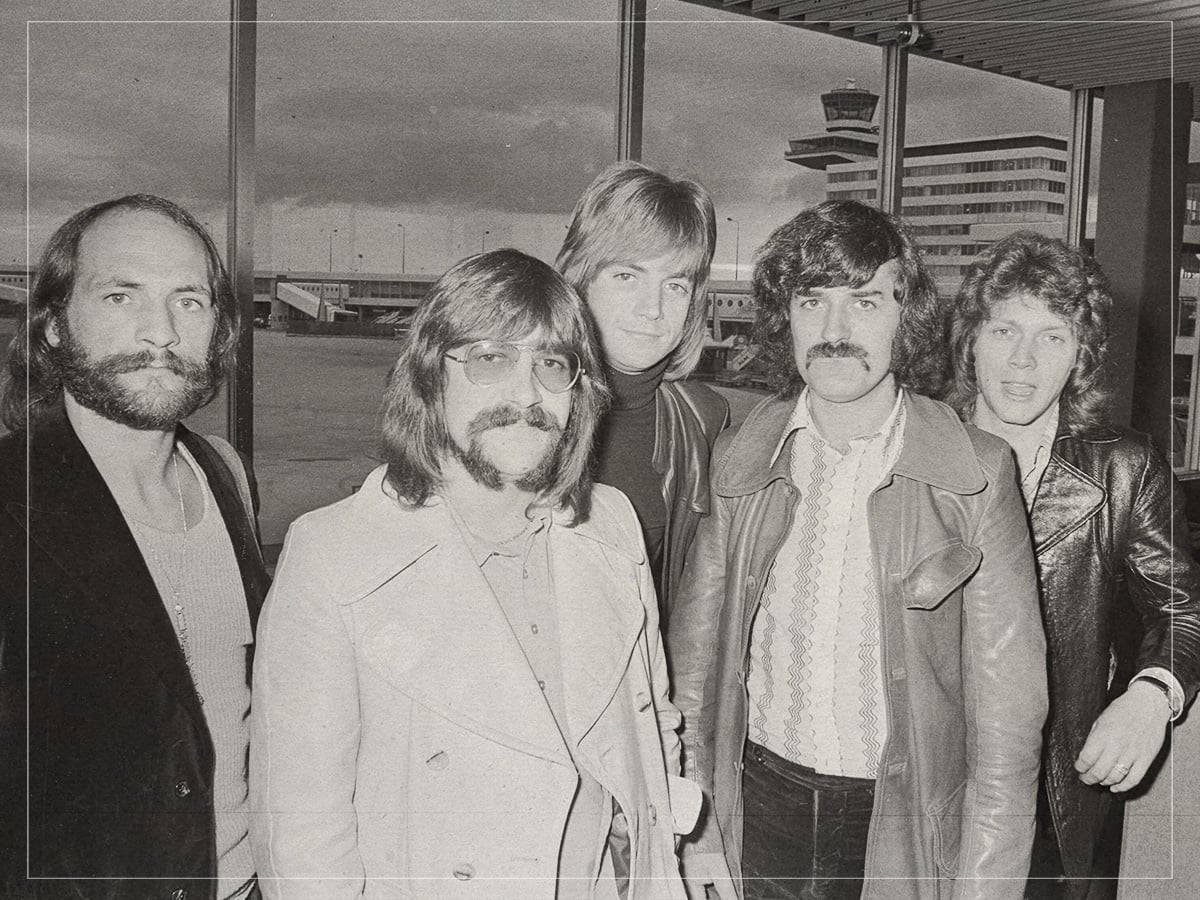
(Credits: Far Out / Nationaal Archief)
Wed 11 March 2026 14:00, UK
When I was 19, I was in a field patiently waiting for the moment that a drunken Greg Harrison would realise that a lit firecracker had just been placed under his camping chair. I was not mournfully contemplating the disillusioning end of an affair like John Lodge. The sad sack of shit behind ‘Nights in White Satin’.
In truth, both instances will go down in history. The difference is that one will be ascribed to the anecdotal lore of regurgitated pub chatter, and the other will be viewed as an anthem that defined an era. With ‘Nights in White Satin’, the Moody Blues added a new level of melodrama to rock ‘n’ roll, colouring it a rather grandiose shade of royal blue.
When you think about the song, its grandeur, and solemnity, you certainly don’t think of a 19-year-old boy. That makes the following assertion from Lodge deeply confounding. “I wrote our most famous song, ‘Nights in White Satin’ when I was 19,” he alarmingly recalls. “It was a series of random thoughts and was quite autobiographical,” he told Daily Express.
But how could that be? How could an autobiographical song by a teenage boy in a band be about anything other than cheap lager, platitudinous sixth-form politics, and woeful attempts to pull?
“It was a very emotional time,” Lodge bizarrely continues, “As I was at the end of one big love affair and the start of another. A lot of that came out in the song.” At the end of the big love affair and the start of another? At 19, mate?
Yet the track itself is incredibly sincere. If Lodge had said, ‘I wrote this after being separated from my wife of 30 years following a sudden tectonic rupture. She was sent drifting, without any means to contact, towards Papua New Guinea, and I was now alone, dreaming of her touch somewhere near the Bering Strait,’ then it would’ve, quite frankly, been fitting.
Or at least more fitting than a spotty lad from the suburbs of Birmingham penning a moving, orchestral, proto-prog song about feeling aimlessly alienated from the world thanks to the throes of star-crossed love. Then there’s the problem of the prodigious talent on display.
The quasi-suite structure, introduction of a mellotron, the swaying time somewhere between 6/8 and 12/8, all imply a composer who had been at the coalface of music way longer than Lodge possibly could’ve been. Then there’s Justin Hayward’s booming vocal take that soars over everything like a heartbroken eagle – and he was only 20 when they recorded the bastard thing!
So, how can any of this be? How can one of the defining anthems of the ‘60s have come from such young, inexperienced pups? Well, perhaps that’s why it captures the youthful zeitgeist of that golden era so purely. It was an age that granted reckless permission to teenagers to be creative. Imagine a 19-year-old from Birmingham being given access to an orchestra on anything bar crummy Pro Tools these days?
You barely trust a working-class 19-year-old of the present to make you a latte. We bemoan that without addressing the fact that it is society itself that infantilises them and shields them from opportunities to mature. Those opportunities were afforded to the likes of Lodge in the ‘60s, and ‘Nights in White Satin’ is just one shimmering example of proper investment in the pent-up passions of youth.
With that in mind, you actually start to think, maybe it’s so dramatic that clearly only a 19-year-old could’ve written it. The truly mournful tale of a 30-odder has a mortgage and blood pressure to worry about.