
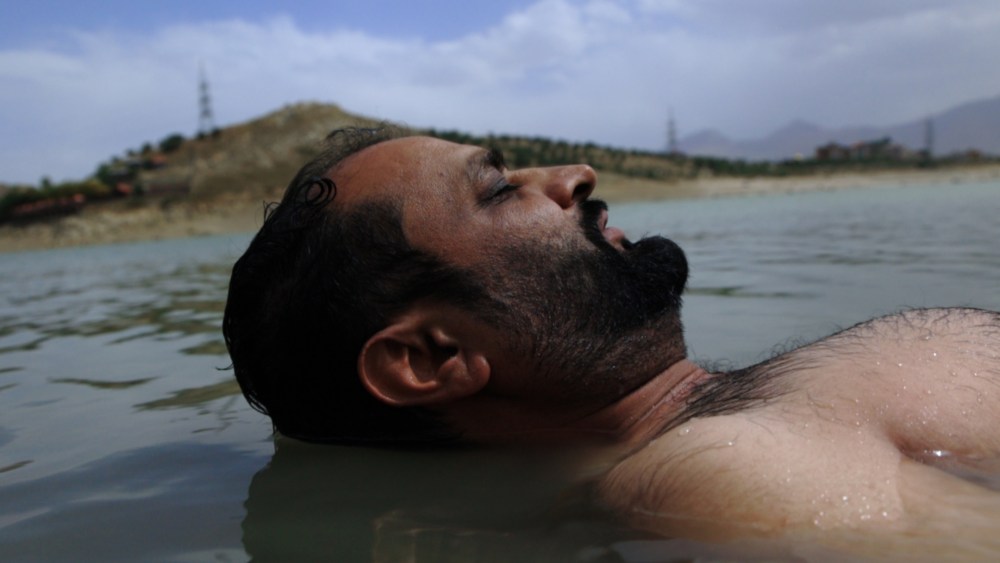
Irish photojournalist and filmmaker Seamus Murphy (“A Dog Called Money”) is developing a feature documentary that tells the remarkable story of a resilient Afghan family forced to flee their war-torn nation — only to face fresh challenges as they struggle to rebuild their lives in exile.
“The Beautiful and the Damned” is produced by BAFTA-winning Irish producer David Rane for Soilsiú Films, in co-production with Catherine Siméon of Faites un voeu (France) and Heino Deckert of Ma.ja.de (Germany). Murphy is presenting the project in the Pitching Forum at the Thessaloniki Intl. Documentary Festival, which runs March 5 – 15.
Speaking to Variety in Thessaloniki, Murphy — whose last feature, “A Dog Called Money,” about award-winning British musician PJ Harvey, premiered at the Berlin Film Festival in 2019 — described his latest film as a personal project three decades in the making, building on friendships forged in the midst of conflict 30 years ago. “I had no idea that this would go on [until now],” he said.
The director, who cut his teeth as a photojournalist in Afghanistan in the 1990s, recalled his formative years covering the bloody conflict in Kabul. “I had no experience. I had nothing like hostile environment training. In those days, these things were unheard of,” he said.
“It was horrific. It was a terrible civil war — really, really bitter,” he continued. “But the people were so amazing. Often, in war situations, people show their best — as well as their worst. That was very moving and very defining.”
It was around that time that Murphy met the Ba Delis, one of the few families still living among the ruins of Kabul’s old town. The war had already taken a heavy toll on them. Two of their six sons had died in the fighting; another lost his leg in a rocket attack. Yet they instantly “welcomed us in,” the director said.
“Knowing them helped me better understand and personalize the grim statistics of the war,” he continued. As his time in Afghanistan wound down, “after all the blood and guts and chaos,” Murphy resolved to do something that was “a bit more sane and a bit more hopeful.” “At that point I resolved to chronicle their lives,” he said.
Murphy began photographing the family on his return visits to the country. Then, in 2014, he produced a short film for the U.K.’s Channel 4 that was tied to the upcoming Afghan elections. With President Obama declaring that U.S. troops would soon be pulling out of Afghanistan, putting an end to decades of American military involvement in the country, Murphy recognized that “there was change afoot.”
“I thought bringing the family into that would be an interesting way [to tell the story],” he said. “That was the seed of [a feature film]. I just knew there was so much more I could do with it.”
In the years that followed, after brothers Farhuddin and Farhad were forced to flee Afghanistan, Murphy continued to chronicle their lives. In Germany, Farhad struggles to provide a stable household for his family in an unfamiliar land, where refugees — especially Afghans — often face bitter discrimination. Meanwhile, in Turkey, Farhuddin anxiously awaits an interview for citizenship, knowing he faces almost certain death if he’s forced to return to Afghanistan, where the Taliban have placed him on an execution list.
Throughout the family’s struggles, however, the years have also brought moments of joy. There have been marriages — Murphy himself often serves as wedding photographer — as well as childbirths, bringing into the world a whole new generation of Ba Delis finding their own place in the world, and learning for themselves how to navigate their Afghan identity.
“The Beautiful and the Damned” builds on Murphy’s extensive archive of photographic and video material. While chronicling the lives of the Ba Deli clan both during the war and in exile, he also examines what three decades of upheaval have meant for their homeland. “There’s a mountain of material — both of the family, but also of Afghanistan,” he said, documenting the tremendous changes the society has undergone since the director’s first visit more than 30 years ago.
Above all, though, the film is a human portrait of the Ba Deli family and a recognition that their story sadly reflects the experience of millions of people today.
“We hear about refugees. We hear about their stories in newspaper articles and TV reports. You do get a glimpse of what they’re going through,” said Murphy. “But I think with this, it is that emotional side of their lives as real individuals. I’m trying to portray them…as individuals that you sympathize with, and you get to know and you get to like. And you’re rooting for them.”
The Thessaloniki Intl. Documentary Festival runs March 5 – 15.