
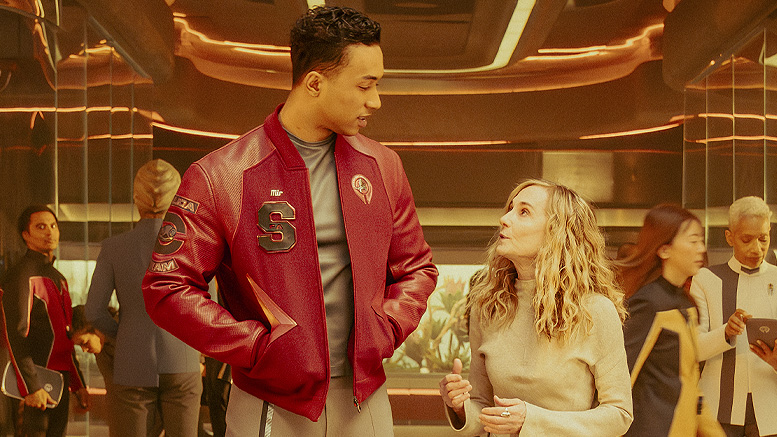
Today the first season of Star Trek: Starfleet Academy wrapped up with “Rubincon.” Executive producers and showrunners Alex Kurtzman and Noga Landau both had writing credits for the finale (he co-wrote teleplay with Kirsten Beyer, she co-wrote the story with Gaia Violo). TrekMovie had a chance to talk to the pair about this episode, and what they have in store for the second season, which wrapped filming a couple of weeks ago. [SPOILERS]
Reflecting on season 1 and the finale
TrekMovie spoke to Alex and Noga on Wednesday, ahead of the season 1 finale.
This finale feels like it is tying up a lot, with callbacks to the first episode. So how mapped out was the season and episode ahead of time, or were there big changes made as you moved through the season?
Alex Kurtzman: Well, there are two answers. The first is that everything that happens in the finale was always planned from the beginning. All that being said, the way we did it changed very radically about two and a half weeks before we started shooting it. We kind of threw out our story and decided – beginnings are much easier, right? Because with beginnings you ask a lot of questions, you throw a lot of mysteries up in the air, and you hook the audience by not answering them. But eventually that bill does come due and you have to answer them. And we knew that there was so much to pay off about what had been set up in the pilot and what had been obviously carried out throughout the season.
And so Noga and I looked at each other, and we just said: we’re going to have nine really great episodes and then one that isn’t quite going to stick the landing, and we got to fix that. And we can either proceed by putting Band-aids on this, or we can, tear the Band-aid off entirely and just say we need to rebuild the foundation of the story. And that’s what we did. So we ended up prepping off an outline. The first stuff that had to get shot was the trial stuff, wo we wrote those scenes first and they kind of didn’t change from the first draft, actually. Which is a rarity, but there just wasn’t time. And so there were no surprises in terms of what we wanted to say, but we did change a lot of the structure.
Is there a message of using a trial structure, and putting the Federation and the ideals of Star Trek on trial?
Noga Landau: Yeah. Any institution should be able to hold up to the rigors of scrutiny. It should be able to win the trial, including the Federation. And that’s why we believe so fiercely in the Federation and in Starfleet, that we are willing to put it on trial. And it’s certainly been done before in previous iterations of Trek. I also think every generation of Trek has to have something to say to the world. And I think that right now, we live in a world where people open up their social media multiple times a day and are told, these guys are the good guys, these guys are the bad guys, and there’s no gray zone and there’s no nuance to any of the conversation, I think it was very important to remind our audience in this final episode that it’s okay to sympathize with Nus Braka. It’s okay to sit and understand where he comes from and why. What are the forces that made him? Why has he chosen brutality? Just as much as it’s okay to question what Starfleet has done to question the Federation. The difference to us in the storytelling is that the Federation is able to stand up to the rigors of a trial. It’s able to use its own brilliance, to use science, to use its empathy to win. But someone with Nus Braka’s mindset is not.

Paul Giamatti as Nus Braka in season 1, episode 10, of Star Trek: Starfleet Academy streaming on Paramount+. Photo Credit: John Medland/Paramount+
The season started with a message about child separation. In the finale we have Braka building a wall and going on TV and pontificating, is there an allegory here?
Noga Landau: I think that it’s a universal allegory, like all good Trek really is. It should work in the time in which it airs, but it should work at any time. And I think the universal message of, don’t separate children from their parents. That always works. Don’t let a bad guy get the upper hand of you, and trap you in a wall, or go after you for the wrong reasons. Those are all timeless lessons. And it’s a timeless story that we tell in season 1. I think people will definitely look at it and say, “Oh, this is about now,” or this is about 10 years ago, or this is about 50 years ago. It’s all relevant. It’s how you interpret what you’re watching.
And the use of a news network broadcast, using mass media to spread a message, were you trying to send a message?
Alex Kurtzman: I think we were trying to reflect in every way – as Trek does at its best – we were trying to reflect the way information is traded and travels today, and how it can shape perception.
In making the show, are you thinking about politics? There are those out there who are presuming a message, so speaking for yourself, what message are you putting out there?
Noga Landau: I would say the truth is that there are writers rooms that are much more political than the Starfleet Academy writers room. What we focus most of our attention on is saying: are we honoring the vision of Gene Roddenberry? Are we honoring the 60 years that came before us? Are we properly showing what Starfleet would do, what the Federation would do under these various circumstances? And if people see themselves or see politics nowadays within the stories we tell, great. But they don’t have to. We really do try and just make sure that no matter what, we are always cleaving to what Star Trek has always stood for and the values that came decades before the current moment.

L-R: Robert Picardo as The Doctor, Tatiana Maslany as Anisha, Sandro Rosta as Caleb, and Holly Hunter as Captain Nahla Ake in season 1, episode 10, of Star Trek: Starfleet Academy streaming on Paramount+. Photo Credit: Michael Gibson/Paramount+
Quick detail from the episode, how did the doctor know about the gluons?
Noga Landau: Well, he’s been around. He’s probably encountered gluons before. He was putting that science together in his head as he watched it unfolding. The problem is he couldn’t communicate it because his whole matrix got warped. But he was trying to tell them, and he was trying to convey. I actually had great conversations with Bob Picardo ahead of time about what was going on in his brain. He thought he was saying words, but he couldn’t get the meaning out.
But how did he know how to stabilize the Omega 47?
Noga Landau: Voyager’s episode “The Omega Directive” informed so much of what we did in the finale, and since the Doctor was a part of that living history, he has centuries of knowledge and scientific insights into omega particles in ways that the other members of our crew don’t. That’s why he ultimately figured out the answer regarding gluons before anyone else did.
Early in the episode it was thrown out that Discovery is not coming to save the day. The Discovery keeps getting mentioned, but we haven’t seen the ship or Michael Burnham, even though this show is sort of a Discovery spin-off. So has not bringing in the Discovery been a debate?
Alex Kurtzman: It was never a question about whether or not Discovery was going to show up. That was never on the table for us. We did not want to do that. The mentions of Discovery have to do with the fact that we’re living in the same timeline. And if you’re dealing with a problem as massive as what happens at the end of episode 9, which is: Okay, everybody’s in a box this. The question suddenly becomes, why can’t Discovery, which has the ability to jump through the mycelial network and get around this thing, not just show up and save the day? And the answer is, because it can’t. Because it could actually set these mines off. So if we didn’t mention it, it would be weird, because anybody who was tracking what was technology was available in the timeline would suddenly go, ‘Wait, why don’t you just do that?’ But I think it would have been probably the cheapest and most unsatisfying ending in the world to have Discovery show up, because then our characters wouldn’t have had to rely on themselves to solve the problem.

Director Alex Kurtzman on the set of Star Trek: Starfleet Academy, episode 1, season 1, streaming on Paramount+, 2025. Photo Credit: Brooke Palmer/Paramount+.
Season 2 clues
TrekMovie also spoke with just Noga Landau at Saturn Awards on Sunday, focusing on season 2.
The season finale feels like Caleb completed the arc set up in the season premiere, of being reluctant to join Starfleet. So is Caleb’s story still a big focus for the series moving forward, or does the show become more an ensemble?
Noga Landau: Yeah, it’s more of an ensemble in season 2. But I also think to just draw another point of connection between an earlier point for Caleb’s story this first season. I also think it’s important for our audience to see a character go through the journey he has in learning that it’s okay to love Starfleet and it’s okay to become a part of Starfleet. I think that a lot of young people have been just hit with barrages for years of messaging that they need to hate certain groups of people, they need to mistrust certain groups of people. This is not unique to this audience, but it is something that is unrelenting for them because of social media. And I think that it was very important in the telling of the story to show how most of the time in the human experience, when you actually spend time around the people or the institutions that you’ve been told that you have to hate, that you start to take on a much more nuanced view of who they are. You see them as individuals. You see them as people with the best of intentions, that you should be able to question if you have to. And that over time, you might even learn that your place is with them, is with people that you were told that that they have to be your enemy. And that’s also what makes Starfleet so enduring. That there is a place for every single person or alien in the galaxy in Starfleet.
What do you see as the biggest difference between season 1 and season 2?
Noga Landau: Here what I can promise about season 2. We do a lot of episodes in season 2 that take the best things that we did in season one and just do it more. These episodes that are really character-based, where we go really deep with our cadets, with our instructors, where we have some real complex Trek dilemmas that come along. Like we loved making episode like 104 for example, that’s Jay-Den’s episode about the Klingons. We realized how successful an episode like that is in Starfleet Academy, and we really doubled down on that kind of an episode in Season 2.
Paul Giamatti [Nus Braka] was a big part of season 1, but he said he isn’t in season 2. So is there another big-name villain for season 2?
Noga Landau: The villain of season 2 is not just a person. In a very classic Trek sense, it is more an impossible dilemma that we find ourselves in as Starfleet.

Sandro Rosta as Caleb Mir, Bella Shepard as Genesis Lythe, Kerrice Brooks as Sam, Romeo Carere as Ocam Sadal and George Hawkins as Darem Reymi in Star Trek: Starfleet Academy, episode 3, season 1, streaming on Paramount+, 3035. Photo Credit: John Medland/Paramount+.
When we talked to talked to you and Gaia a couple of weeks ago, you teased the season 2 finale a bit. So just to be clear, would you call it a cliffhanger?
Noga Landau: I would say it is a cliffhanger. It is a cliffhanger at the end of season 2.
Season 1 finale wraps up cleanly, even though you knew you had another season. But for season 2 you don’t know, so why go with a cliffhanger?
Noga Landau: Honestly it’s because we listened to what our story wanted to be, and we went with it. We wrote it the way that it felt organic and natural. And I hope we get to keep making many more seasons of Starfleet Academy, because we have a lot more story to tell.
Are we going to see Ensign Kreb’s Talaxian Furfly in season 2?
Noga Landau: I hope so. That furfly causes a lot of problems. [laughs]

NEW YORK, NEW YORK – JANUARY 06: Alex Kurtzman and Noga Landau attend the world premiere of Starfleet Academy at American Museum of Natural History on January 06, 2026 in New York City. (Photo by Roy Rochlin/Getty Images for Paramount+)
More on the finale and future of SFA
Yesterday we teased this interview, posting what Alex had to say about his discussions with the Paramount Skydance execs about the future of Trek TV. We also have a new interview with EP/Director Olatunde Osunsanmi about directing the season finale, and talking about what’s new for season 2.
SFA episode 110 will also be reviewed and discussed on the All Access Star Trek podcast in a new episode dropping Friday. The podcast is available on Apple Podcasts, Spotify, Pocket Casts, Stitcher and is part of the TrekMovie Podcast Network.
Keep up with news about the Star Trek Universe at TrekMovie.com.