
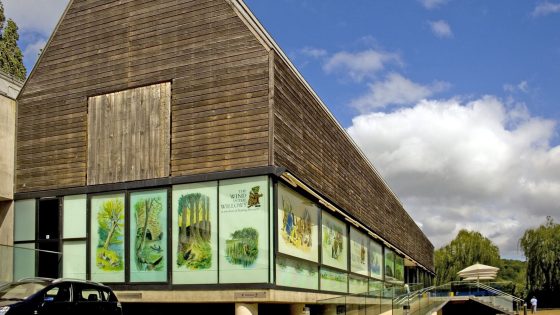
The application comes after the museum closed last September, citing the financial challenges of maintaining the nearly 30-year-old building and the unsuitability of its large size.
The museum, which opened in 1998, housed 35,000 artefacts within a 3,250m² late-Modernist structure inspired by river boathouses in Oxfordshire and designed to contend with the area’s periodic flooding.
The building’s future was first called into question in March last year, when the museum’s director, Steve O’Connor, told the press that ‘radical thinking’ was needed to avoid closure. But despite efforts to keep it in business, the museum shut its doors just six months later.
David Chipperfield has written a letter in support of the listing bid, arguing that the principles used in many of his later works, such as the ‘use of light and sensitivity to context’, were ‘first explored here’.
He concluded (see full letter below): ‘We are convinced that the flexibility of the original design will allow the building to serve a new purpose in a way that respects and preserves its architectural character.’
A Twentieth Century Society spokesperson said: ‘Before the Neues Museum and the Hepworth Wakefield, before the Pritzker Prize, there was the River and Rowing Museum in Henley.
‘David Chipperfield’s pioneering and influential museum building is a calm, elegant and sophisticated project, fusing a Japanese-esque design language with traditional English rural forms. It is perfectly at home in its beautiful setting on the banks of the Thames.’
The heritage lobby group added that the riverside building remained ‘intact and eminently reusable’. It argued that the museum’s closure was the perfect time for it to receive statutory heritage protection to ensure any future changes were ‘sympathetic and carefully managed’.
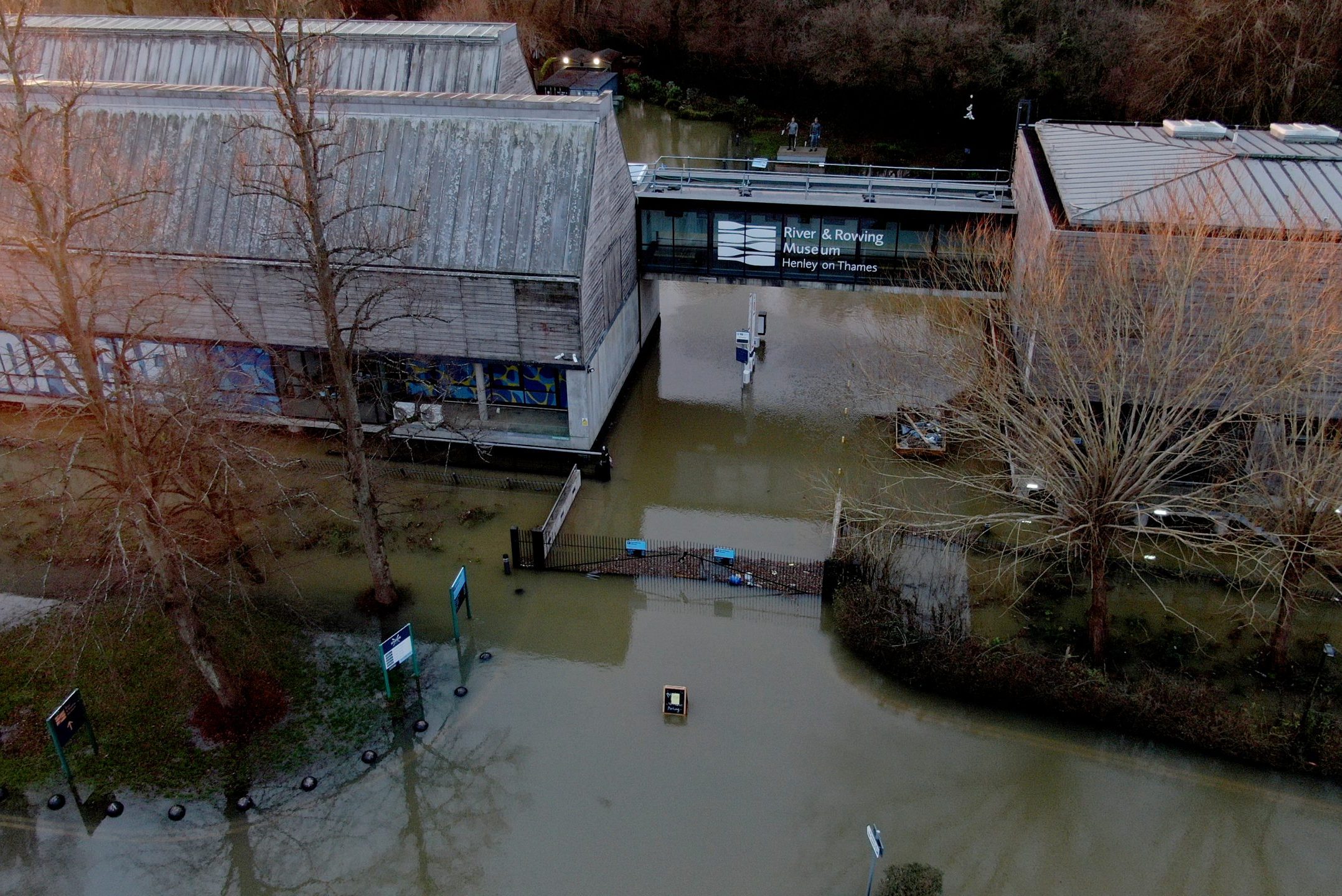
The River and Rowing Museum in January’s flood
The building went up for sale for £3 million in November, and the Twentieth Century Society understands ‘several credible bids’ were received before the deadline in January. The society has been in talks with the Museum Trust, along with bidders, to ‘explore various options for sympathetic adaptive reuse of the building’.
Speaking to the BBC in July, the museum’s interim manager Kevin Sandhu said the museum had been running at a loss for most of the years it had been open, adding that the building was ‘huge – and that takes a lot of looking-after’.
He told the broadcaster: ‘It’s fantastic, architecturally and visually. [But] over the 30 years, technology has moved on, so have the costs of maintaining the sort of systems that operate in buildings.’
In a response to the AJ, Sandhu explained further: ‘It’s the building’s plant equipment that is proving to be a high expense for us. Specifically, the chiller and boilers.’
Sandhu said the organisation was exploring other, smaller spaces to house its collection, even ‘perhaps a new museum, possibly in Henley’. However, he would not speculate on what might become of the existing structures.
The original building, which is elevated above the Thameside plot on concrete pillars and clad in untreated green oak timber, was extended in 2004.
In 2022, the museum temporarily shut for urgent repairs to the flat roof covering the first-floor walkway linking the museum’s two buildings after leaks were found.
In January 2024, flood waters caused by Storm Henk made the entrance and car park inaccessible.
A decision on the new owner of the building is expected to be reached in the next few months, according to the Twentieth Century Society.
David Chipperfield’s letter of support
I am writing to express my strong support for the Twentieth Century Society’s bid to list the River & Rowing Museum in Henley-on-Thames.
Completed in 1997, this project was my practice’s first major UK commission and our first significant cultural building – a sector in which we have since developed an international reputation. Many principles explored here, such as the use of natural light and sensitivity to context, remain central to our work.
The design was shaped by the ideas of critical regionalism, which sought to resist global homogenisation and avoid the stylistic excesses of Postmodernism. Instead, it promoted architecture grounded in local context, climate, and culture.
This is evident in the museum’s formal references to traditional boathouses, notably its pitched roofs, combined with modern construction techniques and material honesty. We were inspired by architects such as Glenn Murcutt, Rafael Moneo, and Álvaro Siza, who demonstrated how contemporary architecture could reconcile Modernist ideals with regional identity.
For me personally, the project offered an opportunity to draw on lessons from Japan – structural clarity, material simplicity, and the elevation of the ordinary – applied to a new setting. Public scepticism at the time challenged us to articulate our intentions and shaped our approach to dialogue and advocacy, lessons that informed later projects such as the Neues Museum in Berlin.
We were saddened to hear of the museum’s closure, but we are convinced that the flexibility of the original design will allow the building to serve a new purpose in a way that respects and preserves its architectural character.