
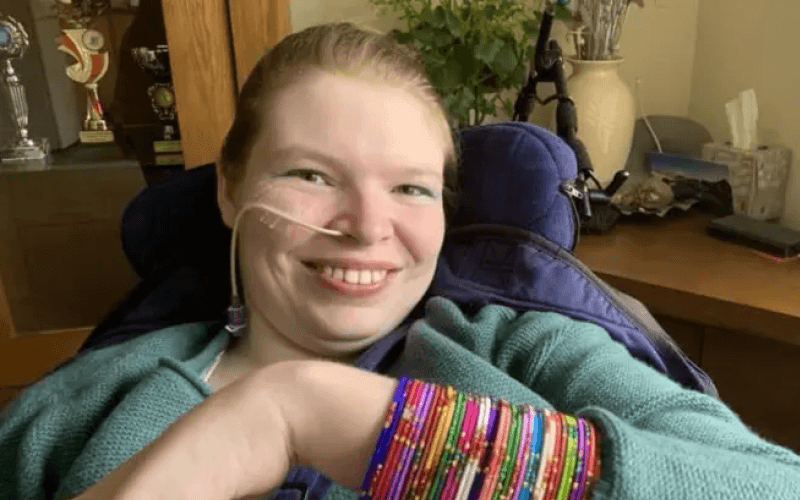
A disabled peer has used a debate celebrating International Women’s Day to highlight how a disabled woman was placed in a nursing home against her will after treatment for pneumonia, rather than being returned to her own home.
Baroness [Jane] Campbell told fellow peers on Friday (6 March) that Lucinda Ritchie had been left “isolated and frightened” by her treatment, and that her experience demonstrated a wider “backward slide from independence to dependency and exclusion”.
She said this showed how for “every socially included disabled woman we celebrate, there are hundreds of others whose independence is denied and potential ignored”.
She described Ritchie (pictured) – who uses a powered wheelchair, breathes with a ventilator and communicates with eye-gaze technology – as “academically accomplished and nationally recognised for her assistive technology advocacy”.
For the last eight years, the 33-year-old has been living in an adapted bungalow in Billingshurst, West Sussex, with 24-hour care funded by NHS Continuing Healthcare.
But following a hospital admission with pneumonia last April, as reported initially by the BBC, the NHS commissioning board decided last month that it was “in her best interests to place her in a nursing home miles from home”, Baroness Campbell told peers.
She said: “Overstretched staff, unfamiliar with her complex needs, switched off her power chair and could not work her eye-gaze technology.
“A woman who had been thriving was now isolated and frightened.
“Last week, she was apparently back in hospital because the care provided was not tailored to her needs.”
She said this appeared to violate her right to independent living under article 19 of the UN Convention on the Rights of Persons with Disabilities.
Baroness Campbell told the International Women’s Day debate: “For decades, personal budgets and empowerment models transformed disabled people’s lives, enabling them to exercise genuine choice and control.
“Independent living is not theoretical; it is deliverable. Has that good practice gone?
“Why did we support disabled people to move out of institutions only to return them to them 30 years later?”
She pointed out that the government minister responding to the debate was Baroness [Jacqui] Smith, who – when minister for social care – appointed her as chair of the Social Care Institute for Excellence in 2001.
She said Baroness Smith had taken “a chance on a disabled woman who wanted to radically transform the way social care operated by empowering service users to be co-producers for community care”, which was her “first big career break”.
And she asked the minister to meet her to “look at ways to prevent this backward slide from independence to dependency and exclusion”.
She added: “Disabled women’s rights to equality, dignity and freedom are not symbolic; they are vital and must be upheld, not just today but every day of the year.”
Responding to the debate, Baroness Smith – who is now minister for women and equalities – did not comment on Baroness Campbell’s request for a meeting, or on the case of Lucinda Ritchie.
But she said that Baroness Campbell had, as always, “ably represented disabled women and challenged us on their role”, and she added: “I do believe that my decision to make her chair of the Social Care Institute for Excellence was one of the better decisions I made as a minister.”
The government had not said by noon today (Thursday) whether Baroness Smith would agree to a meeting with Baroness Campbell, or commented on whether the minister was concerned about the case.
Ritchie told Disability News Service yesterday in an email: “I am really pleased that I was mentioned by Baroness Campbell in her speech.
“Perhaps somebody will listen to me now and this will never happen to any other disabled person.
“Laying here in hospital I have felt hopeless at times and that life was not worth living.
“I don’t know why I was treated so badly, being taken against my will to a nursing home – I felt powerless as nobody listened to me.
“I saw my life in my bungalow with friends, family and doing normal things like studying at university, going shopping, to church, much of what is taken for granted being taken away.
“I felt utterly worthless being wheeled into that ambulance against my will.”
A spokesperson for NHS Sussex Integrated Care Board (ICB) said the nursing home she had been transferred to from hospital was a specialist care centre, and that no previous concerns had been raised about its care with the ICB.
Allison Cannon, chief nursing officer at NHS Sussex, said in a statement yesterday: “Our absolute priority is to ensure that Lucinda is able to receive safe, high quality care that meets her health needs.
“We have worked with Lucinda for some time to provide NHS care to support her, and we actively worked with the health professionals in hospital, Lucinda, her family, and her representatives to consider how she could be safely supported to leave hospital.
“Initially, after a prolonged stay in [an] intensive care unit and clinical assessment, it was not clinically safe for Lucinda to go home straight away, but we are meeting with all partners every week to work to support a safe discharge to her home.”
Baroness Campbell told her fellow peers during the debate that “modern disabled women refuse to be defined by their medical condition” and instead “define themselves by determination, skill and leadership”.
She said: “They are clear that their lives are not exceptional; they are the same as anyone else when barriers are removed.”
She praised her fellow crossbench peer, the retired Paralympic athlete Baroness [Tanni] Grey-Thompson, who had “radically transformed sporting expectations of elite performance”.
And she highlighted the disabled actor and activist Liz Carr, who has “confronted harmful narratives about the value placed on disabled lives”; Rose Ayling-Ellis, the Deaf Strictly Come Dancing champion, whose subsequent campaigning has shown that “when communication barriers fall, everyone benefits”; and Katie Piper, who survived a life-changing acid attack and now “challenges society’s fixation on appearance”.