
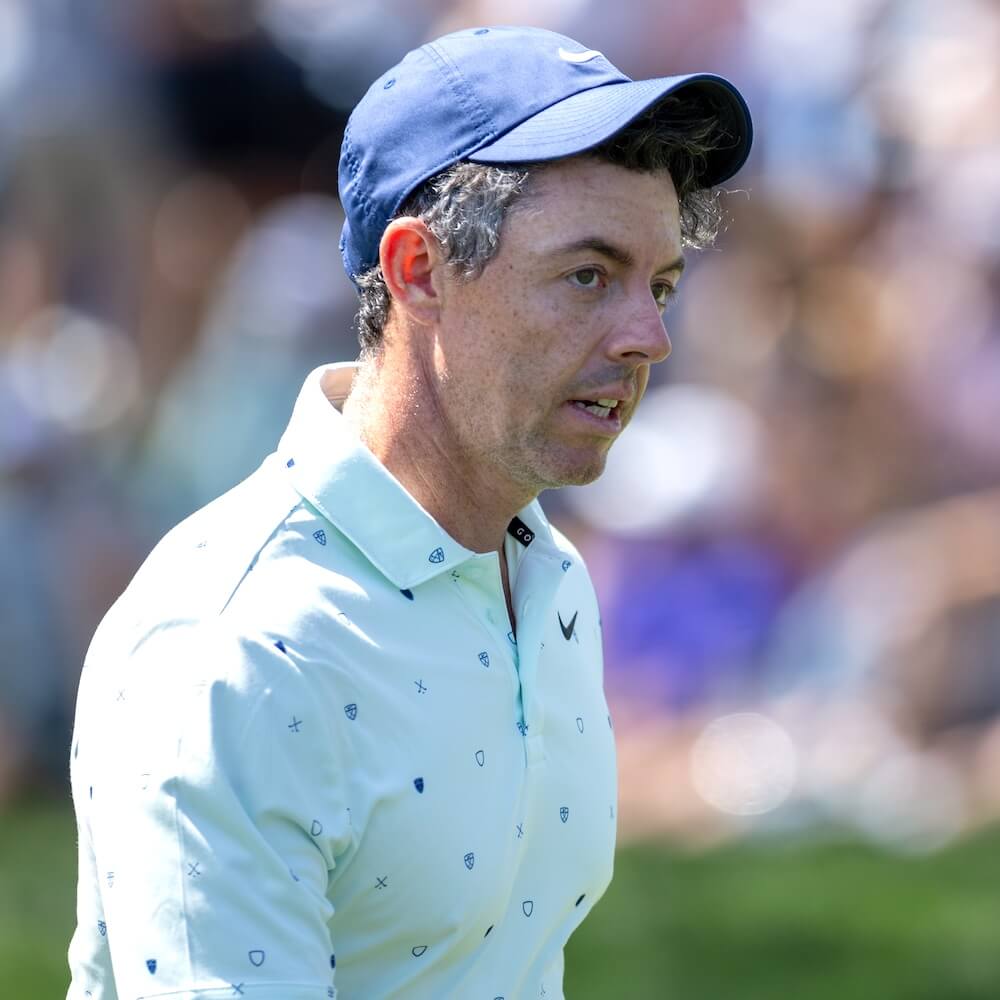
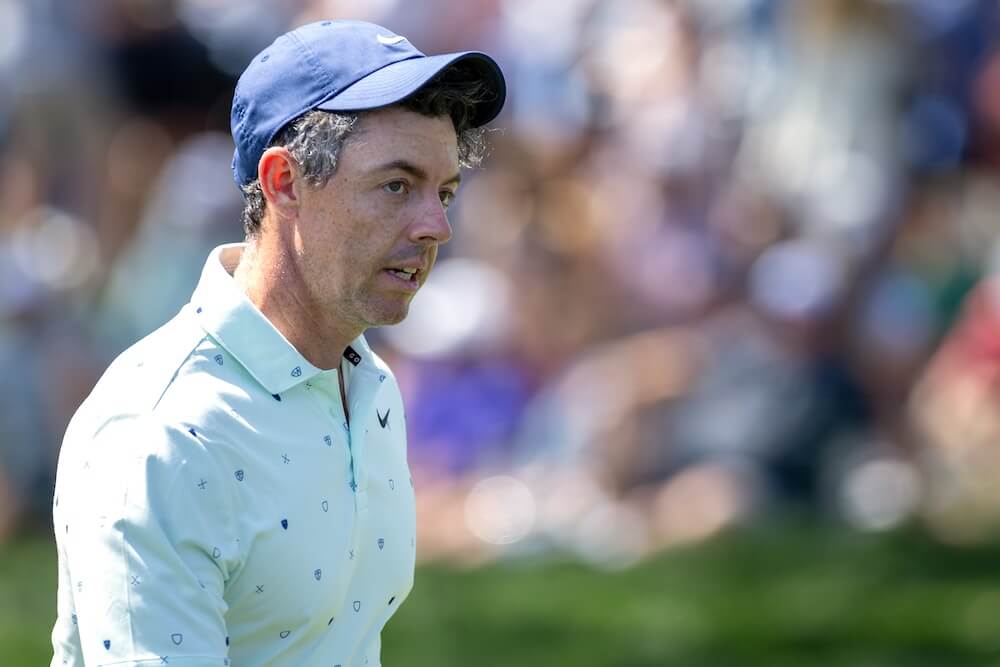
 Rory McIlroy sat at 1-over par after his second round at the Players Championship. Eston Parker, ISI Photos via Getty Images
PONTE VEDRA BEACH, FLORIDA | This much we know about Rory McIlroy:
He became the sixth man to win all four of the game’s major championships on a thrilling afternoon at Augusta 11 months ago and then was instrumental in Europe’s victory in the Ryder Cup last September.
Like Tiger Woods he is known by his first name or nickname. There may be many tigers but there’s only one Rory.
He will be 37 on May 4 and is among the most popular and best players on the PGA Tour, and among the best non-American-born golfers on the PGA Tour.
At least 15 books have been written about Woods; fewer than six about McIlroy. The two most recent McIlroy books are Timothy Gay’s “Rory Land: The Up-and-Down World of Golf’s Global Icon,” published in May last year, and Alan Shipnuck’s much-anticipated biography “Rory: The Heartache and Triumph of Golf’s Most Human Superstar,” which is due out next month.

McIlroy causes heart rates to soar and plummet almost in the time it takes to say those words. One minute he is the most exciting person to watch in modern golf, the next the most frustrating. These McIlroys have been known to occur on the same hole never mind the same round or the same day.
The question is, then, who is Rory McIlroy, the golfer? Is he the game’s current conundrum, a complex person hard to understand? Is that how McIlroy is? Global Golf Post posed that question to Shipnuck, who conducted 150 interviews for the book that took him 18 months to write. “As a golfer he is charismatic, unpredictable, inexplicable, compelling, breathtaking and never, ever boring,” Shipnuck said. “You can’t take your eyes off him for the way he drips charisma and the fact that he is always knocking on the door of history.”
It took barely five minutes after his 8:52 a.m. tee time Friday in the second round of the Players Championship for McIlroy, the defending champion, to shake the spectators out of their early-morning torpor at the TPC Sawgrass. When his approach to the 10th, his first hole, arrowed into the green and stopped 6 feet from the flagstick a spectator shouted: “Oh yes!” Someone else shouted: “You’re the man!” (Is it too much to hope that shout soon fades into obscurity?)
On Wednesday, his target was merely to be well enough to play. Now, 36 hours later, he was fighting to make the cut.
The ensuing birdie got McIlroy’s total moving in the right direction. From the 2-over par he had been after the first round, he was only 1-over now and the 11th, a par-5, often meat and drink to a man of his length, awaited him.
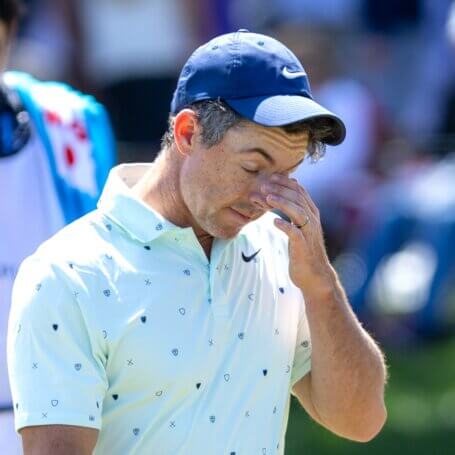 There were moments on Friday McIlroy would rather forget. Eston Parker, ISI Photos via Getty Images
After his drive ended in a fairway bunker, he faced a third shot of 130 yards. With that enviably easy swing that he has on short shots, when he seems less to hit the ball than to caress it, he hit his ball to 9 feet, a shot that earned an accolade from a spectator: “Back looks good to me.” And indeed, the back that had caused McIlroy to withdraw from the Arnold Palmer Invitational last week and delay his arrival at the Players until Wednesday was not giving any appearance of troubling him, even though the temperature was cold enough for it to do so.
Soon the morning chill disappeared to be replaced by warm Florida sunshine, and McIlroy began moving more freely. Often while he stood waiting to putt or watch a playing partner hit a shot, he moved his head and his torso from side to side to stretch muscles. Anyone who has ever had a back issue will know the movements.
On Wednesday, his target was merely to be well enough to play. Now, 36 hours later, he was fighting to make the cut.
Matters took a turn for the worse on the fourth, his 13th, where his tee shot ended in thick rough just off the fairway. It looked as though gelignite would be needed to extricate it, if not an excavator – or both. With an enormous heave (and probably a grunt) in complete contrast to the balance and serenity of his normal swing, McIlroy got the ball out of the rough – but only into the guardian lake. A pitch and a good putt later earned him a bogey that probably felt like a birdie.
On he went, one par after another, until he got to the long ninth, his 18th. An eagle would make almost certain of surviving to the weekend, a birdie wouldn’t be bad. The hole is nearly 600 yards, the green narrow and with a ridge that runs across it. There are bunkers, both sand and grass, left and right. McIlroy’s second was compelling and daring, landing just past the flagstick. It rolled perhaps 30 feet. He had covered the hole with a 310-yard drive and a second of 284 yards. How much easier golf is when you can hit the ball those sorts of distances.
As McIlroy bounced jauntily down the fairway, Jim “Bones” Mackay, the roving TV reporter, asked him what he intended to do that afternoon and in the coming weeks. “Depends a lot on this hole,” McIlroy replied. What he meant was that if he missed the cut he would have to schedule an extra tournament before going to Augusta and, he said to Bones, “… I don’t want to have to do that.”
Moments later his first putt just crept past the hole. McIlroy threw his head back as if he could not believe it. The birdie, only his fourth for 36 holes, took him to 1-over par after 36 holes, tied for 55th, and meant he was likely to survive to the weekend. “A missed cut would wound your pride,” McIlroy said. “I have 280-odd starts on the PGA Tour and I’ve missed fewer than 30. I’m proud of that.”
© 2026 Global Golf Post LLC