
In further comments on his Truth Social app, Donald Trump said “many countries” would send warships to keep the strait of Hormuz open, without providing details on which countries would do so.
He said he hoped the UK, China, France, Japan, South Korea and others will send ships to the area.
Key events
Show key events only
Please turn on JavaScript to use this feature
Trump’s administration has rebuffed efforts by Middle Eastern allies to start diplomatic negotiations aimed at ending the Iran war that started two weeks ago with a massive US-Israeli air assault, according to reporting from Reuters.
Iran has rejected the possibility of any ceasefire until US and Israeli strikes end, two senior Iranian sources told Reuters, adding that several countries had been trying to mediate an end to the conflict. The lack of interest from Washington and Tehran suggests both sides are digging in for an extended conflict, even as the widening war inflicts civilian casualties and Iran’s closure of the Strait of Hormuz sends oil prices soaring.
At least 15 people were killed when a strike by Israel and the US hit a factory in the central Iranian city of Isfahan, the semi-official Fars news agency said on Saturday.
There were workers inside the factory, which produces heaters and refrigerators, when the strike hit, Fars reported.
Turkish foreign minister Hakan Fidan said on Saturday that Iran had denied responsibility for missiles fired toward Turkey, adding that Ankara was discussing contradictions between Tehran’s statements and available technical data on the launches.
Speaking at a press conference in Ankara, Fidan said Turkish authorities possessed technical data regarding the missiles fired toward Turkey and were raising the inconsistencies with Iranian officials.
Here are some pictures on the newswires from the Middle East today.
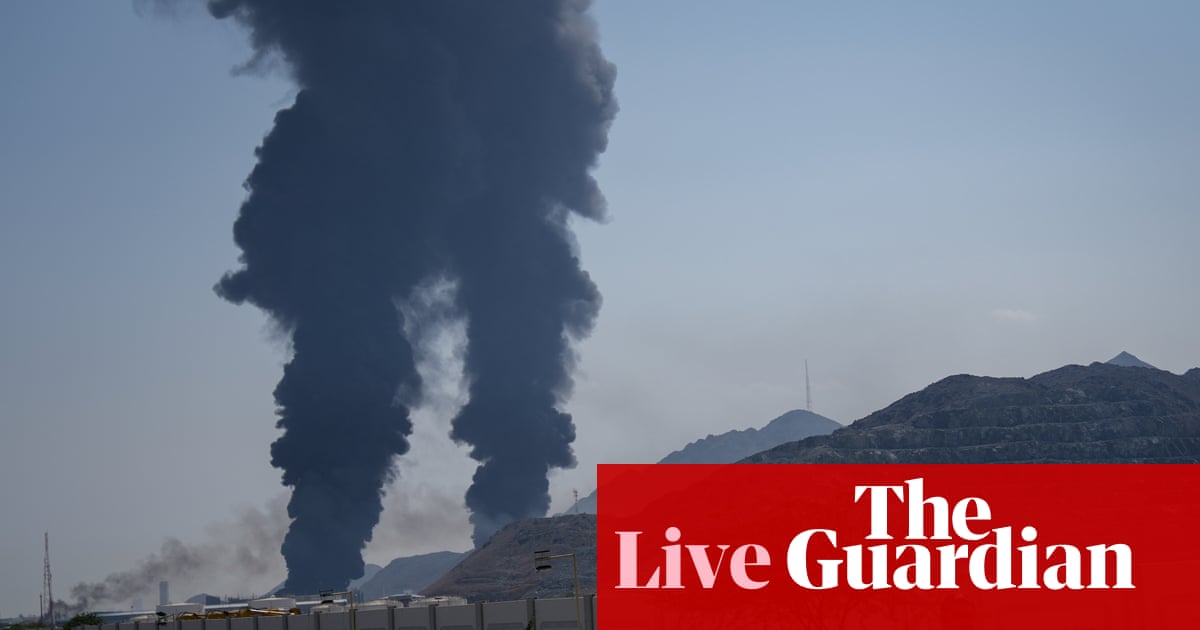
A man stands in a damaged building in the Khani Abad neighbourhood of Tehran, Iran. Photograph: Majid Saeedi/Getty ImagesA destroyed healthcare building in the aftermath of an Israeli strike in the southern Lebanese town of Burj Qalawiya. Photograph: Kawnat Haju/AFP/Getty ImagesSmoke and flames rise from the Fujairah port in the UAE. Photograph: AFP/Getty ImagesEmergency service workers inspect the damage after a missile strike hit a residential area near the city of Shoham, central Israel. Photograph: Abir Sultan/EPAShare
Lebanon’s health ministry said Israeli strikes have killed 826 people, including 65 women and 106 children, since the start of the war.
In a statement today, the ministry said 31 paramedics were among those killed.
Local health authorities reported this morning that an Israeli strike killed 12 medical staff at a clinic in the southern town of Burj Qalaouiya.
Israel has not commented on the report, but its military said it carried out “several additional waves of attacks” against Hezbollah infrastructure in Beirut and southern Lebanon.
The Israeli military has once again issued an evacuation order for the southern suburbs of Beirut, known as the Dahiyeh, telling people to “evacuate immediately and not return to these neighbourhoods until further notice”.
The humanitarian organisation Norwegian Refugee Council said 1 million Lebanese have been displaced from their homes since the conflict began.
Share Hannah Ellis-Petersen
‘Worst nightmare’: anger and frustration as Gulf states bear brunt of war they did not start
An eerie quiet hangs over Ras Al Khaimah’s industrial port. Usually a thriving maritime hub of the United Arab Emirates, now ships stand docked and silent. Not far out along the hazy horizon, a backlog of hundreds of tankers have lined up in recent days, halted along a waterway flooded with danger.
Any vessel heading past Ras Al Khaimah out to the Arabian Sea must traverse the world’s most treacherous strip of water for shipping today: the strait of Hormuz. Just over 20 nautical miles from Ras Al Khaimah, two oil tankers heading for the strait were attacked by Iranian missiles this week, one catching fire.
Aviation in the region remains highly restricted, with airlines losing billions of dollars. Bahrain is facing an economic crisis, while the UAE’s reputation as a haven for tourism and western investment has taken a significant hit.
While the Gulf expected to be caught in the backlash, the scale of Iran’s campaign of revenge has left many shocked. Gulf states had assured Tehran that none of their bases would be used for attacks but that has not stopped Iran launching thousands of drones and missiles targeting airports, military bases, oil refineries, ports, hotels and office buildings.
For all the geopolitical ramifications, the economic effects have also trickled down to ordinary life. Sumon, 27, who works for a boat and jetski rental firm in the marina next to Ras Al Khaimah port, says business has been throttled because none of their boats are allowed out to sea by the coastguard.
“No boats are moving any more,” he says. “No one knows when it will end.”
Read the full report here:
The UN secretary general, António Guterres, is in the Lebanese capital Beirut, where he has opened a press conference regarding the humanitarian crisis unfolding in the country.
He noted that Muslims in Lebanon were observing Ramadan, while Christians were also following Lent. “It breaks my heart to see this period shattered by escalating attacks,” he said.
“Over the past two weeks we have seen widespread destruction. Hezbollah rockets and drones were launched at targets in northern Israel and occupied Syrian Golan.
UN secretary general António Guterres speaks during a press conference in Beirut, Lebanon. Photograph: Mohamed Azakir/Reuters
“This was followed by devastating Israeli bombing operations and blanket evacuation notices.”
He said many Israelis have been sent to shelters while hundreds of Lebanese people have been killed, including many children. Hundreds of thousands of civilians in Lebanon are fleeing with “nothing but what they can carry”, he added.
“I was deeply saddened by the testimonies of the displaced people when I visited a shelter today,” he said, adding that southern Beirut “risks being bombed into oblivion”.
Updated at 10.50 EDT
In further comments on his Truth Social app, Donald Trump said “many countries” would send warships to keep the strait of Hormuz open, without providing details on which countries would do so.
He said he hoped the UK, China, France, Japan, South Korea and others will send ships to the area.
Two Indian-flagged tankers carrying liquefied petroleum gas (LPG) have safely passed through the strait of Hormuz, a Delhi official said.
“They crossed the strait of Hormuz early morning safely and are en route to India,” said Rajesh Kumar Sinha, India’s special secretary of the ministry of ports, shipping and waterways.
It marks a rare exception after Iran effectively blocked traffic through the key oil route since the conflict began.
The tankers Shivalik and Nanda Devi are expected to arrive in the next couple of days, the Associated Press news agency reported.
The safe passage of the two Indian vessels followed talks between New Delhi and Tehran in recent days. Indian foreign minister Subrahmanyam Jaishankar posted on social media earlier this week that he held talks with the Iranian foreign minister, Abbas Araghchi.
Donald Trump has taken to his social media platform Truth Social to take issue with media reports that five US air force refuelling planes had been hit in an Iranian strike on Prince Sultan air base in Saudi Arabia in recent days.
The US president claimed: “In actuality, the Base was hit a few days ago, but the planes were not ‘struck’ or ‘destroyed’. Four of the five had virtually no damage, and are already back in service. One had slightly more damage, but will be in the air shortly.”
The Wall Street Journal, which cited two US officials as the source of its story, had reported that the tanker planes were damaged but not fully destroyed and were being repaired. The WSJ reported that no one was killed in the strikes.
Blasts have been heard over Jerusalem, AFP reports, shortly after the Israeli military said that it had detected incoming missiles from Iran.
The Israeli military said its defence system was “operating to intercept the threat”.
ShareIran warns residents to leave areas in the UAE
Reuters, citing Iranian news agencies, reports that Iran is warning residents to leave areas near Fujairah port, Jebel Ali port in Dubai and Khalifa port in Abu Dhabi.