
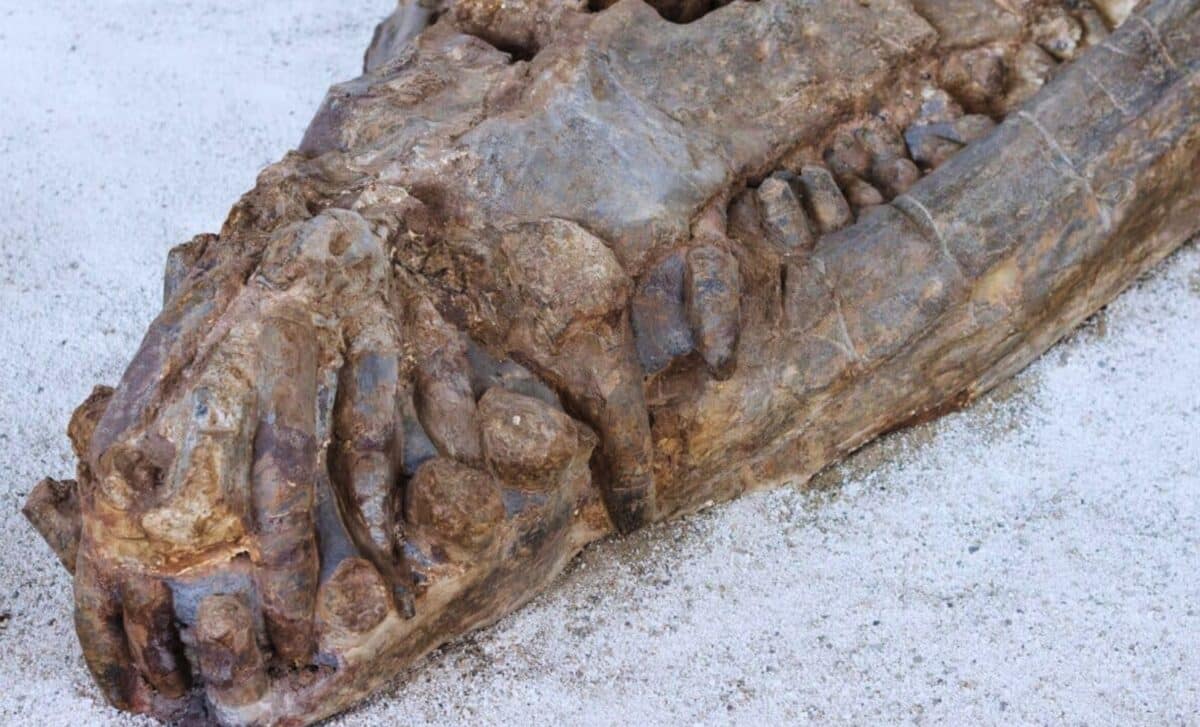
Along the old creek beds and sand pits of the American South, fossil hunting can feel less like discovery and more like detective work. A bone fragment turns up, then another, and soon the ground begins to hint at a much older shoreline. In western Georgia, some of the most telling clues did not come from a complete skeleton. They came as bite-marked dinosaur bone and heavy, dark pieces of fossilized waste.
One set of finds pointed to a warm, shallow place where river water mixed with the sea. In that kind of landscape, big animals are forced into predictable routines, including stepping down to the water’s edge to drink. The fossils were dated to around 79 million years ago, deep in the Late Cretaceous. The question was not whether something large lived there, but what had the strength to leave those marks.
In March 2010, Columbus State University paleontologist Dr. David Schwimmer and student Samantha Harrell presented evidence that tied several clues together. Harrell analyzed spindle-shaped coprolites linked to Deinosuchus, measuring about 8 to 13 centimeters long. She reported sand and shell fragments inside, which suggested brackish, near-shore conditions rather than a purely freshwater setting. Those details made the bite marks on dinosaur bone feel less like a curiosity and more like a pattern.
Schwimmer’s own phrasing captured the stakes in one line: “In some cases we’re talking about a 29-foot Deinosuchus taking down a 29-foot dinosaur,” he said. It was a blunt statement, but it rested on physical evidence rather than storytelling. The problem was that the fossils of Deinosuchus were scattered across huge distances and mixed in with other crocodylian remains. To understand the animal’s true size and identity, researchers would have to reopen museum drawers and re-check old assumptions.
A Continent-Wide Recheck Reshaped Deinosuchus
That recheck arrived in July 2020, when Dr. Adam Cossette of the New York Institute of Technology College of Osteopathic Medicine and Professor Christopher Brochu of the University of Iowa published a sweeping review in the Journal of Vertebrate Paleontology. Their work treated Deinosuchus as a distinct lineage of giant crocodylians from Campanian-age rocks. The fossil record they reviewed stretched from northern Mexico to Montana in the west and from Mississippi to New Jersey in the east. The review also emphasized that these animals fed on large vertebrates, including dinosaurs.
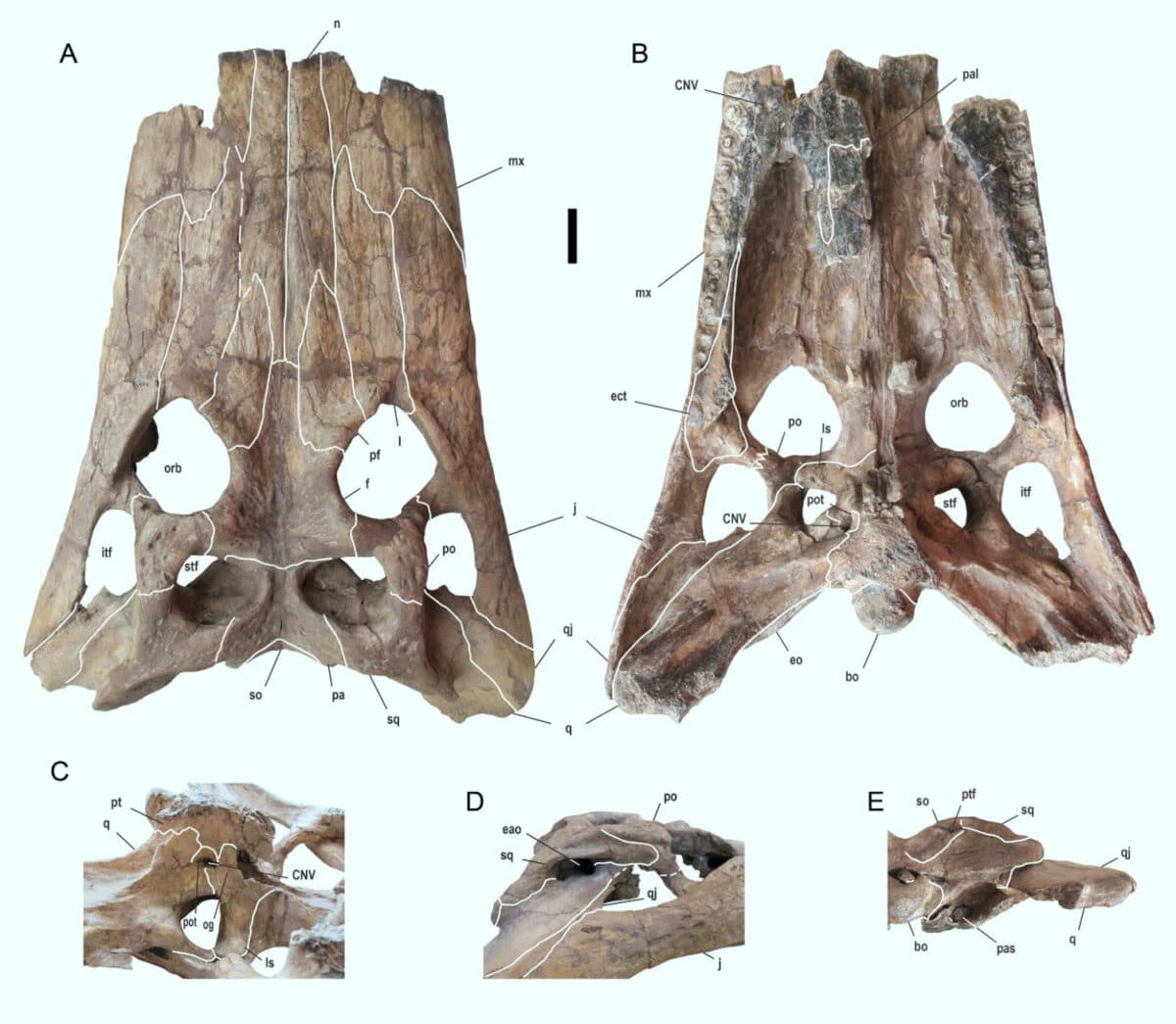 Deinosuchus schwimmeri fossilized skull. Credit: Journal of Vertebrate Paleontology
One of the paper’s most useful outcomes was geographic clarity. The team recognized three species rather than one, and they tied them to the split created by the Western Interior Seaway, the shallow sea that once divided North America. Two species, Deinosuchus hatcheri and Deinosuchus riograndensis, were linked to western habitats on the landmass known as Laramidia. The eastern form, Deinosuchus schwimmeri, lived on Appalachia, the long-separated eastern landmass.
That eastern species name also carried a tribute. Deinosuchus schwimmeri was named to honor Schwimmer’s long fieldwork on the Late Cretaceous fossils of the Southeast and the Eastern Seaboard. For museums and researchers, the name mattered because it tied specific bones and teeth to a better-defined animal. It also helped explain why eastern fossils often looked a little different from the massive western material. When the paper landed, decades of southeastern collecting suddenly fit into a cleaner framework.
The Snout Detail That Still Has No Clean Explanation
Even with the taxonomy steadier, the anatomy had its own surprises. A press release tied to the 2020 work described a long, broad snout that seemed expanded at the front. The release said the reason for that enlarged nose remains unknown, and it highlighted an odd feature at the very tip of the snout. “It had two large holes present at the tip of the snout in front of the nose,” Cossette said. “These holes are unique to Deinosuchus, and we do not know what they were for…”
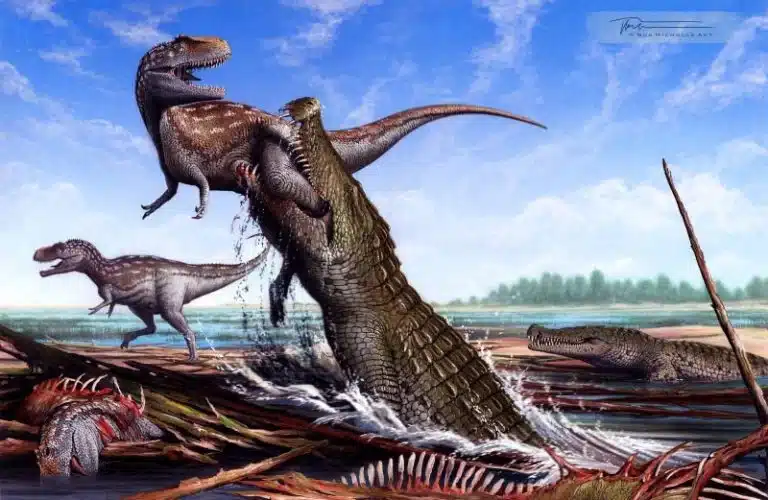 An artist’s interpretation of Deinosuchus schwimmeri surfacing to ambush an Appalachiosaurus. Credit: Bob Nicholls
The same release leaned on another detail fossil hunters love because it is so concrete. It described teeth “the size of bananas,” a comparison meant to convey thickness as much as length. Those stout teeth fit an animal built to crush and hold, not just slice. The quote that followed tied the anatomy to behavior in a single familiar moment at the shoreline. “Deinosuchus was a giant that must have terrorized dinosaurs that came to the water’s edge to drink,” Cossette said.
Those statements aligned with what Schwimmer and Harrell had reported from Georgia: a predator living in brackish coastal habitats with evidence of a mixed diet. Harrell’s coprolite work noted shell fragments, and Schwimmer said the evidence supported feeding that likely included sea turtles. The same Columbus State report also stated that Deinosuchus sometimes preyed on dinosaurs. Taken together, the record did not paint a picky specialist, but a heavy-bodied apex predator that made the shoreline dangerous.
A 31-Foot Deinosuchus Moves from Journals to a Museum Floor
By December 2025, the academic picture began to turn into a physical one that visitors could walk around. A mounted, life-size replica of Deinosuchus schwimmeri measuring up to 31 feet (9.45 meters) was commissioned by the Tellus Science Museum in Cartersville, Georgia, and installed there.
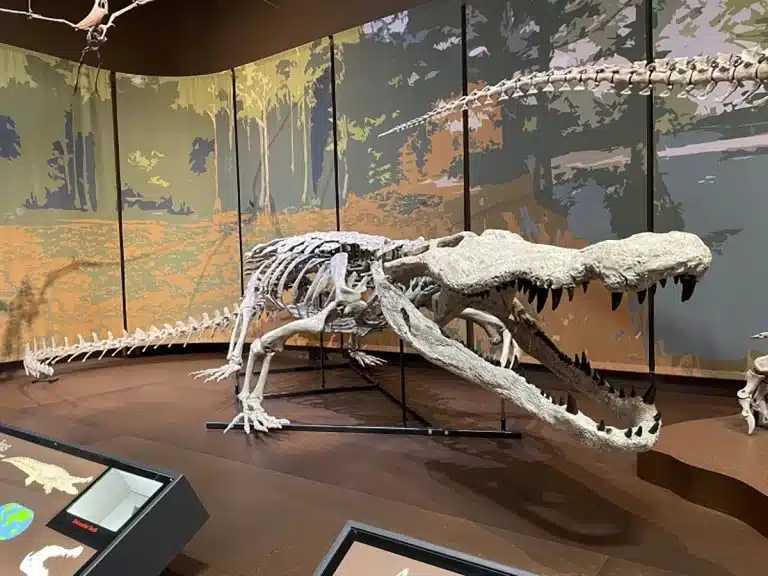 A fossil replica of Deinosuchus schwimmeri featured at the Tellus Science Museum. Credit: Tellus Science Museum
Reports describe two years of consultation between Schwimmer and Triebold Paleontology Inc. to build what was presented as the first “scholarly accurate” mounted replica of the species. The work relied on high-resolution 3D scans of fossil material to reconstruct skeletal and armor details.
Tellus framed the mount as more than a large object in a gallery. “Each year, we have thousands of students visit us from across Georgia and neighboring states,” said Hannah Eisla, the museum’s director of education, explaining that the addition helps the museum show “a more detailed picture of this area’s ecosystem in the Cretaceous Period.”
In the same coverage, Tellus was described as the only museum with a cast of Deinosuchus schwimmeri. For students, that means the animal is not an illustration in a book but a three-dimensional presence.