
(Credits: Far Out / Joan Sorolla)
Sun 15 March 2026 18:58, UK
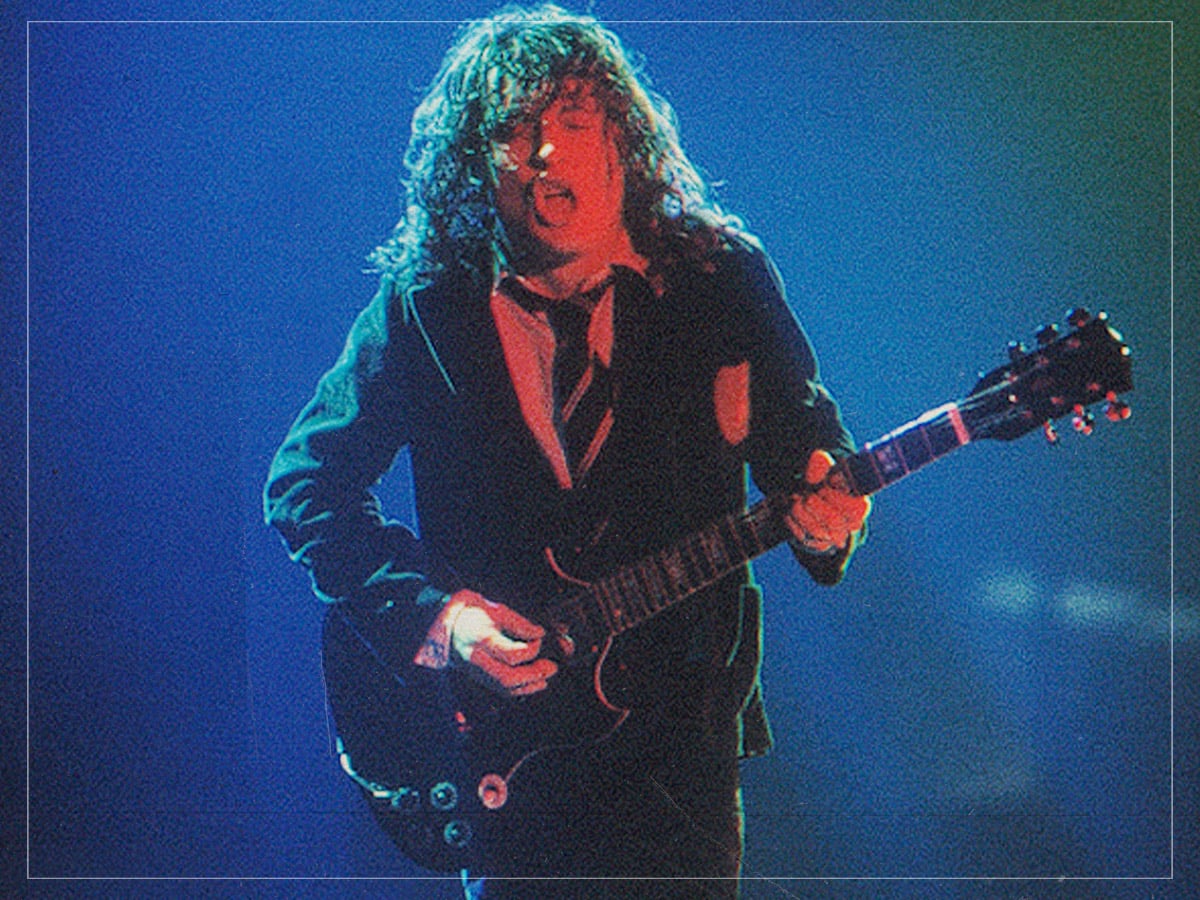
As the guitarist of AC/DC, Angus Young doesn’t carry many regrets. Not only is he one of the most instantly recognisable and influential players of his generation, but given the group’s proclivity for producing resonant anthems steeped in the essence of living in the moment, you wouldn’t necessarily think that he pays much attention to things they could have done better.
Broadly speaking, there is no real rhyme or reason to do so. The Australian band’s long list of successes featuring global classics such as ‘Back in Black’, ‘Highway to Hell’ and ‘Thunderstruck’ would be more than enough for most musicians to die happy, watering down any creative misgivings they may have.
Furthermore, with other songs such as ‘T.N.T.’ and ‘Hells Bells’ also being staples of the rock genre – all boasting the distinctive grit of Young’s Gibson SG – this wildly triumphant career hasn’t produced many artistic regrets.
In Young’s case, this is particularly true. The group set out to bring good old-fashioned rock ‘n’ roll back to the fore due to the emergence of a pompous take on the genre being the zeitgeist in the early 1970s and did so with flying colours. The outspoken Young would even name the decade’s two most overrated live bands as Led Zeppelin and The Rolling Stones, groups he thought had eschewed their electrifying rock ‘n’ roll roots for something much more tedious.
This renouncement of the English bands’ style provides a firm idea of how Young and AC/DC view music. It also bolsters why he hates one song in his band’s oeuvre that stands out as a rare moment he’d rather forget. For a band built on loud riffs and unfiltered energy, the idea of recording a gentle love ballad always felt slightly out of character. AC/DC’s identity had been shaped around raw, blues-driven rock and a sense of rebellious simplicity. Introducing a softer track risked blurring that image, even if it was only done as an experiment early in their career.
 (Credits: Far Out / Harry Potts)
Looking back, the song stands out as an anomaly within the band’s catalogue. While many groups explore different styles as they develop, AC/DC famously built their legacy by refining the same formula again and again. Against a discography packed with hard-hitting anthems, a sentimental ballad was never likely to sit comfortably with someone as committed to straight-ahead rock and roll as Angus Young.
When speaking to Vulture in 2020, the guitar hero named the track he regrets the most, and, in true form, picked their sole ballad, ‘Love Song (Oh Jene)’, from their 1975 Australian debut, High Voltage. If it wasn’t already clear, he really is a rock ‘n’ roll purist.
“On our first album, High Voltage, we did a love song called Love Song,” Young explained. “That was very different for us. I didn’t know if we were trying to parody love songs of the time because Bon [Scott] wrote the lyrics. I don’t even remember what the words are.”
He recalled: “I remember that song because the guy who worked for us at our record label told us that’s what was on the local radio at the time – very soft music. His thought we should release that song, because it’ll probably get some airplay. I remember thinking, ‘Who in their right mind would want this to go out?’”
In another show of AC/DC’s unrelentingly plucky spirit, things turned out successfully on this front. Due to their frenetic sound, which had been making waves in the clubs of Australia, the radio stations knew that the ballad was not who they truly were, so they looked deeper into their work. High Voltage was released simultaneously as ‘Love Song’; however, the B-side, their cover of the blues standard ‘Baby, Please Don’t Go’, eventually took all the plaudits.
Due to the fact that AC/DC are essentially a fast blues band, ‘Love Song’ was overlooked by the radio, and ‘Baby, Please Don’t Go’ started to receive airplay. Young concluded: “We actually scored a hit from the B-side! That was the one saving grace of the song.”