
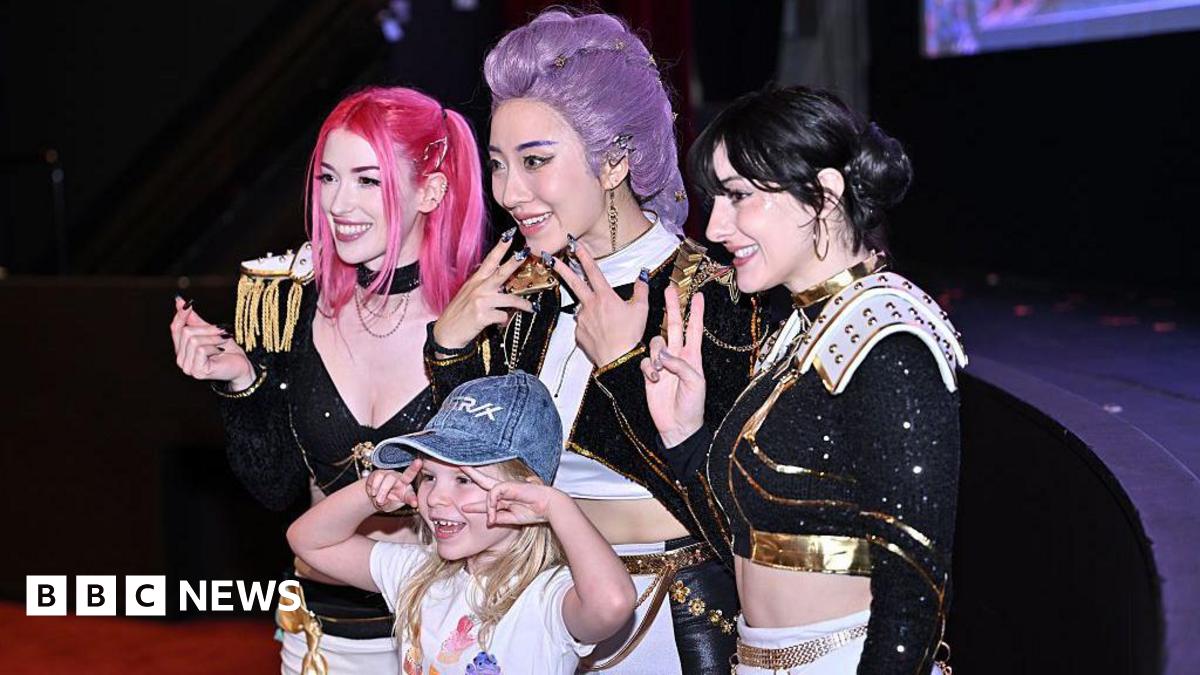
Finally, Kpop Demon Hunters comes at a time when global appetite for Korean pop culture is expanding.
“I feel like it’s not only the quality of the animation itself,” Seol says. “It is time the world is ready to see this very authentic animation, and it’s very fresh.”
The genre has come a long way since Gangnam Style, the viral Korean track that shattered cultural barriers and YouTube viewing records in 2012.
Today, bands like BTS and Blackpink have become regular attendees of Western awards shows, newer groups like Stray Kids and NewJeans increasingly boast members of diverse nationalities, South Korean president Lee Jae Myung has embraced K-pop as a soft power tool to drive diplomacy and economic growth.
On Sunday, the singers behind the protagonists in Kpop Demon Hunters, Ejae, Rei Ami and Audrey Nuna, performed Golden to a sea of swaying colourful lightsticks and light-up bracelets, waved enthusiastically by audience members – just like at a K-pop concert.
“Growing up, people made fun of me for liking K-pop. But now everyone’s singing our song and all the Korean lyrics, I’m so proud,” an emotional Ejae said on Sunday at the Oscars, as she accepted the award for best original song on Sunday.
The success of Kpop Demon Hunters has sparked pride in South Korea, where it has captivated people.
One of them is Yenna Oh, an elementary school student in Paju city, near Seoul. She has amassed a photo card collection of the movie’s characters, which she has gingerly filed in an album.
“I especially get excited when Rumi, Mira, and Zoey defeat the monsters,” says the eight-year-old.
What adults see, though, is a new swell of the unstoppable Korean Wave that is sweeping the world.
“I think [Kpop Demon Hunters] marks a turning point in terms of how cool Korea is,” says Kao, the Yale professor.
“I don’t think it’s just K-pop, but just sort of K-everything.”
Additional reporting by David Oh in Seoul