
Like taxes and the poor for all of us, for some chronic pain is always with them. Some, I say. The science journal Nature estimates that worldwide there are 1.5 billion chronic pain sufferers. In the UK nearly 28 million people (43 per cent of adults) live with it. It has no cure and as a condition that is at once a disease and a symptom it is poorly understood both medically and generally. How many of us know that 70 per cent of its victims are women or that a woman’s chronic pain is different from a man’s chronic pain? Or that childhood trauma, social class, and, weirdly, even body image, may play a part in it?
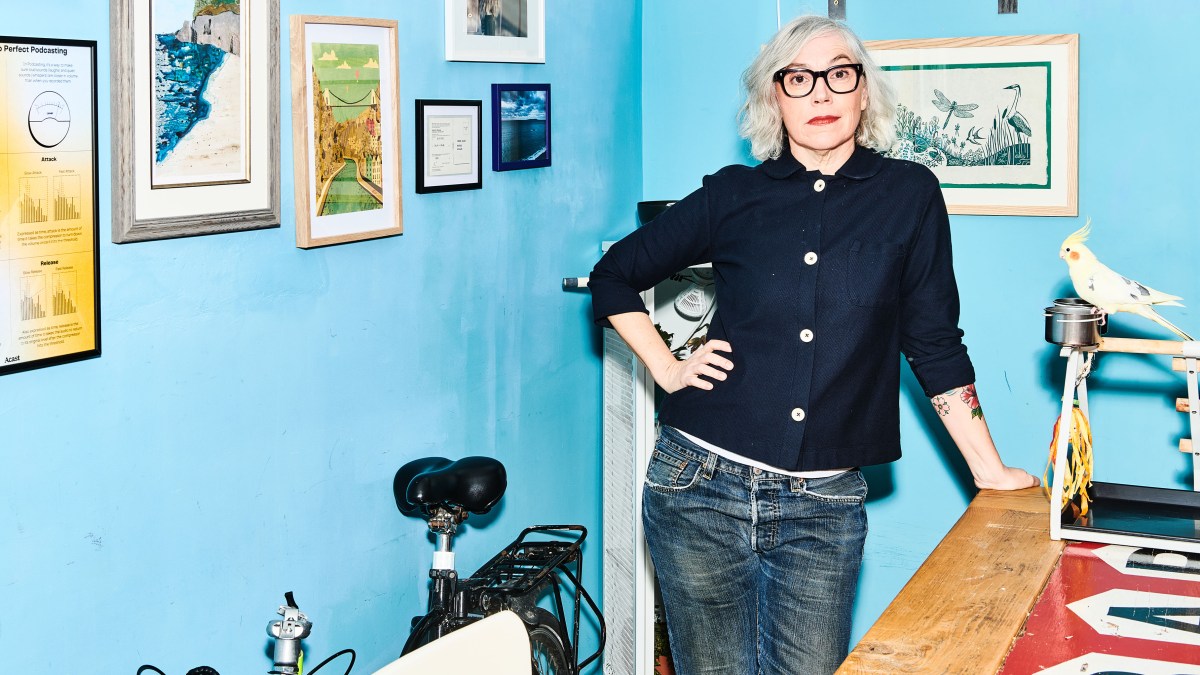
Certainly not me, not until I read a brilliant new book, Chronic: Understanding Pain, and I met its author, Gillian Best. We are sitting in the colourfully bohemian sitting room of her terraced house in Bristol, with its bird cages and a “no sexists, no racists, no fascists” poster. It is 5pm and Best is quietly suffering. “My sitting bones hurt and I’m going to take some tablets,” she says almost dismissively.
A novelist whose 2019 debut, The Last Wave, was well reviewed and shortlisted for a prize, Best has clearly not allowed her own chronic pain to define her, but, she says, “It is a part of me, just the same way that I’m Canadian. It’s like having brown eyes.”
For Chronic her subject was not so much right in front of her as aching right within. Yet it’s an energetic adventure she takes her readers on as she talks to 31 medical researchers across the world, each determined to better understand chronic pain.
• Can these women (and their app) change the lives of new mums?
She is 50 and has suffered from it since her childhood. In her early teens, while at a pool party in Waterloo, a city in Ontario, she was ambushed by such horrible pain she had to be carried to a car and taken home. A few years later, when she was about to go to university in Toronto, she experienced so much pain in her hips and spine that she couldn’t get out of bed. Following hospital treatment she recovered, but while at university, “hobbled around” with a stick.
Best was later diagnosed with ankylosing spondylitis or AS, an inflammatory autoimmune arthritis intent on fusing her spine to her hips. She calls it “ankyspo”. Later the diarrhoea she had put down to her college-days vegetarianism was diagnosed as Crohn’s, a chronic inflammatory bowel disease. Also, she has partial hearing loss, although her audiologist has no idea whether it is connected with her illness or, perhaps, the anti-inflammatory drugs she has taken over the years. “And there’s also this kind of low-grade fluey thing — you just feel sort of like meh.” She does not want to be the teller of “sob stories” and sometimes her partner, Connor, has to remind her not to downplay things: “I did have to brush your hair last year because you couldn’t lift your arm.”
Women are more likely than men to suffer like this. James Lee of the Francis Crick Institute in London handed her some reasons. Women live longer (chronic pain is associated with age) and some underlying causes are female-specific, such as endometriosis (cells similar to womb linings developing elsewhere) and vulvodynia. What’s vulvodynia? I ask. “Oh my God. It’s crazy! I’d never heard of it either. It’s hideous. Has to do with the vulva and stuff like that.”
The differences between male and female pain are not just down to our different sex organs. Immune cells, which attack the bringers of disease into our bodies, play a key role in pain transmission and evidence is growing that they and the pathways they use are different in the two sexes.
It’s not that women are weaker?
“It is sure as shit not that women are weaker. In male rodents pain depends on microglia, purinergic receptors and brain-derived neurotrophic factor signalling — or to put that in a slightly more digestible way, a lot of brain stuff. In female rodents, pain depends on the infiltrating T-cells of the adaptive immune system. Completely different.”
• I took the deadly £3 drug that’s 500 times stronger than heroin
The rodents most commonly used in lab experiments? That’s right: boy mice. And rodents of either sex may not experience pain in the same way we humans do in any case. Jeffrey Mogil, a professor at McGill University in Montreal, told her that mouse models take us only so far: “I think he’s not even sure that we’re measuring spontaneous pain when we’re using these mouse models.” Even when medical research uses humans, there is a sexual imbalance. Richelle Mychasiuk of Sydney University says 95 per cent of all pain research has been done on “white middle-aged dudes”.
Scientists must also struggle to gauge the role of genes. Best’s sister, Kerri, also has AS and both have the HLA-B27 protein on their white blood cells, which increases the risk for autoimmune conditions but does not make them certain. Both Kerri and Gillian also had very bad influenza in childhood. “I think it was James Lee telling me that researchers know that for pretty much all common autoimmune diseases — like type 1 diabetes, inflammatory bowel disease, yada, yada — there’s a strong genetic component, right? But imagine firing a gun. Genetics loads the bullets, but you need something to pull the trigger. And that would have been the flu for Kerri and me. But, again, that’s just what we all think. Nobody knows where AS comes from.”
Melanie Noel, a psychology professor at the University of Calgary in Canada, talked to her about childhood trauma being another potential trigger — “Honestly, when I spoke to her, my hair was blown straight back. She was amazing.” A professor at Toronto University, Massieh Moayedi, tells her that heightened negative body image (after a mastectomy, for instance) increases pain and another academic, Stefan Siebert at Glasgow University, shares his findings that those at the bottom of the pile socio-economically are in greater danger of chronic pain.
“Raj [Sengupta, Best’s rheumatologist in Bath] always talks to me about this bio-psycho-social model,” she says. “If you live on your own, you don’t have much support, you’ve got a lot of stress in your life, maybe your job is unsteady — it’s like little dials. You’ve got to turn them all down before you can really get rid of all this pain.”
The good news? Mychasiuk told Best about a colleague who was retraining the brain out of feeling a specific pain. Is walking up stairs painful? Using virtual reality goggles, you can mentally “relearn” how it feels to go up them.
Still, chronic pain’s great ally remains how little it is understood.
“We go to the doctor expecting to have an easy answer or just an answer. And so often it’s just like ‘But I don’t know’. And we think that’s a failing of that doctor and that if we got a different doctor that they would know. I mean, maybe, but also maybe science just doesn’t know. We haven’t done the research to know yet.”
She believes that the sums spent on research are low and, in America, money tends to be directed at opioids, which are hopeless in tackling chronic pain. On average, also, only a tiny proportion of UK medical schools have compulsory teaching in pain medicine. The median number of hours of pain content in UK medical school curricula is 13 hours.
• What nearly dying at 56 taught me about how I should live
The lack of knowledge probably explains why one study found hospital admission notes for those in chronic pain feature the words “malingerer”, “in denial”, “drug-seeking”, “lifestyle disease” and “fake”. Patients may be told it is “all in their heads”, but, as Best points out, the brain is exactly where pain lodges, because brains, being made of nerve cells and molecules, are no less the body than any other of its parts: you break your knee and it’s a problem; the chronic pain it triggers is another problem.
Ideally Chronic would have been the story of how Best, whose doctorate is in creative writing rather than medicine, leapfrogged all the research scientists she quizzed and came up with a cure none of them had thought of. She actually did have a hunch. This was to treat her “ankyspo” with CAR T-cell therapy, which involves genetically modifying cells and is used in cancer treatment but is being trialled on lupus sufferers. Unfortunately, one by one the experts told her it would not work because the science does not know which problem cells in AS to target.
So which of the ideas for treatment she discovered in her quest does have promise?
“Well, I mean, each and every scientist that I spoke to will tell you they’re not going to produce a cure. Pere Santamaria [of Calgary University] was like, ‘No, not a cure’, but I think his idea of the nano-medicines was amazing. That’s a super science-fiction future. The medicine goes in and stops the inflammation and then repairs it.
“I imagine it as a giant jigsaw puzzle. They’re all putting together all these different pieces. Whoever comes out with great, new, exciting results is going to get us that much further in our understanding and who knows what will kick off? But I can’t stress this to you enough: these people I spoke to are the heroes of the book. This book is not about me, it’s about them and their work, and they are so, so amazing. We should have posters of these people on our walls.”
On the knotty problem of chronic pain, the wretched subject that nature and life have bequeathed her, Best, despite everything, manages to lift the spirit. As I am about to leave, the explanation for the bird cages reveals itself when her pet cockatiel perches on her hand. I choose to read it as a sun-plumed omen of hope.
Chronic by Gillian Best (Icon £20). To order a copy go to timesbookshop.co.uk. Free UK standard P&P on orders over £25. Special discount available for Times+ members