
The dollar figure at which Australians reach financial “breaking point” can be revealed, with Gen Zers feeling the pinch at just $1600 a month.
New data released by ING Bank shows Millennials are the most resilient by being able to absorb $2426 a month in household bills, followed by Gen X at $2068, while Baby Boomers start feeling the stress at $1845 a month.
With rising electricity prices, now coupled with rising petrol prices thanks to the Iran war, ING’s Head of Consumer and Markets Insights Matt Bowen said these pressures have unfortunately “become the new normal”.
“People are feeling a bit frustrated, they are still working just as hard (but) unfortunately the money that we are earning just isn’t cutting it,” Mr Bowen told news.com.au.
MORE:‘Vicious’: Real cause of inflation ‘big shock’
While budgets have tightened, anxiety has peaked with the ING data showing more than 84 per cent of Aussies reported feeling stressed about living expenses in the past year.
According to the Australian Bureau of Statistics, electricity bills increased by an average of 13 per cent and gas bills went up by an average of 4.3 per cent in the past year.
While the increase has contributed to fairly “appalling” cost of living statistics, the answer to reducing household expenses has seemingly been under our nose all this time.
Mr Bowen said skipping over the details on our bills – or refusing to read them – is costing Aussies hundreds of dollars every year.
“The most important thing you can do to save money on your energy bill is to actually take the time to read it,” Mr Bowen said.
“So many people just look at the number that’s owed and pay the money to the provider.”
MORE:Sad update on what to expect in Aus in 2027
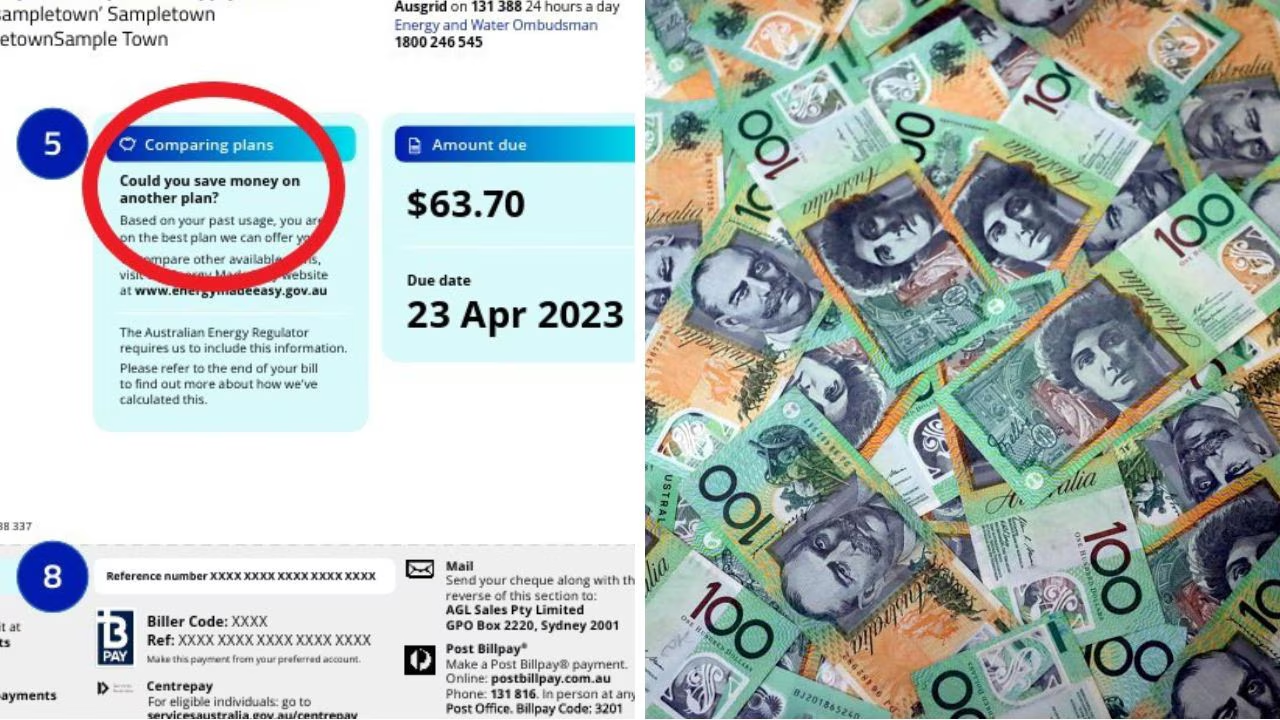
In what might come as a surprise to many, Australian federal law actually requires energy companies to tell their customers if they could save much-needed funds by joining another plan.
But they don’t make it too obvious and they won’t switch you automatically.
Customers must keep an eye out for a box on their energy bills that says ‘could you save money on another plan’.
If a cheaper option is given, you can call the energy company and ask to be put on their ‘Best Offer’.
These small wins are becoming survival tactics as the Reserve Bank of Australia (RBA) prepares for its March meeting this Tuesday.
With inflation running hot, a stretched labour market, and the Iran war driving up fuel costs, the nation’s big four banks – CBA, ANZ, Westpac and NAB – all anticipate a further increase to the cash rate.
As the economy suffers and the household breaking point looms, take this as a reminder that hundreds can be saved by simply reading the fine print.