

The Foodstuffs co-ops said they have been watching developments in the Middle East closely, but food supplies have remained stable, and supermarkets are well stocked.
While the data released related to the period before the conflict, Foodstuffs NZ Managing Director Chris Quin said the co-ops are working with suppliers and freight partners to minimise disruption to the food supply.
New Zealand sits at the end of global supply chains, so we’re always looking upstream and keeping an eye on international events that could have flow-on effects for us.
According to Quin, a large proportion of the products are grown or manufactured locally in New Zealand or Australia, sourced from Asia, or travel from Europe around the Cape of Good Hope at the bottom of Africa. Right now, grocery supplies are largely unaffected by the disruption in the Strait of Hormuz, and the normal offers are available in Foodstuffs’ stores.
At the same time, he mentioned that the main issue at the moment is higher fuel, freight and packaging costs rather than product availability.
“We’ve seen the cost of diesel for our transport fleet rise significantly, but at this stage, we’re absorbing that to help keep our food prices as steady as possible for customers. For every dollar on-shelf, around two-thirds goes to suppliers for the goods themselves,” said Quin.
“So if suppliers are facing higher freight, fuel, packaging or other input costs, those pressures flow through over time. As we’ve all seen, this is a fast-moving situation, with no clear timeframes or outcomes. The effects of what’s happening now with supply chains and fuel prices could still be felt months down the track.”
Quin added that Foodstuffs has been working closely with its supplier partners, who are busy planning ahead. In some cases, that may mean carrying a little more stock, ordering earlier, or sourcing from a broader mix of regions to help keep product moving for customers.
“Our focus remains the same, offering customers high-quality products, a good choice and the best value we can. That’s what our co-ops are built to do, through local family-owned stores that know their communities and work hard every day to deliver for New Zealanders,” he said.
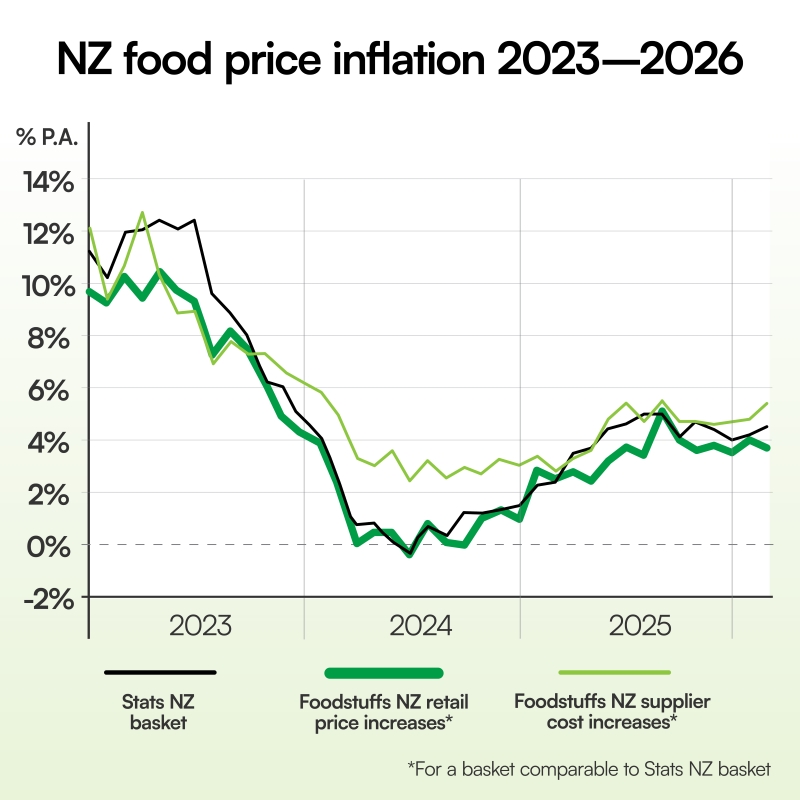
Stats NZ reported an annual food price inflation (FPI) rate of 4.5 percent for February, while Foodstuffs Stores recorded an average year-on-year retail price increase of 3.7 percent across its comparable FPI basket.
Some of the co-ops’ biggest year-on-year price drops in February included olive oil (down 19.0 percent), kumara (-17.5 percent), carrots (-9.8 percent), along with several other grocery items, such as canned tuna (-10.8 percent), chicken nuggets (-10.7 percent), and tomato sauce (-7.5 percent).
Meanwhile, some of the steepest year-on-year price increases last month were cucumbers (up 75.5 percent), courgettes (+70.0 percent), tomatoes (+54.0 percent), and mandarins (+28.9 percent).
“Fresh produce prices can move around quickly when weather conditions change. A cold snap through the middle of February, along with lower sunshine hours, slowed growth in some fruit and vege lines, like cucumbers and courgettes, pushing up prices.”
Looking ahead, Quin said favourites such as feijoas are coming into season, while ruby red kiwifruit are already in store, with green and gold varieties on the way. Pumpkins, including crown, butternut and buttercup, are also offering better value as the season progresses.
Strong global demand and tight supply for red meat are keeping prices elevated, with some of the biggest annual increases seen in sirloin steak (up 22.9 percent), blade steak (+22.6 percent), lamb chops (+20.4 percent), and beef mince (+19.3 percent). Chicken and pork continue to offer customers more affordable protein options, and they’re popular alternatives at the moment.
In February, Foodstuffs’ retail price increases were outpaced by supplier costs, up an average 5.4 percent year on year for products in the co-ops’ FPI basket. The Infometrics Grocery Supplier Cost Index (GSCI), which tracks more than 60,000 goods stocked across the co-ops’ 500+ stores, was steady on 2.3 percent pa, in line with January.
More local FMCG news here