
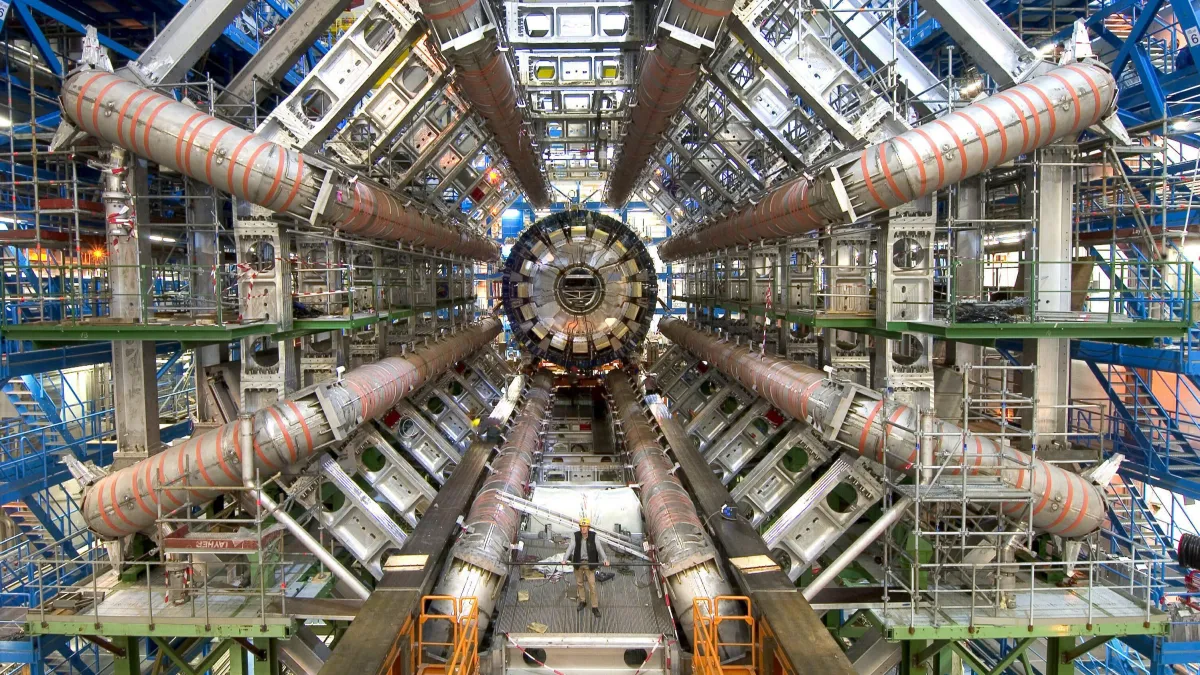
A entirely new subatomic particle has been discovered by a team including British researchers at Cern, the nuclear research laboratory, that could help scientists understand the force that binds all atoms together.
The particle is a heavier version of a proton, the positively charged particle found in varying numbers at the heart of atoms.
It was found using the newly upgraded Large Hadron Collider (LHC) as part of its latest “beauty” experiment, known as LHCb. Scientists spotted the particle amid a spray of debris created by colliding particles at the facility near Geneva, Switzerland.
The particle has been called Xi-cc-plus, written in scientific notation as Ξcc⁺, and is four times heavier than a normal proton. Its extra mass comes from the fact that it is made from heavier building blocks, known as quarks.
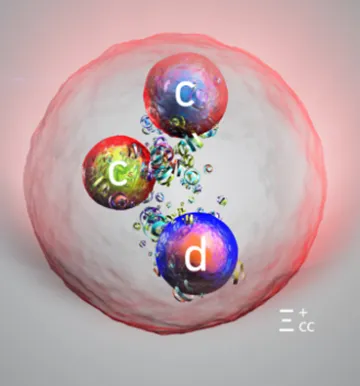 An artist’s illustration of the particle
Quarks are thought to be the fundamental, indivisible ingredients that make up all protons and neutrons, which themselves make up the nuclei of atoms.
There are six types, or flavours of quark, called up, down, charm, strange, top and bottom. The “top” and “bottom” quarks are sometimes known as the “truth” and “beauty” quarks, with the latter lending its name to the “beauty” experiment, which is specifically investigating particles made up of beauty and charm quarks.
A regular proton contains two up quarks and one down. However, the Xi-cc-plus proton contains two “charm” quarks instead of the up quarks, which are heavier. Because of this, it has been dubbed a “doubly charmed baryon”. A baryon is a subatomic particle, including protons and neutrons, that is made of three quarks.
The new particle decayed within a millionth of a second of coming into existence inside the collider. Scientists were able to deduce its existence when they spotted three lighter particles created as by-products when the Xi-cc-plus proton decayed.
It is the first new particle detected by the upgraded LHC, whose first iteration astonished the scientific world with the discovery of the Higgs boson in 2012.
Chris Parkes, head of the Department of Physics and Astronomy at the University of Manchester, said: “Rutherford’s gold‑foil experiment in a Manchester basement transformed our understanding of matter, and today’s discovery builds on that legacy using state‑of‑the‑art technology at Cern.
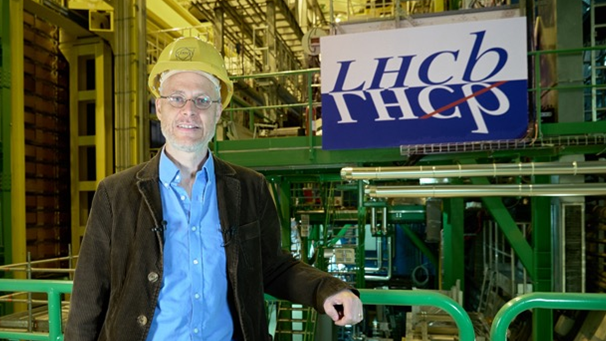 Chris Parkes at the Large Hadron Collider
“Both milestones demonstrate just how far curiosity-driven research can take us. This discovery showcases the extraordinary capability of the upgraded LHCb detector and the strength of UK and Manchester contributions to the experiment.”
There are four fundamental forces in physics. Gravity is by far the weakest, but it can still pull vast objects like planets, stars and galaxies together over enormous distances.
The electromagnetic force is responsible for electricity and magnetism, creating forces of attraction or repulsion between charged objects.
The weak nuclear force governs the interactions between subatomic particles and can change one type of quark into another.
The fourth is the strong nuclear force. This holds together the building blocks of atoms. It binds the protons and neutrons together within an atom’s nucleus and, at an even smaller scale, binds together the quarks that lie inside the protons and neutrons.
It is about 100 times stronger than electromagnetism and “100 trillion trillion trillion times” stronger than gravity, according to Nasa, but only has an influence over tiny distances: around 100 million times smaller than the width of a human hair.
Parkes said learning about new subatomic particles like Xi-cc-plus can teach us more about this strong force. The collisions between protons in the LHC mimic those seen at the very start of the universe. Discovering new particles provides a “new playground” for scientists to refine their theories, he added.
Scientists currently struggle to predict the mass of particles made up of different configurations of quarks. “By finding particles like this, we can test our understanding,” he said.
UK Research and Innovation has faced criticism for withdrawing £50 million of funding that Britain was set to contribute to the upgrade of the LHC at Cern.
Parkes said his reaction was one of “shock” and said the UK had played a central role in driving upgrades to the collider, saying that withdrawing funding at this stage was like “funding the train tracks but not building the train”. He said: “It seems very odd. It is unprecedented that a major country participating in such a Cern experiment would so drastically change its funding plans.”
Paul Howarth, the head of the Institute of Physics, said in February that it was “more terrible news for physics, for the UK and for global scientific progress”. He said it was “incredibly damaging to our international reputation as a science superpower and could cause long-term damage to the UK economy”.