
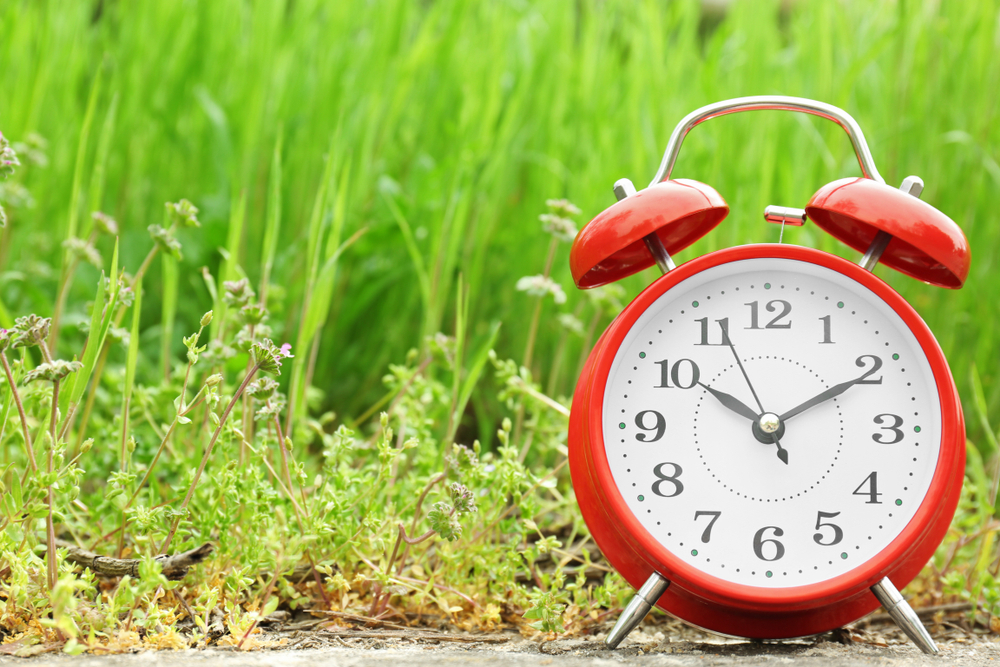
Longer, brighter days are finally in sight! In a little over a week, the UK will be swapping Greenwich Mean Time for British Summer Time (AKA daylight saving time) and putting all our clocks forward by an hour.
The sun will set later in the evening and the season of beer gardens, festivals and al fresco dinners will finally be upon us. No more leaving the office in the pitch black, no more vitamin D deficiency and no more being in pyjamas by 6pm. Before we know it, Easter and its delicious four-day bank holiday weekend will be upon us, too.
From the exact date clocks go forward to why we have it in the first place, here’s everything you should know about British Summer Time this year.
RECOMMENDED: When is Easter 2026? UK bank holiday dates in April.
What date do the clocks go forward in 2026?
The clocks will go forward by an hour to mark the start of British Summer Time on Sunday March 29. That’s a little over a week after spring officially begins which is this Friday March 20.
What time do the clocks go forward?
The clocks will spring forward one hour at 1am. So, it’ll become 2am.
What is British Summer Time?
Also known as daylight saving time, British Summer Time is is simply the name for the practice of turning clocks forward in the summer so that darkness falls at a later time.
Why do the clocks go forward?
Winding the clocks forward in spring started in the UK in 1916 as a way of making better use daylight hours and getting maximum sun. Back then, it meant people could work for longer and save fuel during the war.
When do clocks go back again?
British Summer Time will last until October 25 2026, when we’ll put the clocks back again.
Do I need to change the clocks myself?
Clocks on things like phones, computers, smart TVs and modern cars will change on their own. But you will have to adjust the time yourself on older or more manual timekeeping devices like traditional clocks, some cars and kitchen appliances.
Sunset times after clocks go back
Here’s where the sun will set in major UK cities on Sunday March 29, after the clocks have gone forward.
London – 7.28pm
Birmingham – 7.36pm
Manchester – 7.38pm
Cardiff – 7.40pm
Edinburgh – 7.44pm
Glasgow – 7.48pm
Belfast – 7.54pm
The UK’s post-8pm sunsets will start from April 6 (slightly earlier than last year – find out more here)
Will the UK stop doing daylight savings?
There are scientists that say turning the clocks back and forth messes with our natural body clock and overall health. They argue that daylight saving should be scrapped altogether.
Back in 2023 the EU voted to stop mandatory daylight savings time (though its yet to implement that). There are no plans to do so here in Britain. A 2024 YouGov poll revealed that Brits are split on whether we should or not (46 percent said we should keep it, and 42 percent said to scrap it).
Where else in the world do clocks change?
There are around 70 countries that adopt daylight saving time in some form. Here’s the full list of those territories that do (outside the UK).
Akrotiri and Dhekelia
Albania
Andorra
Australia (partial)
Austria
Bahamas
Belgium
Bermuda
Bosnia and Herzegovina
Bulgaria
Canada (partial)
Chile (partial)
Croatia
Cuba
Cyprus
Czechia
Denmark
Egypt
Estonia
Faroe Islands
Finland
France
Germany
Gibraltar
Greece
Greenland (partial)
Guernsey
Haiti
Hungary
Italy
Ireland
Isle of Man
Israel
Jersey
Kosovo
Latvia
Lebanon
Liechtenstein
Lithuania
Luxembourg
Malta
Mexico
Moldova
Monaco
Montenegro
Netherlands
New Zealand
North Macedonia
Norway
Palestine
Poland
Portugal
Romania
San Marino
Serbia
Slovakia
Slovenia
Spain
Sweden
Switzerland
Turks and Caicos
Ukraine
United States (partial)
Vatican City
The date of Easter each year is determined by the spring equinox (when spring starts in the astronomical calendar) and full moon cycle. It takes place on the first Sunday after the full moon following the spring equinox.
This year, the equinox is on March 20 and the first full moon (known as the Pink Moon) is April 2.
So, Good Friday is on April 3, Easter Sunday is April 5 and Easter Monday in April 6. People in England and Wales will be treated to a bank holiday on both the Friday and Monday.
When does spring officially start?
Spring officially starts on the spring equinox, which this year is on March 20 2026.
Plan your spring break – these are the 14 best places to visit in the UK in 2026 and these and the best new things to do in the UK in 2026.
Stay in the loop: sign up to our free Time Out UK newsletter for the latest UK news and the best stuff happening across the country.