
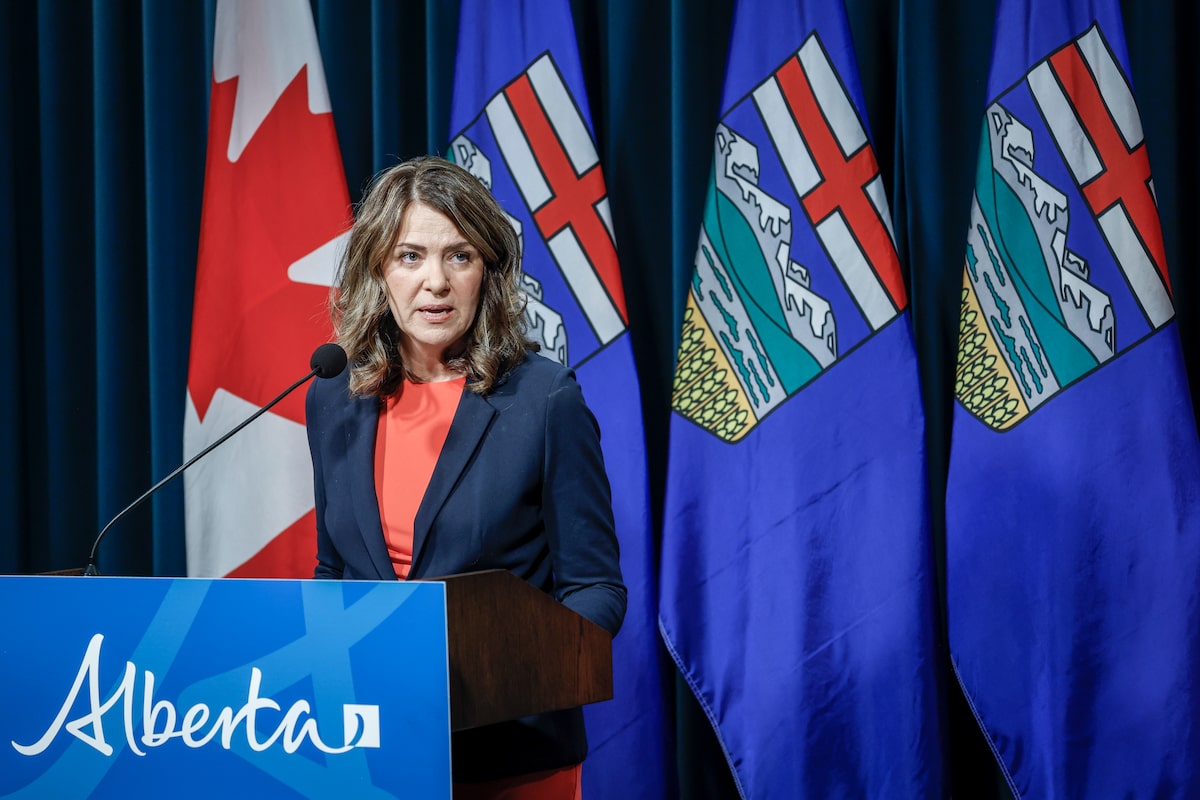
Alberta Premier Danielle Smith in Calgary, in October, 2025.Jeff McIntosh/The Canadian Press
Alberta introduced sweeping legislation Wednesday to drastically restrict medical assistance in dying, which includes barring cases where patients have incurable conditions but their deaths are not reasonably foreseeable.
The legislation, which is the first of its kind in Canada, also proposes that MAID would not be allowed when mental illness is the sole underlying condition.
Under existing federal law, patients can only qualify for MAID if their deaths are deemed reasonably foreseeable or if they have an incurable condition, such as neurological challenges and chronic pain.
Ottawa has delayed the expansion of the procedure for patients living with mental illness until next March. A special joint committee of parliamentarians will begin discussion next week on how the federal government should proceed.
Premier Danielle Smith, at a news conference on Wednesday, said Alberta is introducing the legislation because her government is “highly skeptical” of the potential expansion of MAID by Ottawa.
“Ultimately, this is about protecting vulnerable Albertans and establishing strong safeguards for a health care practice of great consequence and finality,” she said.
Editorial: A better balance is needed on medically assisted death
Alberta’s proposed legislation underscores continuing provincial pushback against Ottawa and friction over health- and justice-related jurisdiction. The government contends it is not overriding the Criminal Code of Canada, under which the criteria for MAID eligibility is established. But if the legislation passes, it could face legal challenges.
The province’s legislation was tabled nearly a decade after MAID first became legal in Canada for patients whose deaths are reasonably foreseeable. In 2021, the law was updated after a successful legal challenge in Quebec, establishing what is called “Track 2.” It applies to those living with incurable conditions but whose deaths are not believed to be imminent.
In recent months, a number of Track 2 cases have landed in court and sparked calls for change, including from an Ontario mother of a 26-year-old who struggled with mental illness and was approved to die by MAID in B.C. At Wednesday’s press conference, Ms. Smith said she was concerned about this case.
An annual report on MAID in Canada said Track 2 provisions represented 4.4 per cent of cases in 2024. Neurological barriers, as well as other conditions such as diabetes, frailty, autoimmune conditions and chronic pain, were most commonly cited as underlying medical conditions.
Opinion: In the MAID debates, the patient’s voice must take precedence
Alberta’s bill proposes that deaths should be reasonably foreseeable within one year for patients to access MAID. It also proposes barring physicians in the province from making referrals for individuals to receive MAID outside Alberta.
Additionally, it says certain health care facilities could refuse to assess patients for MAID or provide the procedure, as well as establish “exclusion zones” of 150 metres around facilities.
The bill also seeks to introduce mandatory sanctions for physicians and nurse practitioners for cases in which a regulatory college finds they have violated provincial MAID legislation.
Alberta Justice Minister Mickey Amery said the Criminal Code sets requirements practitioners need to follow to provide MAID without being prosecuted.
With this legislation, the province is not invoking the notwithstanding clause, a provision that allows governments to override certain sections of the Charter of Rights and Freedoms. Alberta has previously invoked the clause to shield other health policies from legal action.
Ontario woman calls for reform after her son ‘shopped’ for MAID approval in B.C.
Ms. Smith, referring to the Charter, said the province believes the bill is reasonable and justified. “That’s why it’s not being introduced with the notwithstanding clause,” she said.
Alberta’s New Democratic Party said it is carefully reviewing the proposed new legislation.
Lola Dandybaeva, a spokeswoman for federal Justice Minister Sean Fraser, said provinces and territories are responsible, and have jurisdiction, for health care delivery, including end-of-life services, and they have the right to develop their own MAID frameworks.
Gerard Kennedy, an associate law professor at the University of Alberta, said provincial laws can complement federal laws so long as they are done in good faith.
“This might very well be challenged for, in legal terms, pith and substance,” he said, referring to a legal principle used by courts to determine the true nature of a law.
“It is clear that this has been drafted in a way to seem like it’s regulating health care … but certain parts of it, particularly those that appear to be more concerned with outlying immoral practices, could be vulnerable to a constitutional challenge.”
It could also be vulnerable to challenges from individuals who, as a result of the legislation, are prevented from accessing MAID, Prof. Kennedy added.
Helen Long, the chief executive of the advocacy group Dying with Dignity Canada, said in a statement that she is “dismayed” Alberta is introducing legislation that “limits patient autonomy and compassion in end-of-life choice.”
“Safeguards are essential, but they should not come at the expense of access for eligible Canadians who are already navigating a rigorous, highly regulated process,” she said.
Inclusion Canada, a national disability rights organization, welcomed Alberta’s bill and said it marks a “significant step” to protect individuals living with disabilities.
The organization warns that expanding MAID beyond the end of life puts people with disabilities at risk because they lack access to supports and experience housing challenges and poverty.
The Committee on the Rights of Persons with Disabilities, a body of the United Nations, recommended last March that Ottawa should repeal Track 2 MAID and said inequality and discrimination compound suffering for patients.
The committee also said Ottawa should not support advance requests, where MAID procedures can be carried out months or years later, when patients no longer have capacity to offer consent.
Alberta’s government is seeking to prohibit advance requests, which are not permitted under Canada’s Criminal Code. Such requests can, however, be made in Quebec.
Quebec passed legislation in 2023, which the federal government did not challenge, that allowed for patients with a serious, incurable illness that leads to incapacity to apply for MAID in advance. More than 2,100 individuals have been approved for advanced requests since October, 2024.