
Woke environmental scientists want Brits to install shower meters to help close England’s vast water gap.
By 2055, experts predict that England will face a five–billion–litres–a–day water shortfall with very real risks of disrupted supplies.
With supply–side solutions not ready to pick up the slack, experts claim that consumers must tackle 60 per cent of the shortfall themselves by cutting water use.
Now, a group of researchers say that everyone should be doing their bit to cut the deficit by installing water meters in their showers.
The meters feature a timer that’s triggered as soon as you turn on the water, effectively shaming you for indulging in a lengthy wash.
Lead author Professor Benjamin Gardner, of the University of Surrey, told the Daily Mail: ‘We can all play our part by thinking about the water we use and using it more efficiently.
‘And this is not just a UK problem; water scarcity is a global issue. We’re all in this together!’
The news comes shortly research revealed that the average Brit spends 6.7 minutes in the shower – although some people indulge in far longer sessions.

Scientists want Brits to install shower meters to help cut England’s projected five billion litres per day water shortfall, with the smart timers helping to cut shower times by a quarter
In their study, the researchers surveyed 100 water professionals across 60 organisations in the UK.
These experts identified fixing in–home leaks, showering, and flushing the toilet as the three most important areas in which people could save water.
Showering typically uses about 6 to 15 litres of water per minute, and with the average Brit spending 6.7 minutes washing, that’s a potential total of 100 litres of water.
The government is currently aiming to reduce water consumption to 110 litres of water per day by 2050, meaning a long shower could blow your entire daily water budget.
Additionally, studies have shown that some people spend far longer in the shower than others.
Study co–author Professor Ian Walker, Head of the School of Psychology at Swansea University, told the Daily Mail: ‘I’ve measured a lot of people’s showers, and I don’t think I’ve ever come across an everyday behaviour which is so varied.
‘You might have two people who live in the same house, and one routinely uses 10 times more water than the other.
‘You don’t get that anywhere else – no one eats 10 times more food than the person next door.’
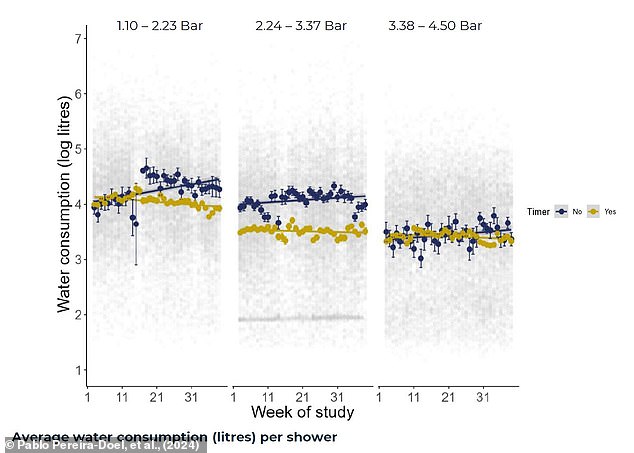
Studies have shown that simply showing someone how long they have been in the shower can cut water consumption by up to 43 per cent (middle) with a medium water pressure setting, saving 25 litres of water per shower
Psychologists say this is because showering is generally done without thinking consciously about the process.
Besides simply trying to get clean, showering is often a time to relax, unwind, and have some ‘me time’, which means people don’t tend to consciously decide how long to shower for.
This is why adding a timer or meter to the shower can dramatically cut the amount of water people use.
In one study, installing shower timers reduced the amount of time people spent under the water by 26 per cent.
Surprisingly, this even worked in hotels and hostels where people weren’t paying for their water bills.
Likewise, research conducted in university student halls of residence found that installing shower timers saved 25 litres of water per shower on average.
Co–author Sofie Voss, a PhD student at the University of Surrey, told the Daily Mail: ‘Most people do not consciously track how long they have been in the shower, and real–time feedback interrupts the autopilot mode.
‘It creates a moment of awareness, urging people to notice that time is passing and to decide to stop sooner.’

With the average person spending 6.7 minutes, even a relatively brief shower can consume up to 100 litres of water. Scientists want people to start using meters to help them cut down on the time spent under the water
The researchers add that timers can ‘gamify’ showering, with some people competing against themselves to shower faster and beat their previous record.
However, despite acknowledging the ‘looming existential crisis’ of water shortages, the researchers aren’t convinced that shower timers should be mandatory.
Ms Voss says: ‘Our research doesn’t call for immediate shower police, but it does raise the question of whether mandatory regulation or water use caps might eventually be required.’
The researchers acknowledge that forcing people to use shower meters, introducing fines for long showers, or making water more expensive might backfire.
Part of what makes the shower meter so effective is that people make a conscious choice to install it, which then affects their largely unconscious showering behaviour down the line.
Professor Gardner adds: ‘It is important that people feel that they are making a conscious decision to reduce their showering, or that they’re on board with the idea of saving water.
‘If not, then initiatives like this may prompt “psychological reactance”, where people respond by doing the opposite of what they are being asked to do, because they feel their free will is under threat.’
Co–author Dr Pablo Pereira–Doel, of the University of Surrey, told the Daily Mail: ‘While the research strongly supports the effectiveness of real–time feedback, I don’t believe that it should be mandated by law because ultimately users will decide how long to shower for.’
Agriculture, textile manufacturing and the chemical industry require enormous amounts of water.
Apparel
The apparel industry is a major consumer of water as it is integral in the manufacture of many products.
Denim is one of the worst offending products as water is needed to die the fabric in the desired colour. Indigo coloured jeans are the worst by this metric.
Levi Strauss, a leader in the sector at trying to reduce unnecessary water consumption, conducted a life-cycle assessment on their iconic 501 jeans.
They found that one pair of jeans uses 3,781 litres of water in its lifetime – from growing cotton, manufacturing, consumer care and end of life disposal.
The Better Cotton Initiative (BCI) was setup by Levi’s in 2005 to make the use of water in the industry more efficient as well as improving labour standards and increasing the economic livelihood for farmers.
BCI farmers use up to 18 per cent less water than non-BCI farmers and, by 2020, othe firm’s goal is to use 100 per cent sustainable cotton to significantly reduce our total water footprint.
Water
A report from 2017 found that the manufacture of chemicals and chemical products is the largest sub-sector in terms of volume for water usage in the UK.
This sector accounts for over one-half of the total volume directly abstracted by the manufacturing sector for consumptive uses.
Another significant sub-sector was the ‘Manufacture of paper and paper products’.
In total, these two sub-sectors accounted for approximately 70 per cent of the total volume directly abstracted for consumptive use by the manufacturing sector in England.
In a table showing the estimated volume of water from non-tidal sources in England and Wales the upper limit for the ‘manufacture of chemicals and chemical products’ was 228,427 million litres.
Farming
Farming accounts for around 70 per cent of water used in the world today and also contributes to water pollution from excess nutrients, pesticides and other pollutants.
It is used to help and advance the growing of arable crops as well as fallow land.
The cotton industry is incredibly thirsty and improper Soviet irrigation has caused the Aral Sea to shrink drastically, destroying local towns and ecosystems.