
A subtle pattern hidden in spacecraft images has revealed that rocks are actively traveling between the asteroid Didymos and its small moon Dimorphos. This quiet exchange is described as “cosmic snowballs.”
The finding, reported in The Planetary Science Journal on March 6, 2026, suggests that near-Earth asteroids are far more dynamic than previously thought. It also raises new questions about how these systems evolve, and how they might behave if they ever threaten Earth.
Binary asteroid systems are not rare. Around 15% of near-Earth asteroids have moons, making interactions like these potentially widespread. Until now, evidence of material exchange had remained indirect.
Faint Streaks Reveal a Hidden Exchange
The discovery centers on faint, fan-shaped streaks observed across Dimorphos. According to the research team led by Jessica Sunshine at the University of Maryland, these features only became visible after removing lighting variations and shadows from the original images.
“At first, we thought something was wrong with the camera,” Sunshine said, as reported in a press release published by University of Maryland. The patterns, once clarified, matched what scientists would expect from low-speed impacts. ” We were seeing were very consistent with low velocity impacts, like throwing ‘cosmic snowballs.’ We had the first direct proof for recent material transport in a binary asteroid system.”
The same source showed that the researchers traced these streaks back to a specific region near the moon’s edge, confirming they were not lighting artifacts. Their consistent geometry and placement pointed to real physical processes shaping the surface.
 Corrected lighting unveils subtle fan-shaped streaks on Dimorphos (bottom, color), hidden in the original image taken 8.55 seconds before impact (top). Credit: The Planetary Science Journal.
First Visual Confirmation of the YORP Effect
The latest research, also delivers the first direct visual evidence of the YORP effect, a process where sunlight gradually accelerates an asteroid’s rotation until it sheds material. Scientists had long inferred this mechanism, but never observed its effects this clearly.
As shown in the published findings, material likely escaped from Didymos at a speed of 30.7 centimeters per second. That is slower than an average walking pace.
“Instead of even spreading, these slow-moving impacts would create a deposit rather than a crater. And they are centered on the equator as predicted from modeling material spun off the primar,” she added.
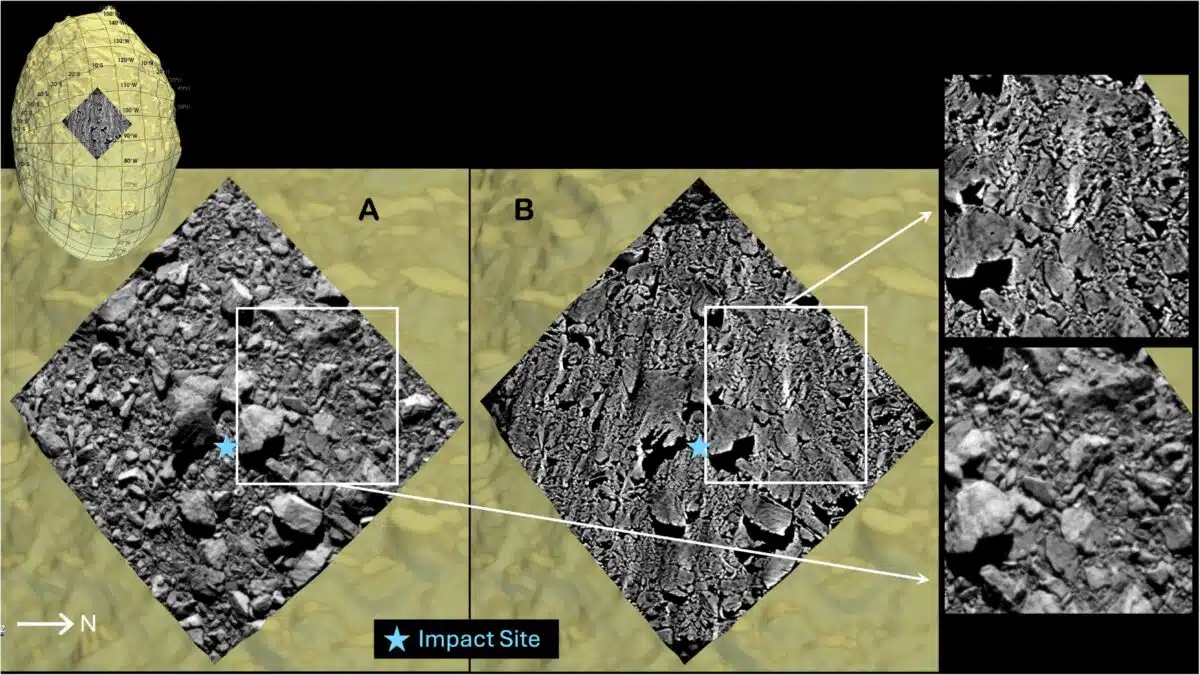 Comparison of brightness (top) and normalized albedo (bottom) at the DART impact site. Credit: The Planetary Science Journal.
Experiments On Earth Confirm The Pattern
To verify their interpretation, scientists recreated the process in laboratory conditions. As explained in the study, experiments at the University of Maryland’s Institute for Physical Science and Technology involved dropping marbles into sand mixed with gravel to simulate asteroid surfaces.
High-speed footage showed that boulders deflected incoming material, producing ray-like streaks similar to those observed on Dimorphos. Parallel simulations conducted at Lawrence Livermore National Laboratory confirmed that both compact rocks and loose dust could generate these patterns.
As reported by the researchers, these combined results provide strong evidence that the streaks seen by DART are the result of natural material exchange between the two bodies. The marks may still exist on parts of the moon untouched by the spacecraft’s impact.
The upcoming Hera mission from the European Space Agency, expected to reach the system in December 2026, could verify whether these features survived, and possibly reveal new ones formed after the collision.