
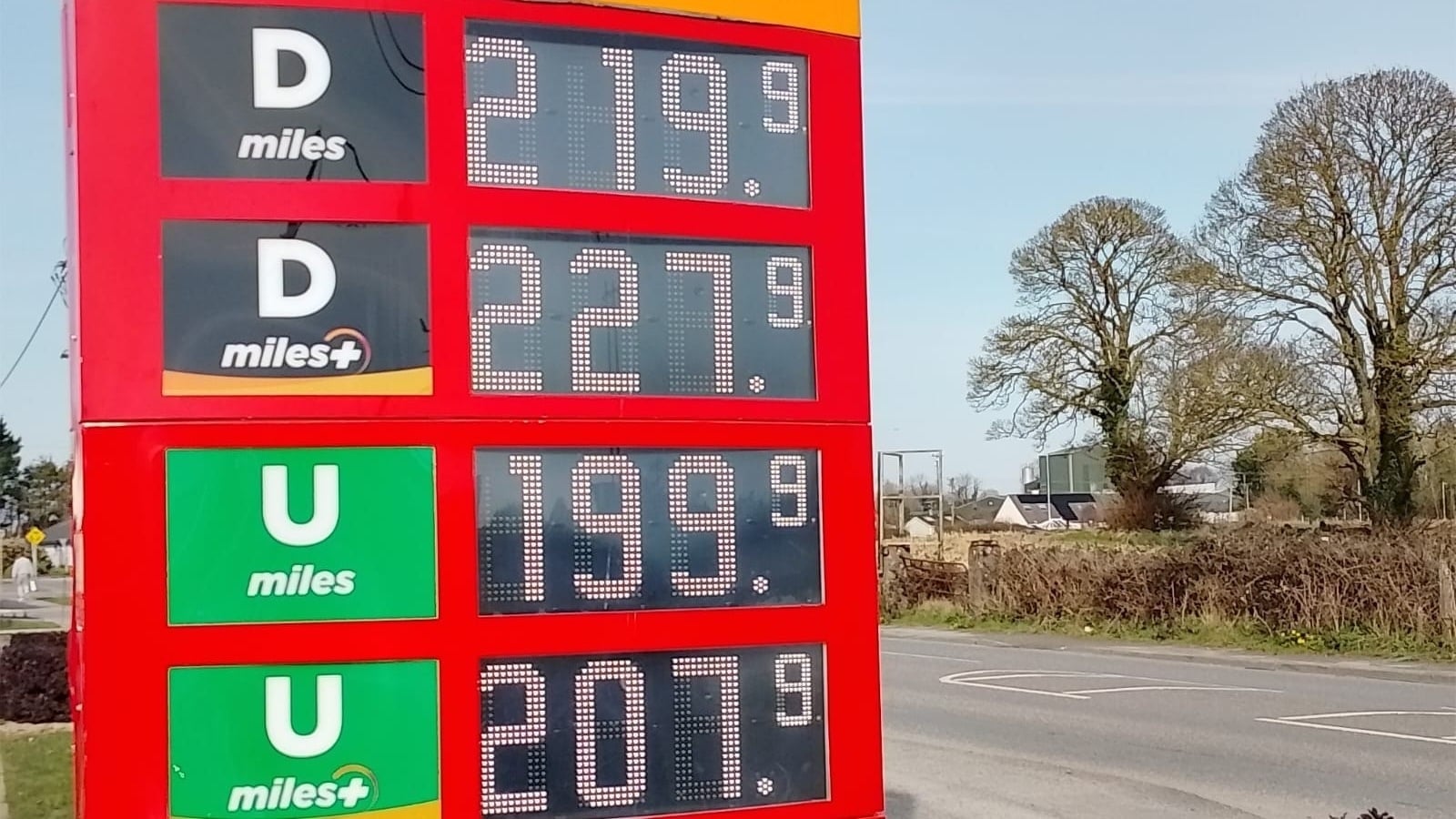
Diesel car owners are feeling the pinch at the pumps.
Prices have soared in the past month since the start of the US-Israeli conflict in Iran.
AA Ireland’s latest monthly fuel price survey is reporting an average 18 cents jump in recent weeks.
It said average diesel prices are €1.90 per litre in March, up from €1.72 in February.
These are, however, average prices, and the cost of diesel has been reported at between €2 and nearly €2.20 per litre at some locations.
Why is diesel so expensive right now?
While petrol prices have also risen, diesel drivers will feel the biggest impact at the pumps.
The obvious answer is the oil price crisis – the price of a barrel of oil was trading $114 at lunchtime.
This affects the supply chain and has pushed up the price of diesel, not just in Ireland, but globally.
Here, we are seeing the price jump by 18 cents, according to AA Ireland, or higher if you remove the average price and that is in response to the global situation.
Looking at the domestic factors in Ireland, there is high taxation on diesel which is why consumers feel it jump at the pumps.
At the start of the conflict there were questions over the quality of price competition here and whether there was profiteering going on.
However the most likely scenario for why diesel is so expensive is high Irish taxes, compounded by the world oil price.
Why do prices vary at different service stations?
This is down to price competition.
In the 1970s and 1980s there used to be a maximum price order, a legal cap where all fuel stations charged the same.
They used to compete with incentives and loyalty schemes for drivers such as Esso’s Tiger Tokens allowing customers to collect tokens for items like mugs, glasses and toys.
In 1991, the Government scrapped a policy that set a maximum price for fuel.
Since then every individual retailer is free to set their own price, allowing consumers shop around for the best value.
It is unlikely such an order would be re-introduced to address this fuel spike.
A preferred option could be for the Government to reduce excise duty.
Will prices come back down?
It is very difficult to predict the future of oil prices.
It the international situation resolves itself in any sort of reasonable time scale, then prices might recover.
Before the crisis began, analysts were expecting that 2026 would be a cheap oil year because there was a bit of a global glut and supply was plentiful.
Now that has all changed.
But the global market was in a good starting position, which is perhaps why the oil price has not gone even higher already.
If the crisis were to be resolved, oil prices might moderate downwards again quite quickly.
Whether that comes to pass depends on how geopolitical issues work out.
As of right now there does not seem to be any short-term prospect of fuel prices coming down due to international factors.
Domestically, the Taoiseach has confirmed the Government is finalising an “appropriate intervention” to address rising fuel costs.
He said the response will be finalised at the next Cabinet meeting, which is on Tuesday.
Independent motoring expert for CarZone Conor Faughnan suggested that prices could come down quite substantially if the Government reduces the excise duty.
He believes fuel is taxed too highly – “at an almost unreasonable rate”.
“We’re hoping for that at the Cabinet meeting next Tuesday, it was done four years ago, in 2022, after the Russian invasion of Ukraine, and the oil price spike that resulted then,” said Mr Faughnan.
“At that time, the Government effectively knocked 20 cent off petrol and 15 cent off diesel, and that was very helpful to the consumer at the time,” he said.
How much of every litre of diesel goes to the Government?
Despite the Government reducing prices during the Ukraine energy crisis in 2022, those taxes have gradually returned.
Over 60% of the pump price when you buy your diesel is going directly to the Government in taxes.
If the Government reduced the excise duty it would help drivers in the short term.
After that, it could be debated whether they should reapply the taxes if oil prices moderate downwards again.