
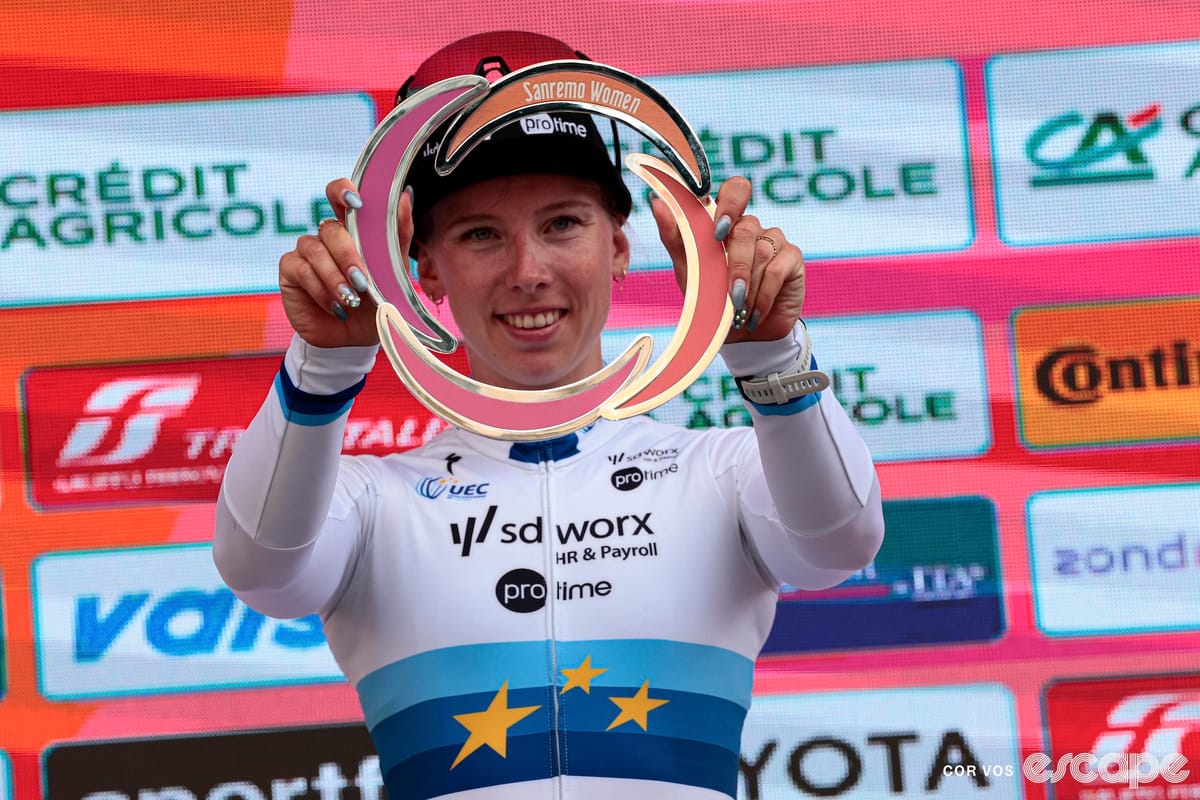
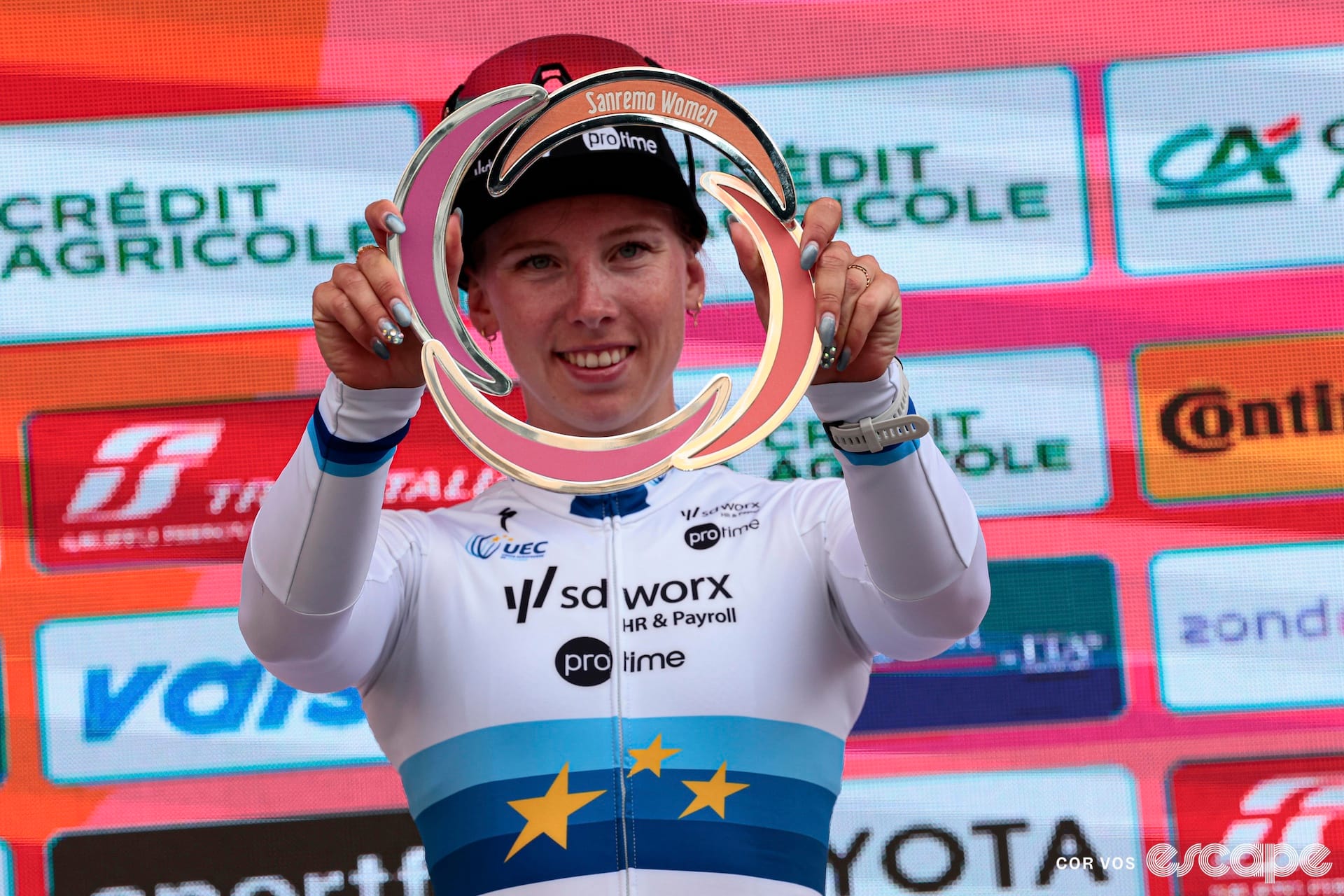
The Dutch champion is the #1 favourite, but last year’s race provides a blueprint for how she can be defeated.

Cor Vos
When the second edition of the women’s Milan-San Remo rolls out of Genoa on Saturday, one rider will stand above all others on the startlist. Lorena Wiebes (SD Worx-Protime) is the best sprinter in the peloton and has been for some years now. In fact, Wiebes might just be the greatest sprinter women’s road cycling has ever seen.
Wiebes also happens to be the defending champion at Milan-San Remo after showing last year that the iconic late climbs – the Cipressa and Poggio – aren’t hard enough to stop her from winning the Italian ‘Monument’.
So, going into this weekend, how are other teams going to prevent Wiebes from winning again and taking the 123rd win of her career?
What happened last year?
Let’s start by reminding ourselves what happened in 2025. Because while Wiebes did win the bunch sprint with relative ease, she almost didn’t get the chance.
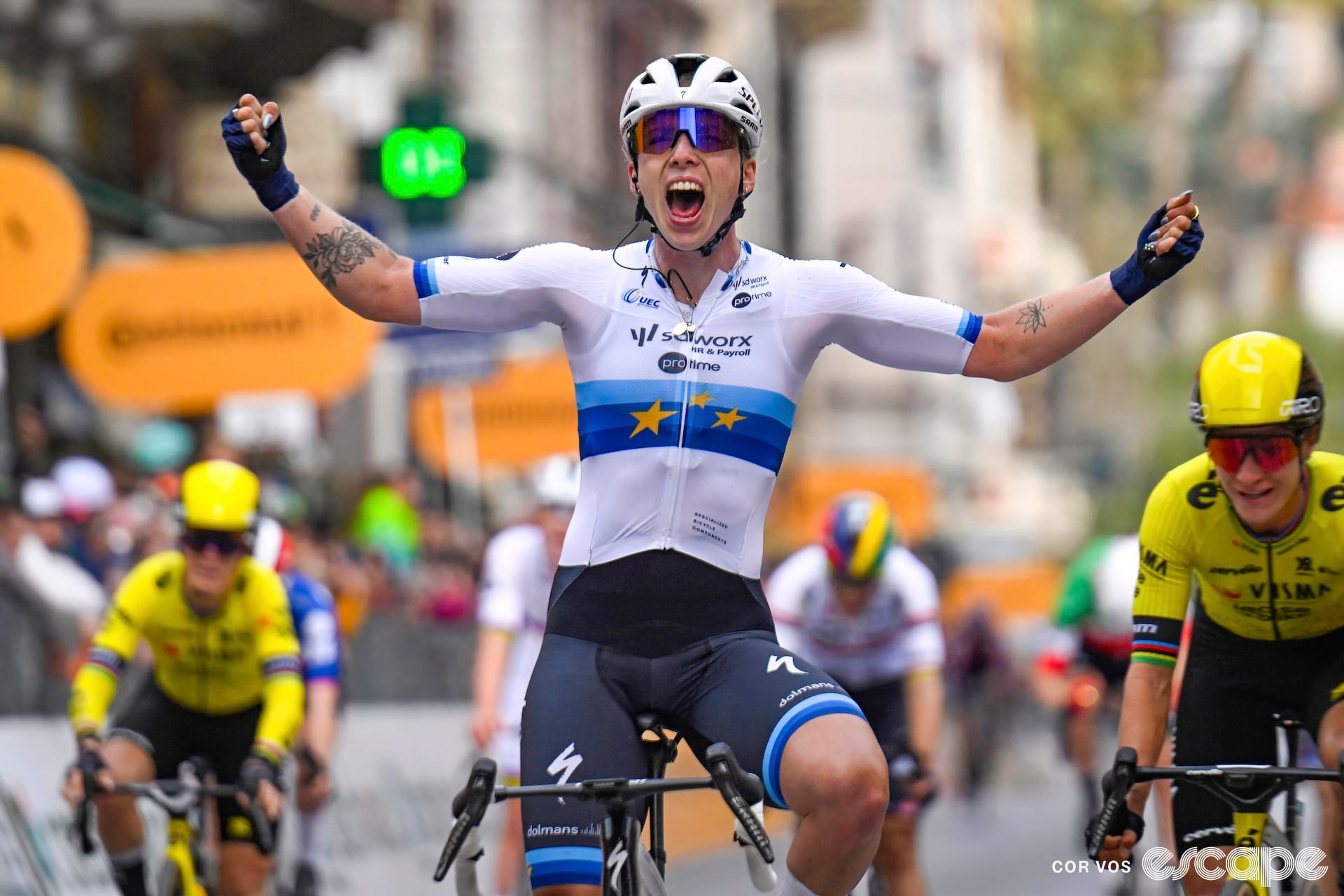 Wiebes winning the inaugural edition last year.
The pace was high coming into the Cipressa climb with 27 km to go but there were no real attacks on the climb itself, which was something of a surprise. UAE Team ADQ, FDJ United-Suez, and Lidl-Trek did most of the pacemaking on the front, but Wiebes looked very comfortable the whole way up.
The descent off the Cipressa proved more decisive than the climb. Pauline-Ferrand Prévot (Visma-Lease a Bike) did the initial damage and by the time the descent was over, just 12 riders were left at the front of the race. It did all come back together, though, on approach to the Poggio.
Ceciie Uttrup Ludwig (Canyon-SRAM zondacrypto) led most of the way up the climb, for Kasia Niewiadoma-Phinney. There were a few attacks on the way up, but nothing of any real consequence, leaving Wiebes in a group of around 15 over the top.
That group strung out on the descent but the big move came from Elisa Longo Borghini (UAE Team ADQ) with just over 2 km to go, at the bottom of the Poggio descent. At that moment, with no one having any teammates in the group behind to help chase, Longo Borghini got a gap that she very nearly held to the line.
In the end it was only a brilliant effort by Wiebes’ teammate Lotte Kopecky that made the difference. Kopecky bridged to the Wiebes group with 1.5 km to go, came straight to the front, and ultimately caught Longo Borghini inside the final 200 metres. From there Wiebes won the sprint comfortably.
So for the teams hoping to prevent a repeat of last year, how might they be approaching Saturday’s race? Let’s run through some options.
An early breakaway?
We’ll almost certainly see an early break (or several) get up the road on Saturday. There’s more than 100 km of mostly flat coastal roads before the climbing begins – plenty of opportunity for the smaller teams to bank some TV time and dream of a situation like last year’s Omloop Nieuwsblad, where the break was given too much leeway.
In reality, it’s hard to see SD Worx-Protime (or the other sprint teams) letting the same happen here, in a race which should be decided in a reduced bunch sprint.
There’s a world in which a large group gets off the front early, and SD Worx-Protime are happy to let it go because they have a few riders of their own up there. That might be one scenario in which Wiebes doesn’t win, but SD Worx-Protime still might, if the likes of Kopecky or Blanka Vas are up there.
Regardless, it feels unlikely the race will unfold in that way. It’s more likely that the best chance of thwarting Wiebes will come later in the race.
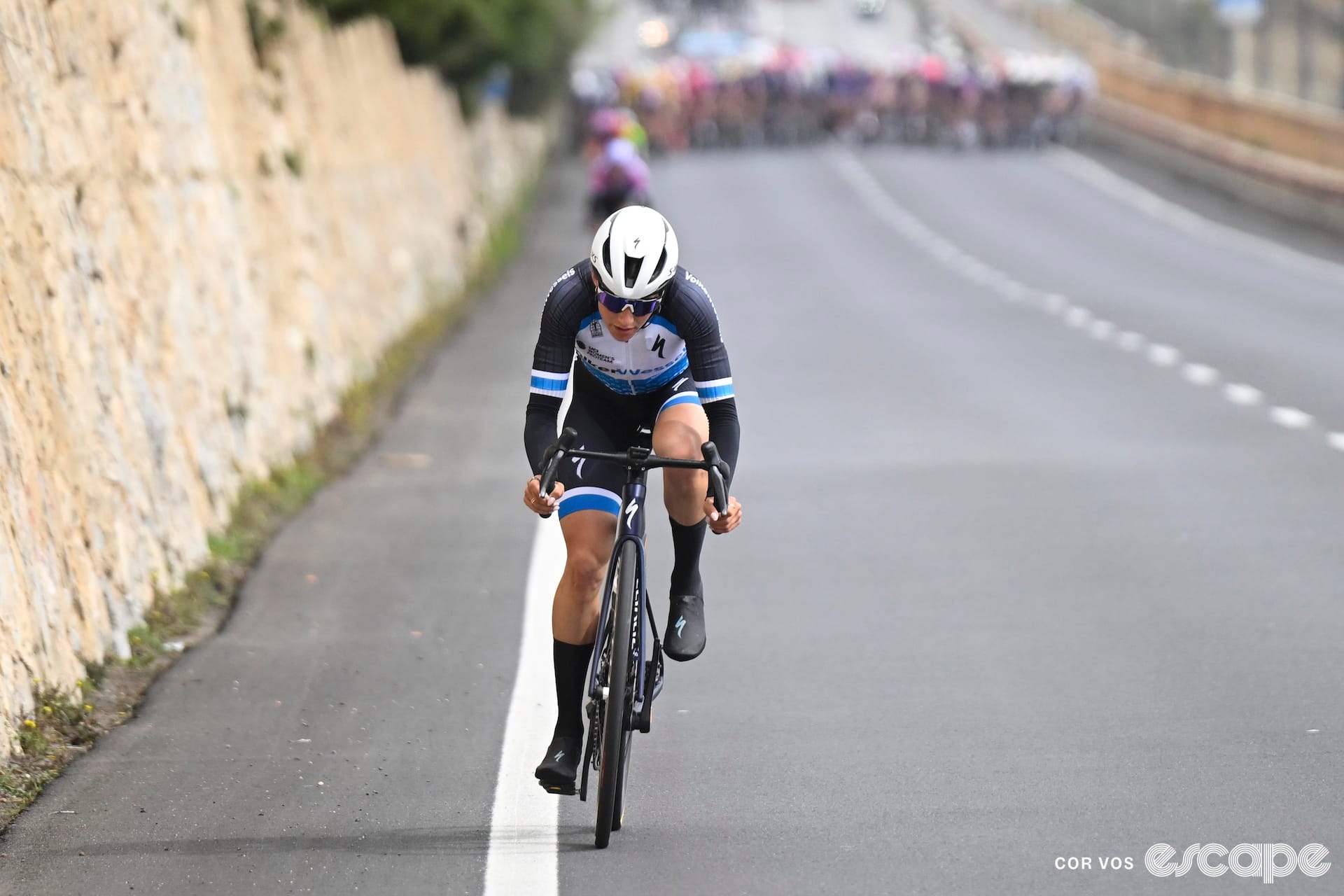 It’ll take more than one rider for the early break to have an impact on Saturday.Pressure on the climbs?
There are five climbs in the final 55 km of the race that, in theory, provide the sort of terrain that might be useful for those looking to ride a sprinter out of the wheels. The Tre Capi – Capo Mele, Capo Cervo, and Capo Berta – whet the appetite, before the arrival of the Cipressa and Poggio – the most decisive of the lot.
In reality, and based on what we’ve seen of Wiebes’ climbing in recent years, there’s no reason to suggest that simply riding a high tempo in the bunch on Saturday is likely to dislodge her. The climbs aren’t steep enough, and Wiebes climbs too well (a reminder that Wiebes won Leeuw-Oetingen last week by attacking on the final climb and dropping all bar one rider).
A well-timed attack on Saturday’s late climbs though? That might be more effective at shedding Wiebes.
This post is for subscribers only
Subscribe now
Already have an account? Sign in
Did we do a good job with this story?
👍Yep
👎Nope