
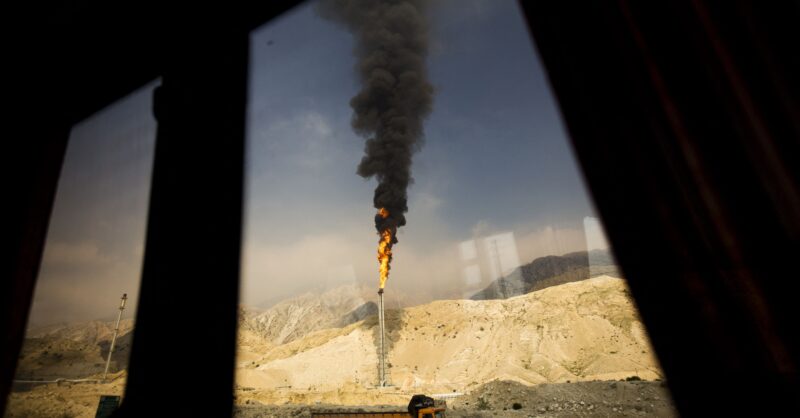
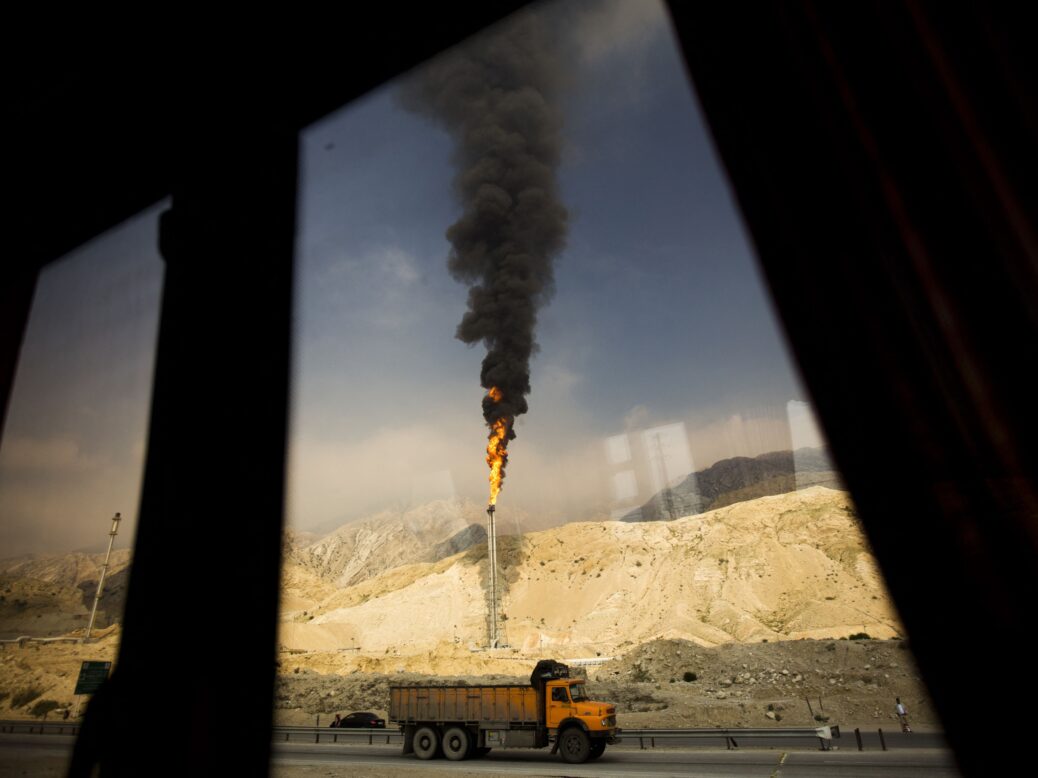
A gas flame is seen through a bus window in the South Pars gas field facilities in the southern Iranian port of Assaluyeh. Photo by Behrouz Mehri/AFP via Getty Images
Motorists queue for hours to top up tanks they do not yet need. Petrol stations across the country run dry within days. The NHS is placed on an emergency footing, supermarket shelves are stripped back by panic buying, and some schools are forced to close. That sequence of events has already happened once in my living memory, during the September 2000 fuel protests. The uncomfortable question now is how easily it could happen again.
Speaking as the current crisis unfolds, the energy expert and former policy adviser to Gordon Brown, Nick Butler, warns that fuel shortages are no longer a distant risk. They are looking increasingly likely in the next few weeks. “People said to me that this could start panic-buying quite soon,” Butler told me recently. “I hope it doesn’t happen. But sentiment and concern about the future often drive markets.” Iran’s effective closure of the Strait of Hormuz is already impacting markets, even more so after both Israel’s strike on Iran’s South Pars gas site and Iran’s retaliatory strike on energy facilities in Qatar. And the longer the conflict in the Middle East continues, the more pressure will build.
“It’s cumulative,” Butler said, “because each day that Hormuz is closed, that oil – which is 20 per cent of normal supply and consumption – is just not getting to the market.”
Markets are already reacting as if shortages are coming. A barrel of Brent crude rose to over $114 on Thursday 19 March – an increase of more than 50 per cent since the war with Iran began on 28 February. According to the RAC, petrol prices in the UK have risen by 9.8p per litre over the same period, and diesel by 20.3p – increases of around 7 and 14 per cent respectively, with further rises anticipated. And there are anecdotal reports of petrol stations rationing fuel and imposing maximum spends per visit – early signs, perhaps, of a pattern the UK has seen before. As in 2000, the risk is not just the shortage itself, but the public reaction to it.

Subscribe to the New Statesman today and save 75%
As demand increases for dwindling supplies, the government, Butler argued, will have to step in. He said it must first protect the key areas of the economy: the health service, schools, and our food supply. “I think if you protect those areas, then that takes a fair amount of supply off the market,” he added, “and then I think the government will have to look seriously at how it handles the rest of the market.”
If shortages do materialise, they are likely to spread through the economy in ways that go far beyond queues at petrol stations. Professor Lucy Easthope, an expert in emergency planning who advises central and local government, believes some damage has already been done from three weeks of conflict. “That’s enough to do harm to prices, harm to inflation, harm to world stability, and specifically harm to things like our fuel supply,” she said. “There’s no doubt we’re heading for a very difficult winter.”
The longer the disruption continues, the more likely it is that the effects begin to cascade – turning a supply shock into something that looks much closer to the kind of systemic disruption seen in 2000, but on a broader scale. Take food. Tom Bradshaw, president of the National Farmers’ Union, said the crisis could mark the “start of the next inflationary cycle in global food production”, as the sector is so independent on fossil fuels – from red diesel for machinery to natural gas for heating greenhouses and producing fertiliser.
Food prices have already been impacted, Bradshaw said. Imported fruit and vegetables have become more expensive due to higher transport costs. For British farmers, the immediate concern is whether they can afford to heat greenhouses at the start of the growing season for crops like tomatoes, peppers and cucumbers. Some producers secured gas contracts in advance. But others are exposed to the spot market, where prices had roughly doubled even before the most recent strikes on core energy facilities in the Middle East. Farmers cannot absorb increases on this scale. How much is passed on to consumers will depend on how big a hit retailers are prepared to take.
Uncertainty is compounding the problem. In some cases, Bradshaw says, farmers have been unable even to obtain prices for fertiliser or fuel on certain days. When they can, they are often being asked to commit to buying without knowing the final cost. “It’s the first time I’ve ever been in that position,” Bradshaw said. “And I’ve been responsible for buying diesel for 25 years.” Where supplies are available, he said, prices for red diesel have in some cases risen by as much as 75 per cent.
The next few weeks will be critical. Spring crops must be planted by early April. If fuel and fertiliser remain scarce or prohibitively expensive, some farmers may choose not to plant at all – raising the prospect of supply shortages in grain later in the year. Irrespective of how long the war in Iran continues, experts are calling on the government to relay a plan. But Butler fears ministers are still adjusting to the scale of the problem. “I think it’s so new to them,” he said. “They lived in hope for some time that this would be a very short war. I think they’re now adjusting to the possibility that it goes on for several weeks.”
The UK does have a National Emergency Plan for Fuel, which sets out measures such as prioritising emergency services vehicles, limiting fuel purchases and releasing strategic reserves. Only a summary is public, and it’s understood that the government is reviewing it. The question is whether those tools are sufficient for a crisis of this scale.
For Easthope, the issue is not just the plan, but also whether the government had fully anticipated the scenario it now faces. “If [the Iranians] didn’t shut down the Strait of Hormuz, then we go, ‘hurrah’. But it’s much better to work on the principle they will,” she said. And, she maintained, they should have. It was, she contends, “a very likely scenario”. There is also the risk that reassurance delays preparation. “What I’m seeing civil servants do is, if a minister says on TV, ‘It’s not a problem, the solution is diplomatic,’ they don’t plan for the next stage,” she said.
For most households, the consequences of an ongoing conflict in the Middle East are becoming visible. The effects extend beyond the petrol pump. Air travel costs are rising and interest rates have remained steady (rather than be cut), which has pushed mortgage costs up as lenders withdraw their best deals.
The government has indicated it might step in to help with rising energy bills if necessary. But such support cannot be open-ended. Bradshaw argued that limiting the knock-on effects – particularly in food production and supply – might ultimately require intervention in energy markets, potentially including price controls. The difficulty, he acknowledges, is we simply don’t know whether that is a realistic proposal or not. “None of us know how long this situation is going to carry on for,” he said.
Which brings the question back to where it began. Britain has seen how quickly fuel disruption can spill over into everyday life – how queues form, how behaviour changes, how pressure spreads from forecourts to hospitals, schools and supermarkets. Whether it happens again will depend on forces far beyond the government’s control. But how closely this crisis comes to resembling that experience – and how painful it becomes – will depend on how prepared it is for the possibility that it might.
[Further reading: The battle for the Strait of Hormuz]
Content from our partners