
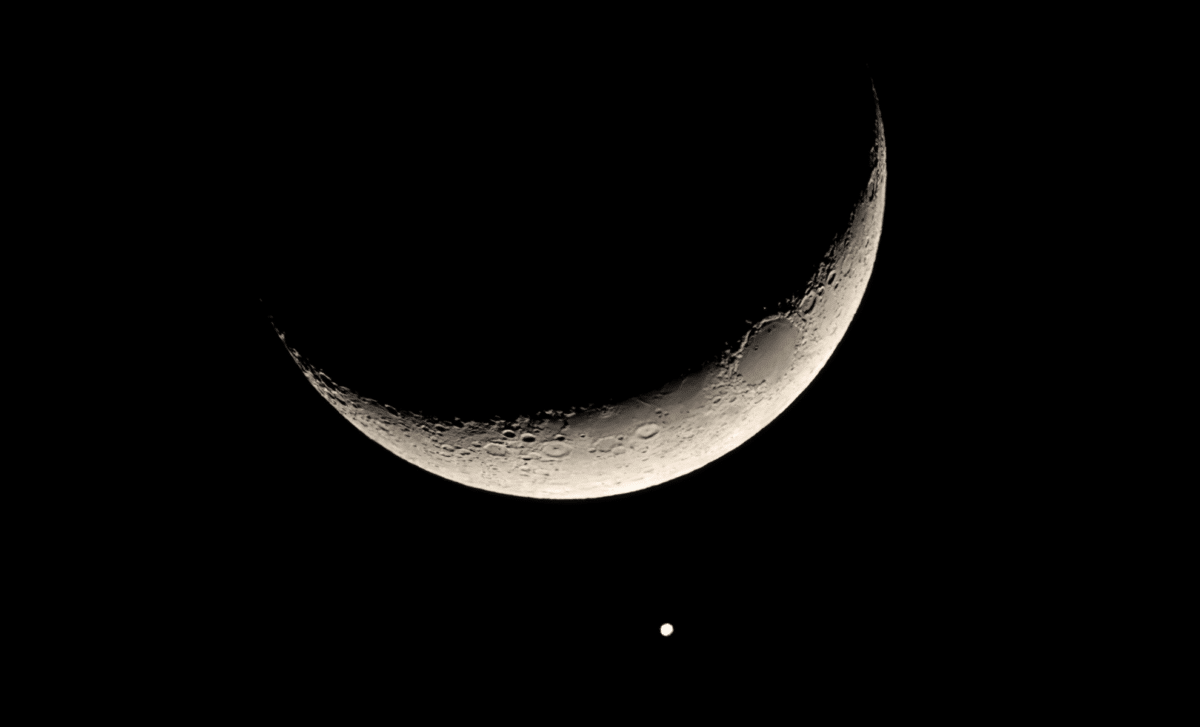
Tonight, March 19, skywatchers will witness one of the rarest and most breathtaking sights of the year as Venus, known as the “Evening Star,” guides observers to a razor-thin crescent moon. Less than 24 hours old, this young moon will appear alongside the brilliant planet in a celestial spectacle that few will ever see in their lifetime. This unique alignment is a fleeting moment, presenting an opportunity for enthusiasts to observe an extraordinarily delicate moon that is just 1% illuminated. If weather conditions cooperate, this will be a chance for stargazers to connect with the universe in an unforgettable way.
The Cosmic Connection: Venus Points the Way
As dusk settles on March 19, Venus will light up the twilight sky, a beacon for those hoping to spot the moon. According to Space.com, the evening’s sky is expected to remain bright, but once the sun dips below the horizon, Venus, the second planet from the Sun, will shine brightly in the west, almost as if it’s inviting viewers to look closer. Positioned just below Venus, the crescent moon will be an incredibly challenging yet rewarding sight for those with a sharp eye. At barely 20 hours past the new moon, it will be one of the youngest moons visible this year.
The key to spotting this moon lies in the position of Venus. The planet’s light will serve as a guide, making it easier for observers to locate the moon. The young crescent will appear 7 degrees to the lower right of Venus, a crucial piece of information that will help amateurs and seasoned astronomers alike find the sliver of lunar light. The moon will be perched low in the sky, around 2 to 5 degrees above the horizon, which means it won’t be visible for long. Time is critical, viewers should aim to step outside 30 to 60 minutes after sunset to catch the celestial dance between Venus and the moon.
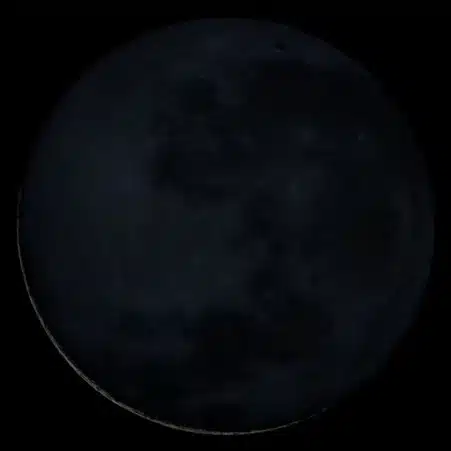 To get an idea of just how thin the crescent moon will appear on March 19, little more than 1% of the moon will be illuminated, creating an arc that subtends less than 180 degrees along one side of the lunar limb.
Image credit: NASA Scientific Visualization Studio.
A Moon Like No Other: The Science Behind This Phenomenon
In order to fully appreciate this event, one must understand just how thin the moon will appear. According to Space.com’s Joe Rao, the moon will only be about 1% illuminated, creating a razor-thin crescent that stretches just 130 degrees around the lunar rim. For perspective, this is far less than a typical crescent moon, where the illuminated arc usually spans about 180 degrees. The thinness of this moon is a rare phenomenon, especially since new moons typically leave the sky darker, offering no moonlight at all. With the waxing crescent moon just emerging from the new moon phase, its delicate arc will almost seem fragile, a perfect moment for skywatchers to observe this cosmic rarity.
Moreover, the timing of this event is exceptional. The March equinox, occurring just the following day, will align the ecliptic path of the Sun, Moon, and planets in such a way that the crescent moon will appear almost directly above the sun’s setting point on the horizon. This positioning ensures the moon’s visibility in a way that’s nearly impossible to replicate in other seasons, making tonight’s observation even more special.
When and Where to Watch: Best Viewing Locations for the March 19 Event
To catch this rare event, skywatchers should position themselves somewhere with a clear view of the western horizon. The best locations are open fields, parks, or areas away from city lights. A flat landscape will allow a direct line of sight to the setting Sun and the distant planets. The event will be visible across much of the Northern Hemisphere, including parts of North America, Europe, and Asia.
For those living near major cities, it’s essential to find a spot free of buildings or tall trees that could block the view of Venus and the moon. Since the moon will be low on the horizon, any obstruction could easily prevent its visibility. The best time to observe the moon is between 30 to 60 minutes after sunset, when Venus is bright enough to guide observers to the moon’s exact location. A pair of binoculars may be useful for spotting the young moon if it’s too faint to see with the naked eye. However, many first-time viewers will find the crescent visible with just their eyes if they focus on the sky in the right place.