
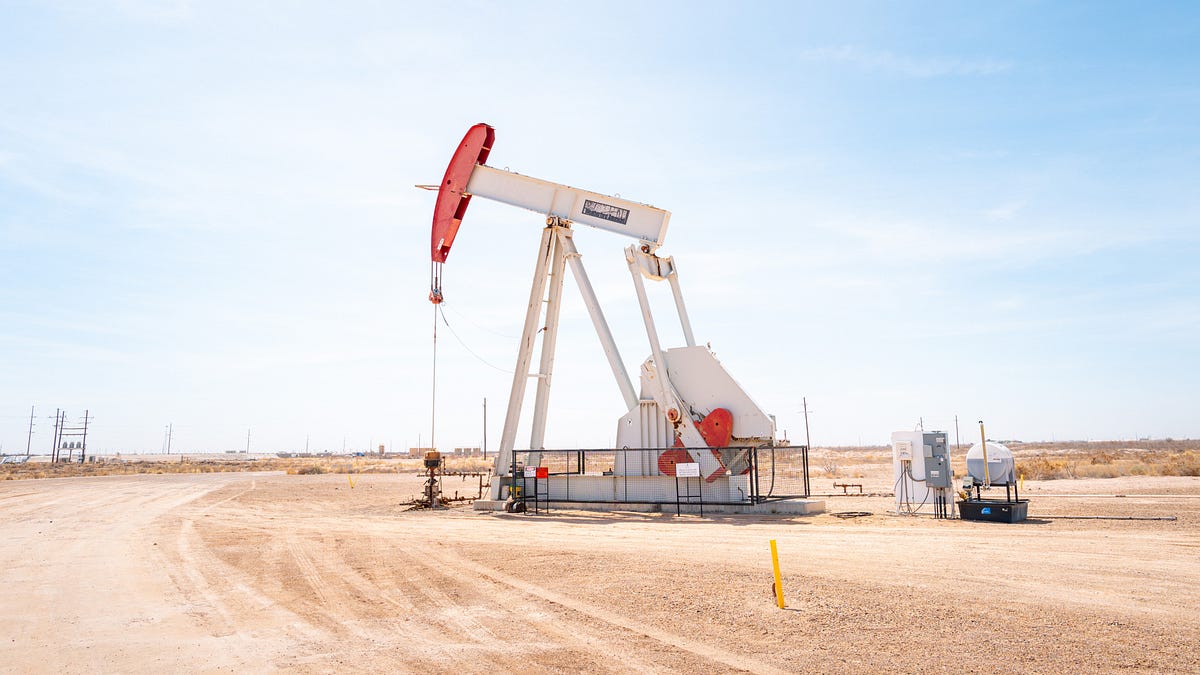
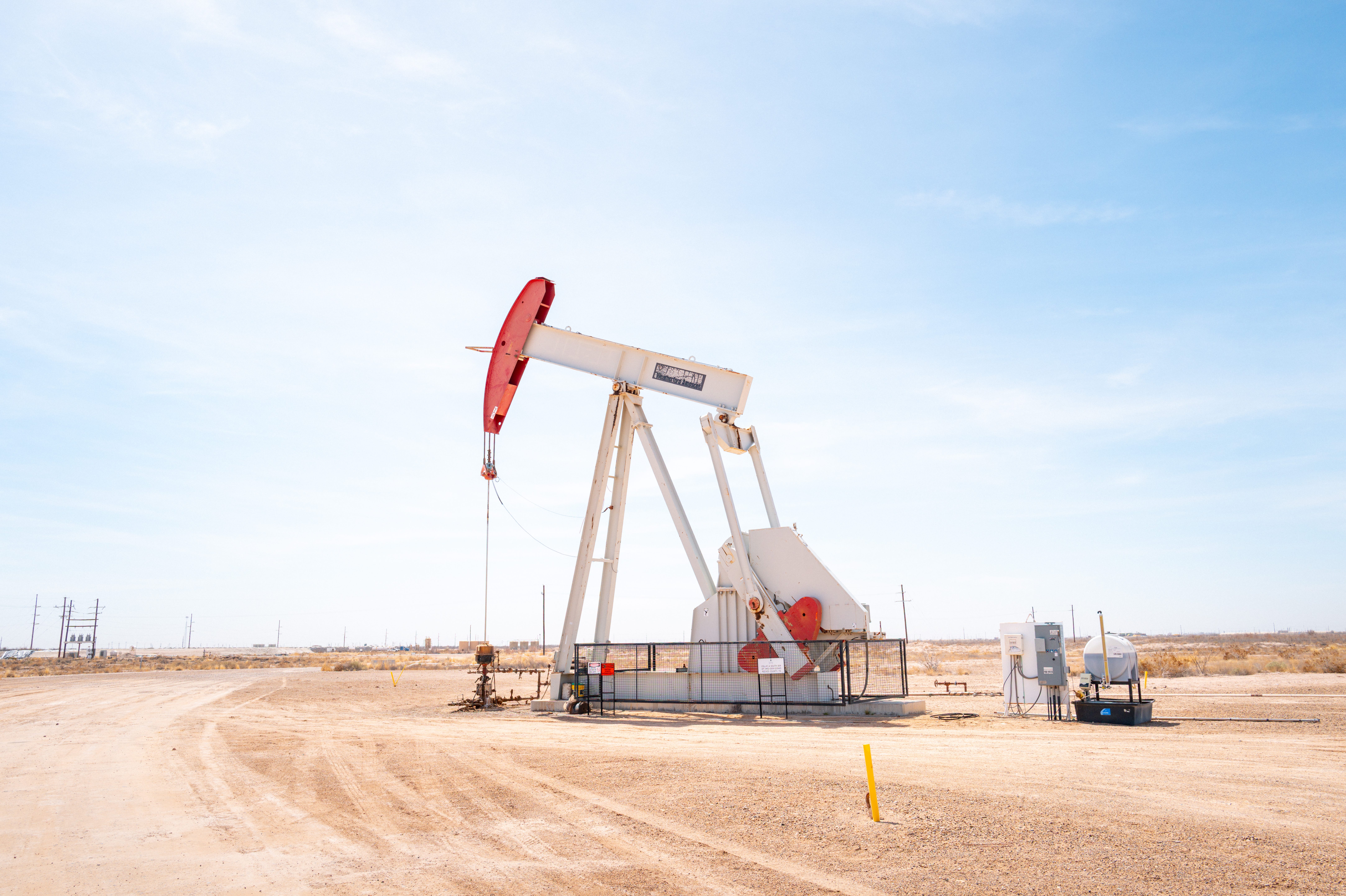
 A pump jack is seen in a field on March 18, 2026 in Pecos, Texas. Oil prices have risen roughly 4 percent as the recent conflict involving Iran, the United States, and Israel has heightened global concerns over energy costs. (Photo by Brandon Bell/Getty Images)
THE IRAN WAR HAS BROUGHT the dreaded r-word—recession—back into play amid a deeply fractured global energy market. To be clear, a massive downturn is not inevitable, nor can we even say it’s more likely than not. Recent surveys of economic forecasters place recession odds over the next year at about a third.
But those surveys were at least partly fielded before recent escalations in the war. And historically, oil shocks have preceded recessions in the United States (and elsewhere). So it’s worth walking through why this war and its resulting supply-chain disruptions have significantly raised the odds of recession—and what that outcome would actually look like. Buckle up. . .
Even before the war, the U.S. economy was showing serious signs of fragility.
Inflation has been above the Federal Reserve’s target of 2 percent for five years now, and Donald Trump’s trade wars have contributed to rapid price growth. For example, wholesale prices rose sharply in February (i.e., before the war began). Meanwhile, job growth has also sputtered; Fed Chair Jerome Powell said in a press conference Wednesday that if you adjust for what Fed staff thinks may be “overstatement” owing to methodological challenges, there has been effectively “zero net job creation in the private sector” over the past six months. And uncertainty (related to trade wars, regulatory changes, various rule-of-law-type risks) has also been a drag on economic growth.
That was the grim baseline prior to the war. Now layer on to those conditions a global oil shock.
Oil prices have been extremely volatile since the war started. Brent crude briefly surged above $119 per barrel on Thursday morning, then fell back and settled around $108. Fuels made from crude have become painfully expensive, with diesel prices nationwide now above $5 per gallon, and gasoline prices inching toward $4 per gallon. In much of the western United States, they’re already well above that milestone.
Jet fuel prices have likewise nearly doubled in the past month, leading to higher airline fares and canceled flights.
And needless to say, this is not only a U.S. story. Petroleum product prices have shot up even higher in Europe and Asia, leading to fuel hoarding and social unrest. The same holds true for liquefied natural gas prices, although the United States is relatively insulated from that hike because we produce so much LNG ourselves.
Obviously, high fuel prices are frustrating for consumers, who see billboard advertisements on their drive to work every day reminding them how expensive gas keeps getting. But fuel prices don’t just feed into inflation; they also have enormous consequences for global economic growth.
That’s because demand for fuel is pretty “inelastic,” meaning it’s hard for consumers or companies to cut back how much they buy when prices rise. People have to buy gas to commute to work or take their kids to school. Companies have to buy fuel to run their factories or keep the lights on. This means that when fuel prices rise, the buyers of fuel must grit their teeth, spend the money, and then cut back spending on other things.
Think about it this way: American consumers are collectively spending an extra $300 million per day on gasoline compared to about a month ago. That $300 million is now unavailable to purchase other goods and services in the economy, because so much disposable income has been gobbled up by gasoline.
We’re not there yet! So if you’re inclined to spend your disposable income on a product worth the price tag, let me suggest a Bulwark+ membership:
In an economy driven by consumer spending, this can get very painful very quickly. When businesses lose customers, they cut back on their own investment and staffing. Their laid-off workers in turn cut back on their own spending, which contributes to further layoffs. And companies are dealing with their own higher input prices, thanks to the war. Which makes hanging on to staff even harder.
This is exactly the kind of vicious cycle that causes recessions.
The risk of falling into a doom loop like this was apparent the moment the Strait of Hormuz was effectively shut down, and oil prices shot up. But many hoped the strait might quickly reopen and the shock would be short-lived.
That hasn’t happened. And there’s now no way we can return to the antebellum status quo quickly—or perhaps ever.
That’s because, in a significant escalation, both sides in the conflict have now started targeting energy infrastructure. On Wednesday, Israel bombed Iran’s South Pars gas field, the largest natural gas field in the world and a major lifeline for Iran. Subsequently, Iran attacked the world’s largest LNG facility (located in Qatar, whose LNG exports will as a result be down by almost a fifth for up to five years) and it has targeted a host of other natural resources, refineries, and other processing facilities in the United Arab Emirates, Saudi Arabia, Kuwait, and Israel. (The AP put together this useful map of major energy infrastructure sites that have been hit so far.)
Destroying fuel-producing infrastructure is fundamentally different from temporarily blocking a fuel transit passageway. When infrastructure is gone, it’s gone. It could take years to rebuild.
And energy is hardly the only supply chain to get snarled. Fertilizer prices have skyrocketed just in time for spring planting season. That will contribute to higher food prices. (As well as higher diesel prices, for that matter, because farmers use diesel to power their tractors and other equipment.)
The generic drug industry is also under pressure. Key chemical inputs used in pharma production transit through the Strait of Hormuz to India, which produces nearly half of U.S. generic drug prescriptions.
In forecasts generally collected before this recent escalation in the war, economists had already begun raising their forecasts for inflation this year, and reducing their forecasts for growth. It’s hard to see that outlook getting any better.
The other tricky thing about all this is that there aren’t a lot of policy levers available to fix these economic problems, particularly when they happen in combination.
Normally, when the Fed worries about a slowdown or recession, it would cut interest rates. But cutting rates seems like a bad idea when prices are also rising, since normally the response to rising inflation is to raise interest rates. This is fundamentally why “stagflation” sucks so much. It’s not only painful to go through both inflation and stagnation at the same time. It’s also really hard to solve both at once. Whatever you do to fix one problem inevitably makes the other one worse.
Broad-based fiscal remedies—such as sending out stimulus checks or cutting taxes—also risk stoking even more inflation, particularly if people start to anticipate higher prices. And in much of the world, fiscal remedies are not particularly viable options anyway. That’s because sending out checks or otherwise shielding consumers from high fuel prices would require taking on additional federal debt, which the countries feeling the war’s economic effects most acutely can’t afford to do.
The Trump administration has taken other measures to get more oil flowing—such as suspending the Jones Act, releasing oil from strategic reserves, and loosening sanctions on Russia and Iran. But those will only modestly affect prices, and they involve major non-economic tradeoffs, to say the least.
There are (metaphorical) ticking time-bombs planted around the global economy that are unrelated to what’s happening in Iran. And if we are unlucky, some or all of those bombs might explode in short order. Among them:
The AI bubble could burst. This could take down much of the stock market. As Apollo’s Torsten Slok recently observed, markets have gotten extremely concentrated in AI stocks: “The 10 biggest companies in the S&P 500 make up almost 40% of the index, and if Anthropic, OpenAI and SpaceX are added later this year, the concentration could approach 50%.” The real economy would be affected, too, since AI-related investment in things like data centers and software has driven an uncomfortably large portion of American GDP growth over the past year.
Even if the AI bubble bursts—in the sense that some companies pull their investment in data centers, etc.—AI is still going to displace a lot of white-collar jobs. I see that as mostly a longer-term issue rather than something that would materially affect employment in the next year, but a faster time frame is certainly possible. Particularly if employers are suddenly in a rush to find savings.
“Private credit” markets could collapse. This is a corner of the financial sector in which non-bank companies (such as private equity firms) issue loans with relatively little regulation or oversight. There have been some blowups in private credit markets recently, after multiple businesses backed by private credit companies went belly-up. (“When you see one cockroach, there are probably more,” JPMorgan Chase CEO Jamie Dimon warned last fall.)
These risks may all seem different, but they can feed into and exacerbate one another. For example, maybe higher input prices caused by the war make replacing workers with AI more attractive. Or maybe one overleveraged, distressed company blows up, causing other investors to look around and re-evaluate their market positions. Maybe some of them say, ‘Hey, why is 50 percent of my portfolio in AI? Maybe I should sell some stuff.’
Again, none of this is inevitable. And much of it isn’t even Trump’s fault! But if we get unlucky, things could go south pretty fast. And not just south but really south.
— The Pentagon has asked the White House for an additional $200 billion, according to the Washington Post. This suggests either that running costs of the war are much higher than previously estimated ($1 billion to $2 billion per day), or that the Pentagon expects the war to last much longer than it claims. Or both.
— On Wednesday, Fed Chair Powell said he planned to stay on the Fed Board even after his term as chair ends in May, at least until the DOJ’s bogus investigation into him is dropped. Or maybe longer than that; he hasn’t decided, and his term on the board technically lasts another two years. It is very, very unusual for a Fed chair to stay on the board after their chair term ends. To my knowledge it’s happened twice in history, most recently when Arthur Burns stuck around in 1978 to help with a transition.
— A majority of Canadians say it’s better to depend on China than on the United States under Trump. For other key allies—Germany, Britain, France—a plurality say the same.
— Does Trump know his favorite shoe company is suing him over his tariffs?
— This whole article about the pardon-lobbying industrial complex makes me want to take a shower.