
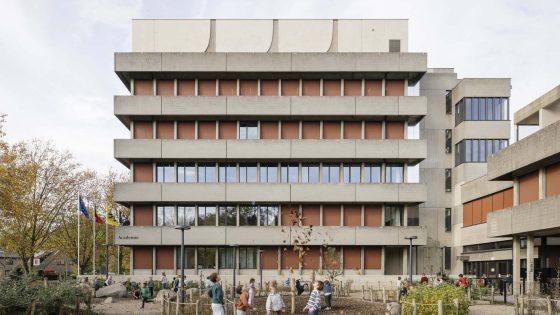
A brutalist town hall in Belgium has been comprehensively renovated and remodelled as the multi-functional community hub containing a range of uses including a school, library, art academy, police station and municipal administration office.
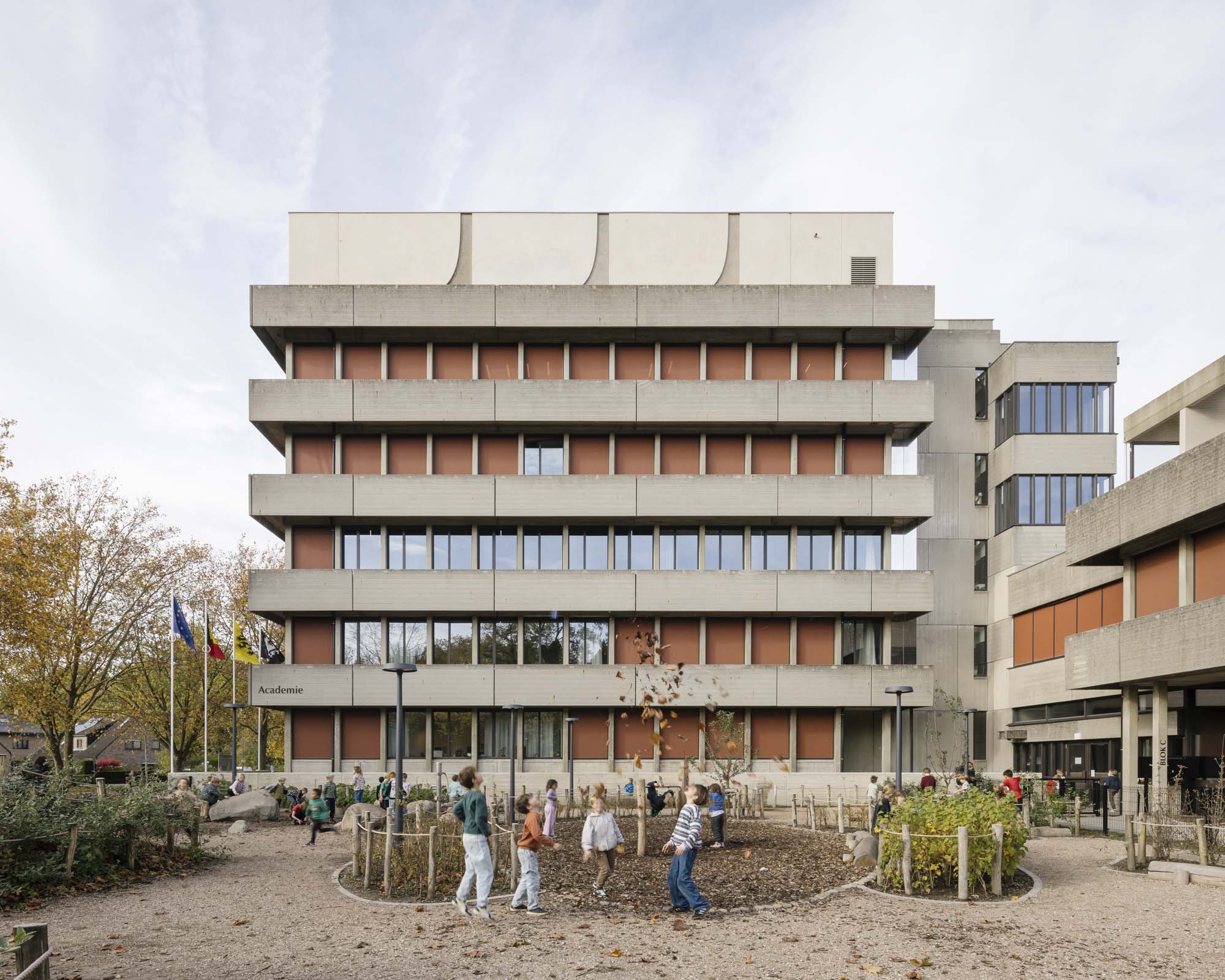
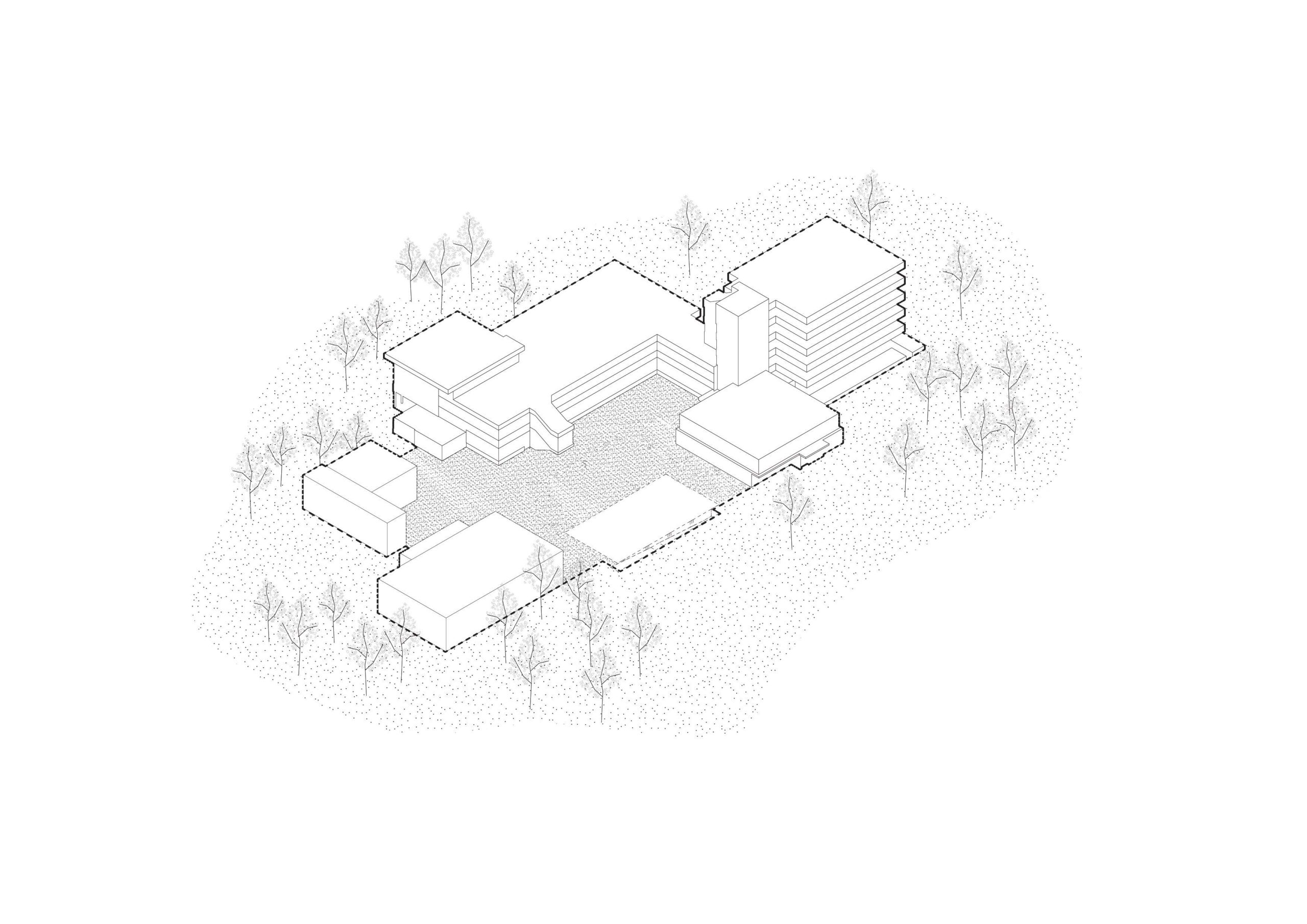
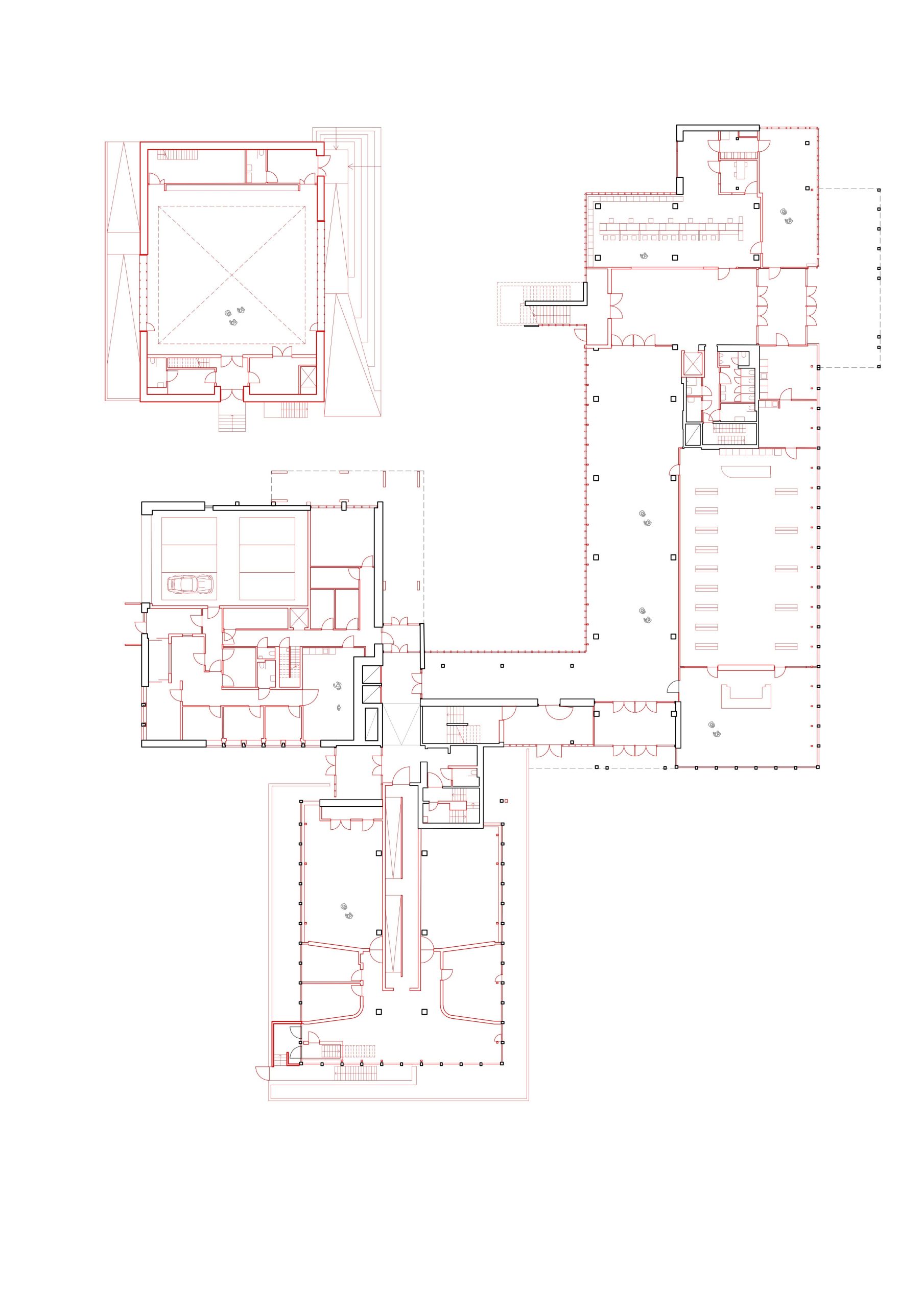
Designed by Paul Felix in the 1970s and sitting adjacent to Gentbrugse Meersen park on the outskirts of Ghent, the original ensemble of three buildings forms a linked composition. These have each been crowned by a rooftop extension. A fourth building, containing a small performance hall, extends this composition, loosely enclosing a courtyard formed by the existing buildings.
This upgraded and extended complex, renamed De Felix after its original architect, has deliberately sought to continue the spirit of the original building, preserving and reusing as much of the existing fabric as possible.
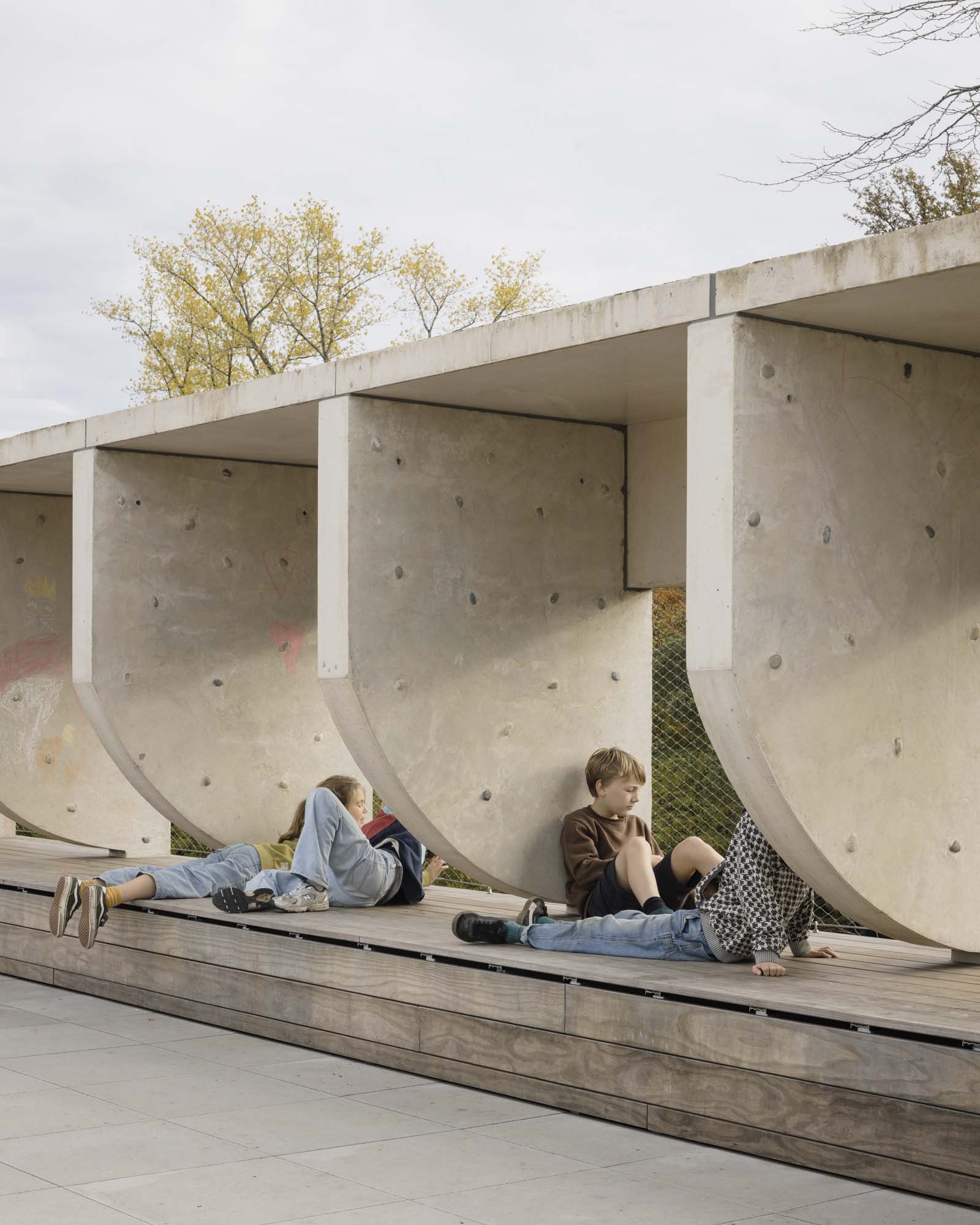
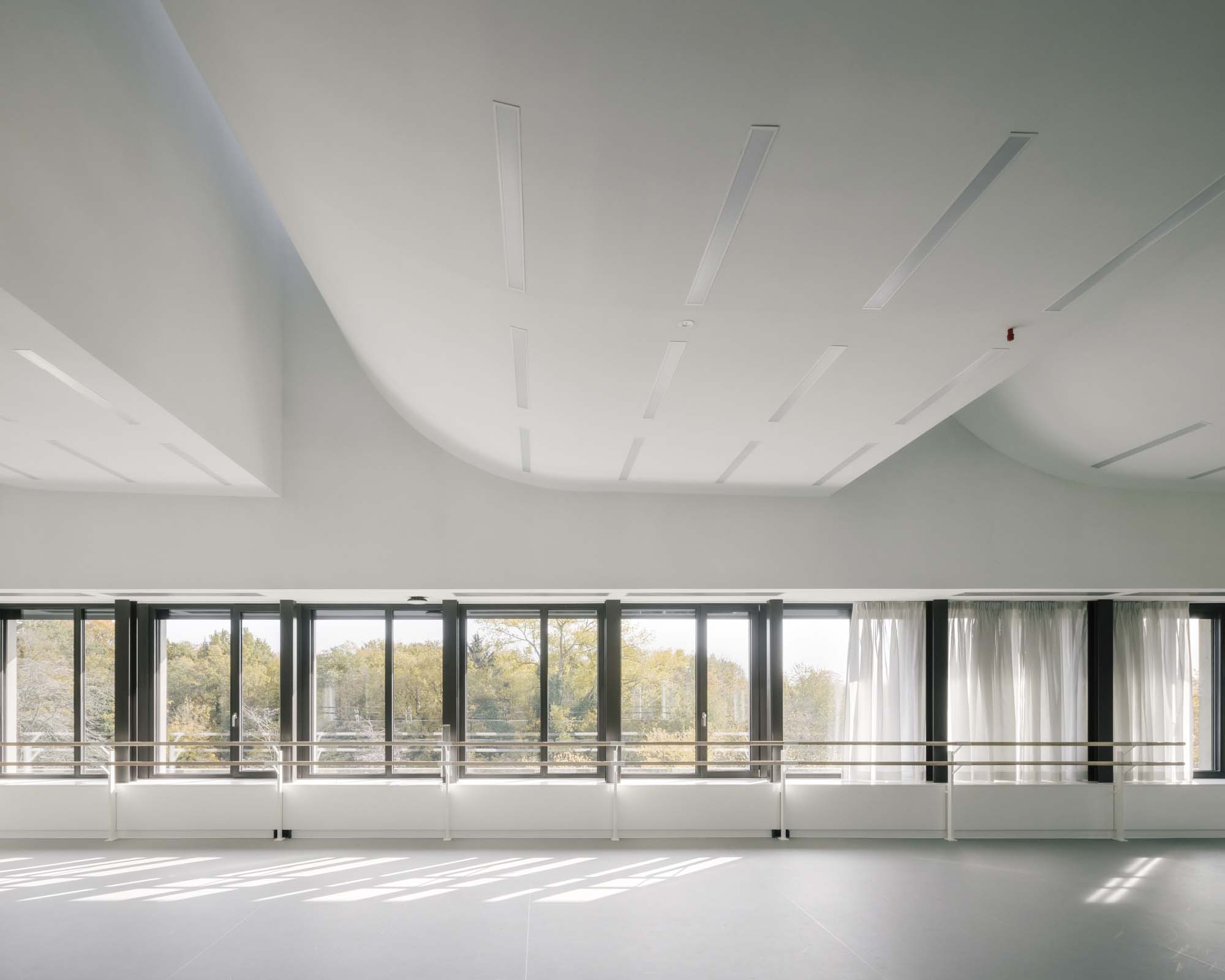
The original buildings have not been cleaned up but retain their original weathering. The new performance hall, eschewing deliberate contrast with the existing buildings, features a load-bearing concrete façade, while the rooftop extensions – which accommodate a dance hall, office space and playground – also consciously ‘build on’ the original Brutalist aesthetic – are formed as concrete ‘crowns’. These pick up the rhythm of the existing structures while introducing softer rounded forms in their constituent columns, beams and façade panels – linking the old with the new.
Architect’s view
The renovation of the former town hall of Gentbrugge transforms a 1970s Brutalist complex by architect Paul Felix into a vibrant, multi-functional, and nearly zero-energy hub. The site is considered an example of brutalist architecture from the 1960s that is threatened with demolition. ATAMA won the competition by advocating for the almost complete preservation of the buildings and for expanding the complex with buildings related to the existing architecture.
The project creates a shared home for a school, a library, an art academy, a police station and a municipal administration office. The design introduces a new sense of cohesion between the existing buildings by adding a compact performance hall to the site. This addition unites the previously scattered structures into a single ensemble. Within the ensemble, the programme is placed alongside and on top of each other to encourage encounters between users. The central agora is the meeting place par excellence for users of the highly diverse cluster. Each building is crowned with a rooftop extension, such as a daylight-filled ballet hall and a rooftop playground.
The characteristic concrete exterior could not be insulated from the outside. The design uses high-performance internal insulation and airtight finishes. Technical solutions are cleverly hidden such as the ventilation ducts that were integrated into the external terraces to preserve high ceilings.
The project demonstrates that there is a bright future for buildings that many consider dark and grey but which intrinsically possess exceptional spatial qualities such as generous free heights, good daylight conditions, low-plastic materiality, high-quality shared spaces and good integration into the context.
Atelier of Transformative Architecture and Masterplanning
Client’s view
This building is a valuable and striking example of modernist architecture from the 1960s, designed by Paul Felix. It is one of the few public projects he realised in Ghent, and given the design and construction dates, it can be considered an example of early Brutalist concrete architecture.
The complex is in critical condition and requires a thorough renovation due to structural decay (concrete rot and worn finishes), poor thermal performance (uninsulated envelope and single glazing), and obsolete, energy-inefficient technical systems.
The building complex had to receive a very diverse programme as an Academy for Music, Word, and Dance, a primary school, a police station, civil registry service counters, a library branch, a cafeteria, and potentially space for co-working spots.
To this end, the City of Ghent wished to thoroughly renovate this architecturally valuable building in a sustainable and high-quality manner, with respect for the current architecture. In doing so, the City starts from the principle of a broad site, where as many spaces as possible are shared, including with the neighbourhood and other relevant partners.
By bundling functions (primary school, music academy, library, civil affairs, police and co-working spaces), this project aims to realise synergy gains, such as the multiple use of spaces (for example, primary school classrooms used in the evening by the music academy) and shared infrastructure (access, reception, waiting areas, sanitation, parking). Furthermore, bundling functions lowers the threshold for using each other’s services (a waiting parent takes the opportunity to seek information at Civil Affairs or to drop into the library). A design competition was organised and, after a selection of five teams, ATAMA was named the winner.
City of Ghent
Project data
Location Gentbrugge, Belgium
Start on site August 2021
Completion October 2025
Gross internal floor area 5,674m2
Gross (internal + external) floor area 6,670m2
Procurement Two-stage design competition
Construction cost €14.73 million
Construction cost per m2 €2,208
Architect ATAMA (Atelier of Transformative Architecture and Masterplanning)
Client City of Ghent
Structural engineer UTIL
M&E consultant SWECO
QS ATAMA
Landscape consultant Cluster
Acoustic consultant Daidalos
Project manager ATAMA
Principal designer ATAMA
CDM co-ordinator AB Solid
Main contractor ACH Bouw, Floré
Airtightness at 50Pa Block A: 1.477 m3/h.m2, Block B: 4.691 m3/h.m2, Block C: 1.919 m3/h.m2, Block D: 0.7858 m3/h.m2
Energy performance certificate rating NZEB
CAD software used AutoCAD, Revit