
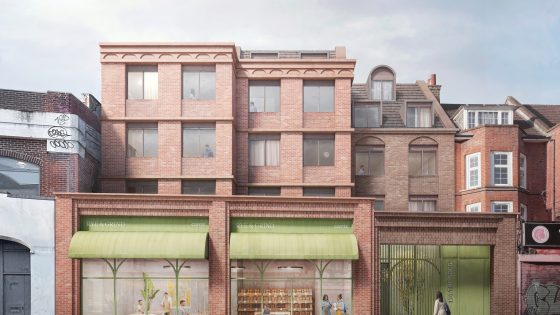
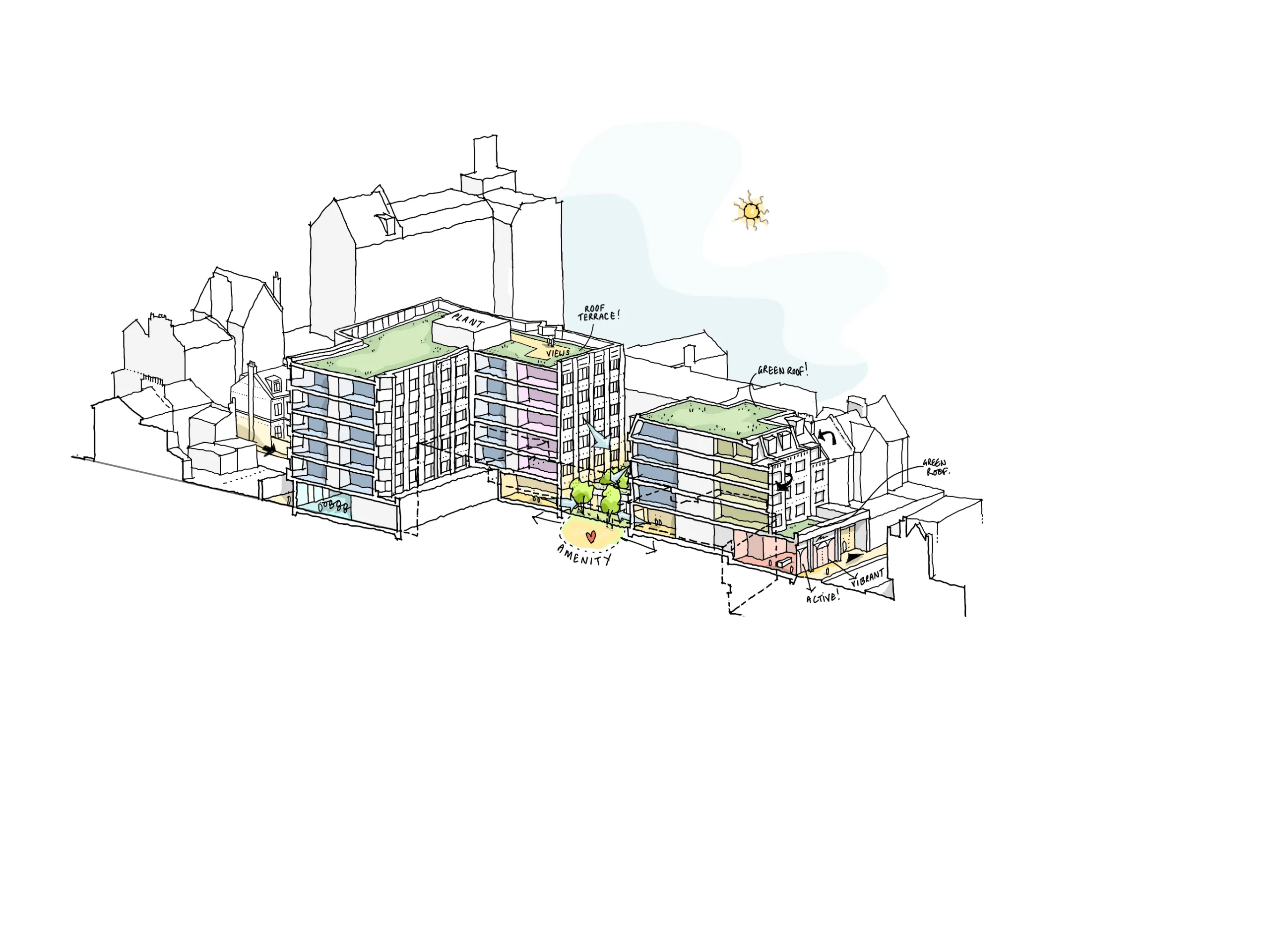
Clients the SoCo and Wittington Investments want to demolish the 1970s-built supermarket on Rye Lane and replace it with two new shared living buildings connected by a glazed link and a commercial unit on the ground floor.
Two five-bedroom (eight-person) affordable houses would also be built as part of the scheme, which ranges from one to six storeys overall.
According to the practice, the design follows Greater London Authority guidance for large-scale purpose-built shared living, also known as co-living, which it said would provide high-quality accommodation for all residents.
Co-living spaces have boomed in London in recent years. In 2024, the AJ examined the reasons behind this and the factors constraining further growth.
The practice said in a statement that its design responds to the rich and varied character of Rye Lane, forming a contemporary response to its architectural heritage.
Materiality and construction detail have been treated as integral to the character of the scheme, which has been through two rounds of public consultation.
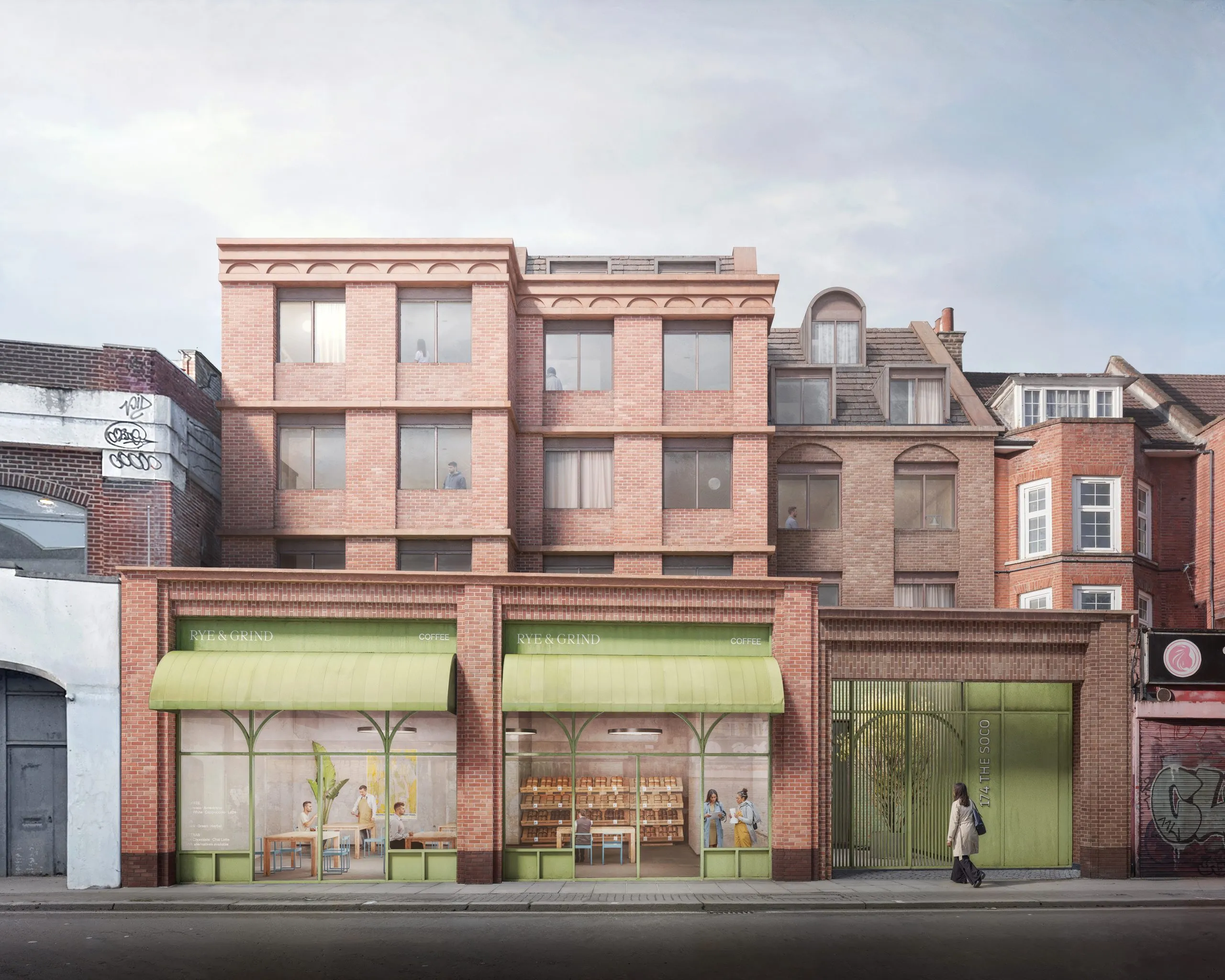
The Rye Lane frontage uses a palette of brick and metalwork that ‘feels rooted in Peckham’s existing shopfront character, while introducing a crafted, contemporary interpretation of Rye Lane’s decorative traditions’, according to the practice.
‘A rational, residential-scale façade grid is overlaid with a material change to the podium to break the massing and define the entrance. A contemporary interpretation of a traditional shopfront on Rye Lane gives the street frontage a human and welcoming scale,’ it said.
The palette at Alpha Street is softer and more traditional to blend with neighbouring buildings while retaining its own identity, it added.
According to Dowen Farmer, the two large family homes will be designated ‘affordable’ and have been added after consultation with Southwark Council, which said it favoured the bigger housing over flats.
The potential impact of the largest six-storey block behind Alpha Street has already attracted some local criticism, with one objector to the plans claiming they were worried about ‘the height of the development and loss of light and sunlight to properties that have been in situ since circa 1890’.
The practice’s studio is also located on Rye Lane and last year Dowen Farmer landed permission for a five-storey infill hotel scheme in the road under Southwark Council’s delegated powers.
A planned overhaul of nearby Peckham Rye station by Landolt + Brown was scrapped last summer, in a move branded ‘disastrous’ by architect Adam Brown.
The plans, submitted in 2022, would have added a new two-storey concourse to the rear of the Grade II-listed station, plus stairs, new toilets and lifts to all platforms. The station’s gate line would also have been enlarged.
The scheme was halted after the Department for Transport pulled its funding for the £40 million project.
That announcement came two weeks after Southwark Council confirmed the demolition of ‘dilapidated’ 1930s buildings in front of the station to make way for a new station square, also designed by Landolt + Brown, would begin. That plan was approved separately in 2016.
174 Rye Lane, Peckham
Project data
Project 174 Rye Lane
Lead architect Dowen Farmer Architects
Client The SoCo and Wittington Investments
Planning consultant Rolfe Judd Planning
Structural engineer Walsh
MEP consultant Hoare Lea
Landscape designer Place Design UK
Transport consultant Caneparo Associates
Heritage consultant Iceni Projects
ESG consultant Life Proven
Daylight/sunlight consultant C3-RE
Cost consultant Core Five
Gross site area 0.3 Ha
174 Rye Lane, Peckham sketch