
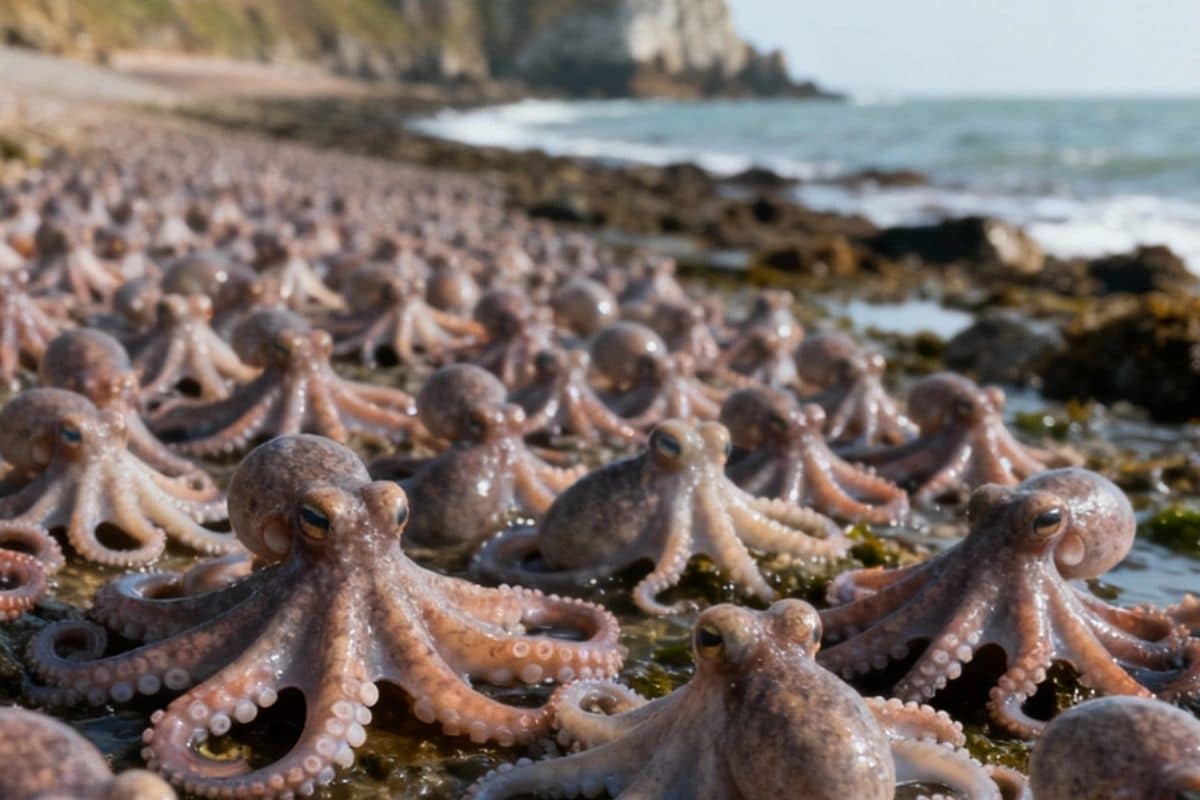
Something unusual is happening beneath the waves of the English Channel. Octopus sightings along England’s southern coastline have shifted from rare curiosities to near-daily encounters. What was once an almost exotic experience for local fishermen has become an overwhelming reality — and the marine ecosystem is already feeling the pressure.
From rarity to invasion : octopuses take over English waters
Not long ago, spotting an octopus off the shores of Sussex or Cornwall was genuinely surprising. Marine biologists would note such encounters carefully. Today, that scientific excitement has given way to something closer to alarm. Cephalopod populations have surged dramatically across the Channel’s northern reaches, colonising areas where they were historically absent or marginal.
The primary driver appears to be ocean warming. Rising sea temperatures in the Channel are making previously inhospitable waters far more suitable for octopus egg survival. Scientists describe this process as the Mediterraneanisation of the English Channel — a slow but steady transformation that mirrors conditions long associated with warmer southern seas. As water temperatures climb, species boundaries shift northward, and opportunistic animals like octopuses are among the first to take advantage.
Other factors are likely compounding this shift. The collapse of key predatory fish populations — partly due to decades of overfishing — has removed natural checks on cephalopod numbers. Changes in pollution levels and broader disruptions to marine food webs may also be contributing. The result is an environment where octopuses face few threats and abundant prey.
For Sussex fishermen, the numbers are staggering. Catch densities have reportedly increased tenfold — and in some cases a hundredfold — compared to typical seasonal averages. Nets that would once bring up crustaceans and flatfish now overflow with writhing tentacles. One local fisherman described the situation bluntly : “they eat almost everything they find, it’s a real tidal wave of tentacular invasion.” That visceral description captures the speed and scale of what marine professionals are witnessing firsthand.
A disrupted food chain and crumbling biodiversity
The ecological consequences of this cephalopod population explosion are serious and far-reaching. Octopuses are voracious, intelligent hunters. They target crustaceans, molluscs, and small fish with remarkable efficiency. As their numbers grow, competition for shared prey intensifies dramatically across the Channel’s already fragile ecosystem.
Consider what this means for the species that depend on the same food sources :
Shrimp and langoustine populations face mounting predation pressure from octopuses moving into traditional fishing grounds.
Coastal bird species that rely on shallow-water fish are losing access to prey increasingly consumed by cephalopods.
Commercial fish stocks, already weakened by overfishing, must now compete with a surging new predator.
Juvenile crustaceans are particularly vulnerable, reducing future stock recovery potential significantly.
The food chain does not absorb this kind of pressure quietly. Trophic cascades — chain reactions triggered when one species dominates — can reshape entire marine communities over relatively short periods. With so few natural predators capable of controlling octopus numbers in these northern waters, the imbalance may deepen before it stabilises.
Traditional fisheries are caught in the middle. Already strained by regulatory changes and declining catches, fishing communities along the southern English coast are now contending with nets damaged by octopuses, loss of target species, and shifting seasonal patterns. The economic toll is difficult to quantify but is felt concretely in harbours from Brighton to Brixham.
Appetite meets opportunity : can England turn the tide ?
Not everyone views this eight-armed upheaval purely as a crisis. Opportunistic thinking has emerged alongside ecological concern, particularly within the food and restaurant industry. In Spain and Italy, octopus has long been a celebrated ingredient — grilled, marinated, or simmered into rich stews. British chefs and restaurateurs are beginning to ask whether England’s sudden abundance could feed a similar cultural shift.
Several coastal restaurants have started featuring octopus dishes on their menus, positioning the animal as a locally sourced, sustainable alternative to species under greater pressure. If managed carefully, redirecting fishing effort toward this invasive species could simultaneously relieve pressure on depleted stocks and create new commercial value. It is an appealing idea — but it carries real risks.
History offers a cautionary example. When new species are commercialised quickly without proper stock assessment, demand can strip populations far faster than ecosystems recover. Turning today’s glut into tomorrow’s scarcity would simply repeat the overfishing mistakes that contributed to this imbalance in the first place. Responsible harvesting frameworks and close monitoring by bodies like the Marine Conservation Society will be essential if opportunity is to be seized without further damage.
What England is experiencing sits at an uncomfortable intersection : climate change, ecological disruption, economic vulnerability, and cultural adaptation are all converging in the same stretch of water. The octopus, ancient and adaptable, is thriving precisely because the conditions it needs are expanding. The Channel is changing, and its new resident is not waiting for permission.
Whether the response focuses on ecological management, gastronomic reinvention, or scientific monitoring, one thing is clear — England’s relationship with its surrounding sea will never look quite the same again. Eight arms and limitless appetite have arrived, and the coast is still working out what to do next.