
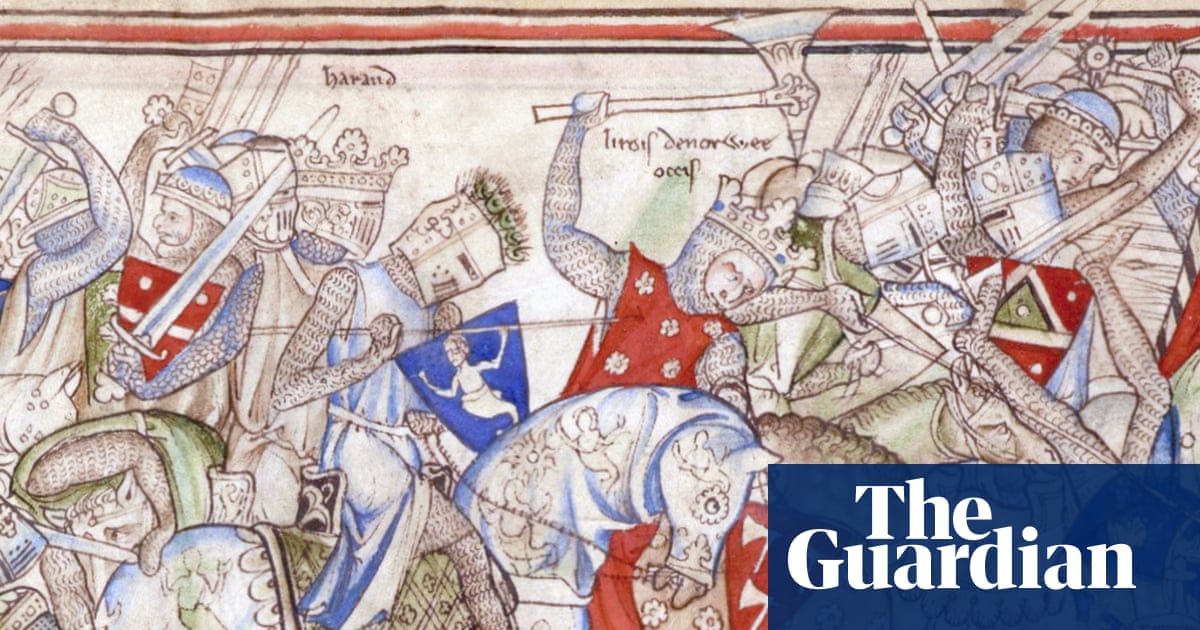
It is a story that has been taught to generations of British schoolchildren about one of the most famous and pivotal events in the country’s history.
The Guardian’s journalism is independent. We will earn a commission if you buy something through an affiliate link. Learn more.
In September 1066, as a Norman duke called William prepared to sail from France to claim the English throne, King Harold of England discovered the Viking leader Harald Hardrada had landed in Yorkshire with an army of his own.
Unfortunately, according to historians, the English king had disbanded his naval fleet weeks before, and so he was forced to march his army almost 300 miles (about 480km) north to Stamford Bridge, near York, confront – and defeat – the Vikings, and then somehow march the troops all the way back to the south coast. Exhausted by this almost superhuman trudge, the English forces were then defeated by William on 14 October, in what would become known as the Battle of Hastings.
But what if historians have got one of the most crucial assumptions about one of England’s most pivotal battles completely wrong?
That’s the claim of one British academic, who argues that the notorious “forced march” of the English army to Stamford Bridge – interpreted for centuries as a sign of Harold’s recklessness and a key factor in his defeat – in fact never happened at all.
What’s more, he believes that as well as their clash on land at Hastings – as depicted in the Bayeux tapestry, shortly to go on display in London for the first time in a millennium – Harold also attempted to resist William’s invasion by sea, sending ships to try to trap the Norman fleet in a pincer movement that was ultimately unsuccessful.
The Bayeux tapestry is to go on display in London for the first time in a millennium. Photograph: Hemis/Alamy
Tom Licence, a professor of medieval history and literature at the University of East Anglia, argues that a misreading of Old English records led historians to believe Harold had disbanded his navy – making a march to Yorkshire inevitable – when in fact the king had done no such thing.
He points to an entry in the Anglo-Saxon Chronicle which says that the English fleet – which had been stationed in the Channel through the summer of 1066 in case of invasion – “came home” in early September. Influential Victorian historians took that to mean the warships had been sent back to their home ports around the country from where Harold had mustered them, an interpretation that has shaped assumptions ever since.
“[They] read it to mean that as soon as the fleet had all been disbanded, Harold heard this terrible news that Hardrada, the most feared warrior in Christendom, had landed in the north. So Harold is basically without a fleet. And it follows from that that he’s got to march everywhere,” says Licence.
When Licence re-examined the sources, he found evidence, he says, that “coming home” had previously been used to mean returning to their home base in London. “And when I realised that passage had been misread, then everything else that had previously confused historians began to fall into place.”
There are, in fact, multiple references to Harold having a fleet at this point, says Licence, “which had really confused historians, [so] they tried to explain it away in various ways. There are also two references in very early Norman accounts to Harold sending hundreds of ships around the south coast to block William in at Hastings.”
Harold Godwinson (circa 1022-1066), also called King Harold II was King of England from 6th January 1066 until his death at the Battle of Hastings on the 14th October 1066. Photograph: incamerastock/Alamy
Licence also hunted the contemporary sources for evidence for the long march north, “and I couldn’t find any reference to marching at all. That was a real surprise because it’s such an entrenched story. I mean, it’s the most famous march in English history, it’s so central to the debate around Harold’s defeat at Hastings. And it’s not in the texts.”
His interpretation? Harold simply sailed his armies to Yorkshire and back. “Only a mad general would have attempted what seems like an impossible march, which isn’t recorded in the sources anyway.” The English king, Licence believes, “was not a reactive, exhausted commander, he was a strategist using England’s naval assets to wage a coordinated defence”.
He will present his evidence at a conference at the University of Oxford on 24 March.
“The supposed forced march has long been the accepted explanation for Harold’s swift journey from York to Hastings following the Battle of Stamford Bridge,” said Rebecca Tyson, a doctoral researcher and expert in 11th century maritime history at the University of Bristol.
“This new discovery that Harold maintained his fleet right up until the Battle of Hastings highlights the central importance of maritime aspects to the events of 1066, which have largely been overlooked in scholarship to date.”
According to Prof Michael Lewis, the head of the portable antiquities scheme at the British Museum and curator of its forthcoming Bayeux tapestry exhibition, Licence’s research “shows there is much still to be learned about the events of 1066”.
“It is clearly a fascinating discovery that following the Battle of Stamford Bridge, Harold took an easier, more logical, trip south by ship to meet Duke William in battle, rather than a long trek overland, as has long been supposed,” he said.