
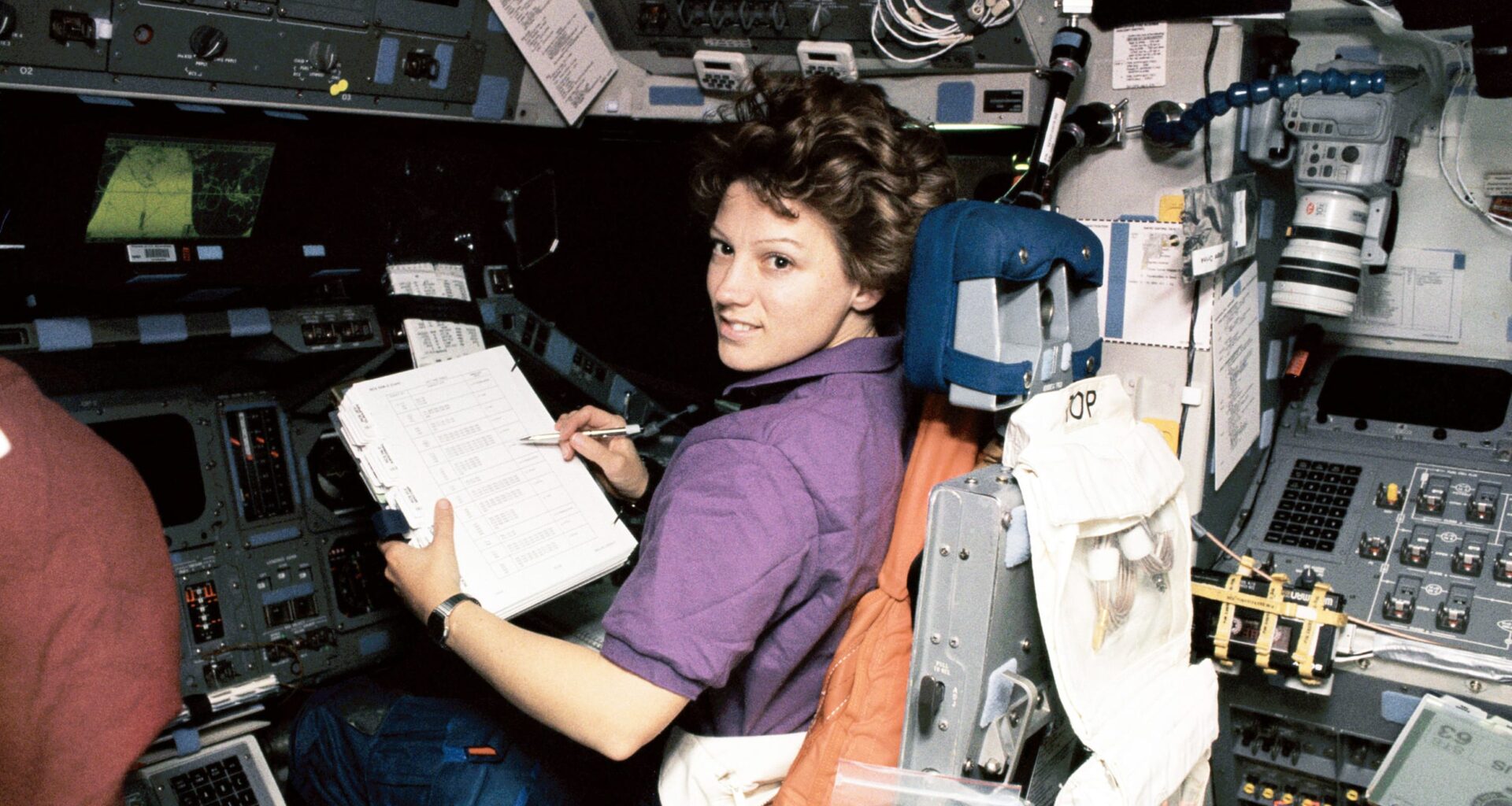
Before Eileen Collins ever left Earth, she had to fight to be seen on it.
It’s a story Collins, the first woman to pilot and command a spacecraft, tells in the new documentary “Spacewoman.”
Directed by Hannah Berryman, the film follows Collins’ journey from her working-class childhood in Elmira, New York, to leading historic missions at NASA, including the critical return to flight after the Space Shuttle Columbia disaster in 2003. The film offers an intimate look at both the risks of spaceflight and the personal sacrifices behind Collins’ achievements.
In a candid interview with Know Your Value, Collins, now 69, reflected on how early hardship shaped her resilience and drive, how she juggled motherhood and a demanding career, what it took to succeed in male-dominated fields where she often stood out — and why working harder became her greatest advantage.
Below is the conversation, which has been edited for brevity and clarity:
Know Your Value: In the documentary, you open up about your humble and often challenging childhood in Elmira, New York — your family’s financial struggles, your father’s battle with alcoholism, and growing up on welfare. How did those early hardships shape your resilience and fuel your determination to become an astronaut?
Eileen Collins: Primarily, I watched my parents struggle with their problems and how they managed to keep going. They were able to live through their day-to-day life and continue supporting their children, put food on the table, and make sure we got to school every day. And I watched them fail, and get back up again, and keep trying…
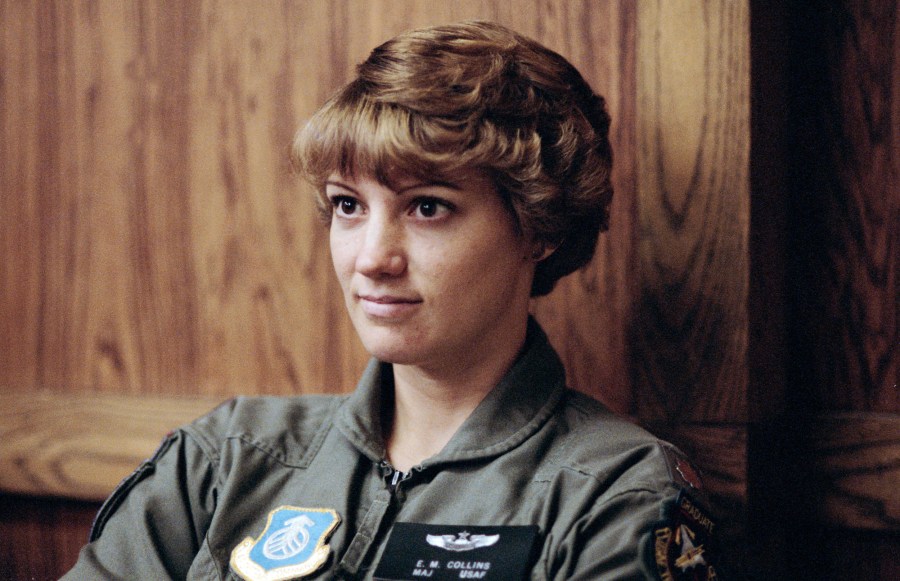 Eileen Collins listens to a briefing on parachute ejection during a training course hosted by Vance Air Force Base in Oklahoma. NASA
I don’t think my parents ever just gave up. But I will also say that my parents were very wise. My dad always told me, “Don’t follow the crowd.” He was very colorful. He would say, “If all your friends jumped off the Walnut Street Bridge, would you jump off the Walnut Street Bridge? Have a mind of your own, Eileen. Have a mind of your own.” And I think that might be part of why I decided to go do something that was non-traditional. Then my mom would say to me, “Isn’t it really interesting that every person in the world is different? You are an individual. There’s no one else exactly like you.”
And that’s the way it should be. Go find your unique talents, and that’s what you contribute…
Know Your Value: In the documentary, we see you navigating both motherhood and a groundbreaking career — something many women relate to. Your daughter speaks candidly about her fear during your missions, especially the first flight after the Space Shuttle Columbia disaster, and the emotional toll of being apart from you. Looking back, what did you learn about balancing ambition and family? Is there anything you would have done differently?
Eileen Collins: When it comes to balancing motherhood, basically having a family is a very challenging job. I found that to do well, you have to really love what you’re doing, and I felt that I had the two best jobs in the world. I was a parent and I was an astronaut, and because I loved what I was doing, I think that gave me the energy to keep going every day.
My job was very challenging. I had to study for that. I would get my space shuttle manuals out, sit down with my daughter, and I would read the space shuttle manuals to her. I’d be studying and reading to her at the same time. Sometimes I put her in the stroller, and I’d be pushing the stroller, and I’d have a procedure in the other hand, and I’d be memorizing a procedure for the space shuttle emergencies. My daughter learned a lot about being an astronaut. So I really enjoyed being a mom. I actually found that being a mother was really good for me. I called my daughter my stress reliever. Before she was born, I would work a lot– every waking hour I was working. After my daughter came along, when I came home I got to spend time with her and I would–for a period of time–not think about my job, and I found that to be very energizing.
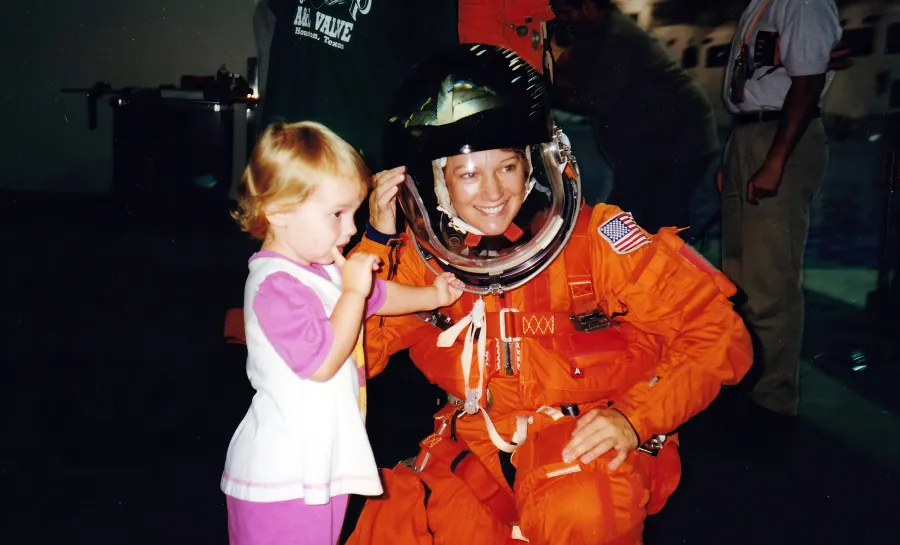 Eileen in space suit with daughter Bridget, age 3, in 1998. Courtesy Collins Family
Know Your Value: You entered aviation and spaceflight when they were overwhelmingly male-dominated fields. What advice would you give young women who are working to break into industries where they may be the only woman in the room — or where they may not feel they fully belong yet?
Eileen Collins: My advice is to learn as much as you can about your job, first, and then learn as much as you can about your industry. I found being the only woman in an all-male squadron, or all-male wing in the military, everybody knew my name.
Everybody knew who I was, and everybody knew every mistake I made. I learned that I had to be as smart as I possibly can to get the same level of respect. So I studied all the time, I studied whenever I could. I wanted to be smarter than every guy in my squadron. I wanted to be the smartest.
I would even go as far as walking down to the airplane hangars and looking at my airplane with the panels off, and making sure I knew where the wire bundles were, where the hydraulic pumps were, what the brakes look like underneath the tires. When we were in a meeting and someone had a question, I wanted to have the answer, so I had to work harder. But you know what? That was not a detriment, it was a plus. And I was a better pilot because I worked harder. So I would say that would be the advice that I would give. If you stand out, you have to work harder, but that’s good because you will be better in the end. Also, read case studies and read about the mistakes people have made in the past in your industry.
Know Your Value: For many women, there’s a defining “know your value” moment — a time when you had to advocate for yourself, push back, or clearly articulate your worth. Did you experience a moment like that in your career? What did it teach you?
Recommended
Eileen Collins: I was on a crew on an airplane, as an air force pilot. I was the co-pilot and the aircraft commander, who is the ultimate person responsible for the aircraft and crew, wanted to do something that was against the rules. I told him, “I don’t want to do that, that’s against the rules.”
We get back home, and we get called in the office, and they’re gonna punish me for something that I didn’t do and I had to stand up for myself. I spoke up and said, “I didn’t want to do it, but he did it anyway.” They were going to demote me down one level and they didn’t because I stood up for myself.
They said, “OK, we’re not going to demote you. If you’re on a team, whether you’re a man or woman, you have a responsibility to speak up for yourself. Don’t worry about hurting the other person’s feelings, maybe that other person needs to learn a lesson.”
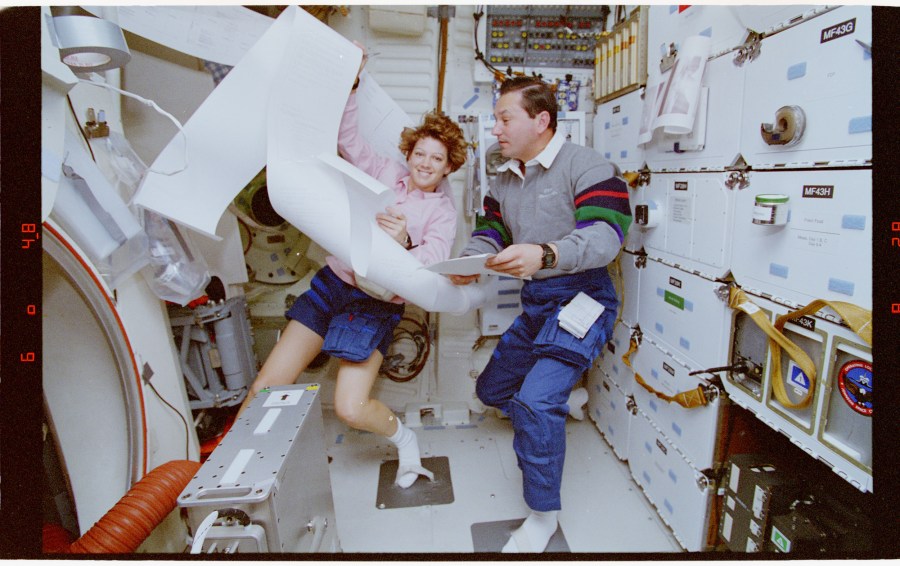 Pilot Eileen Collins and Mission Specialist Vladimir Titov posing with papers from the Thermal Impulse Printer System (TIPS) on the Space Shuttle Discovery’s mid-deck. NASA
Know Your Value: You’ve achieved so many historic firsts. Did you feel the weight of representing women while you were breaking those barriers — or were you simply focused on the job? How did you manage the pressure that came with being a trailblazer?
Eileen Collins: I would say I was mostly focused on doing my job. That was the vast majority of where I spent my time and energy. But there were times when my friends who were also women pilots. would write to me and say “Do it for us, Eileen! Do it for women!”
So then came a little bit of pressure because I knew if I made a mistake, it would reflect poorly on all women pilots. That’s just a fact, and it shouldn’t be that way, but that’s the way it is. So, in the end, I knew that I had to work very hard to not make a serious mistake because I knew that from a strategic or a historical point of view, what I was doing would reflect on women. But that was not my day-to-day thinking, because that would be too much pressure if I always thought about my job from a historical perspective. Over 90 percent of my time was doing my day-to-day job but I had the historical significance in the back of my mind.
By the way, I saw that as a challenge and I was very well prepared. I was always very confident at my role as the first woman to pilot and command a space shuttle mission, and that is due to the training that I received. I did not start out as a confident person . I learned to be prepared, so I was very confident when I went to fly because of the training that NASA provided, which was excellent.”
Know Your Value: What do you hope women — especially young girls watching — take away from “Spacewoman” about possibility, perseverance, and believing in themselves?
Eileen Collins: Well, I hope they’re inspired. I think “Spacewoman is very inspirational. It’s the story. It’s the music. It’s the people. We have interviews with flight directors, we have interviews with crew members, we have interviews with family members. And my Spacewoman director picked interviewees that were very articulate, and have a lot of personality and they really add a lot to “Spacewoman.”
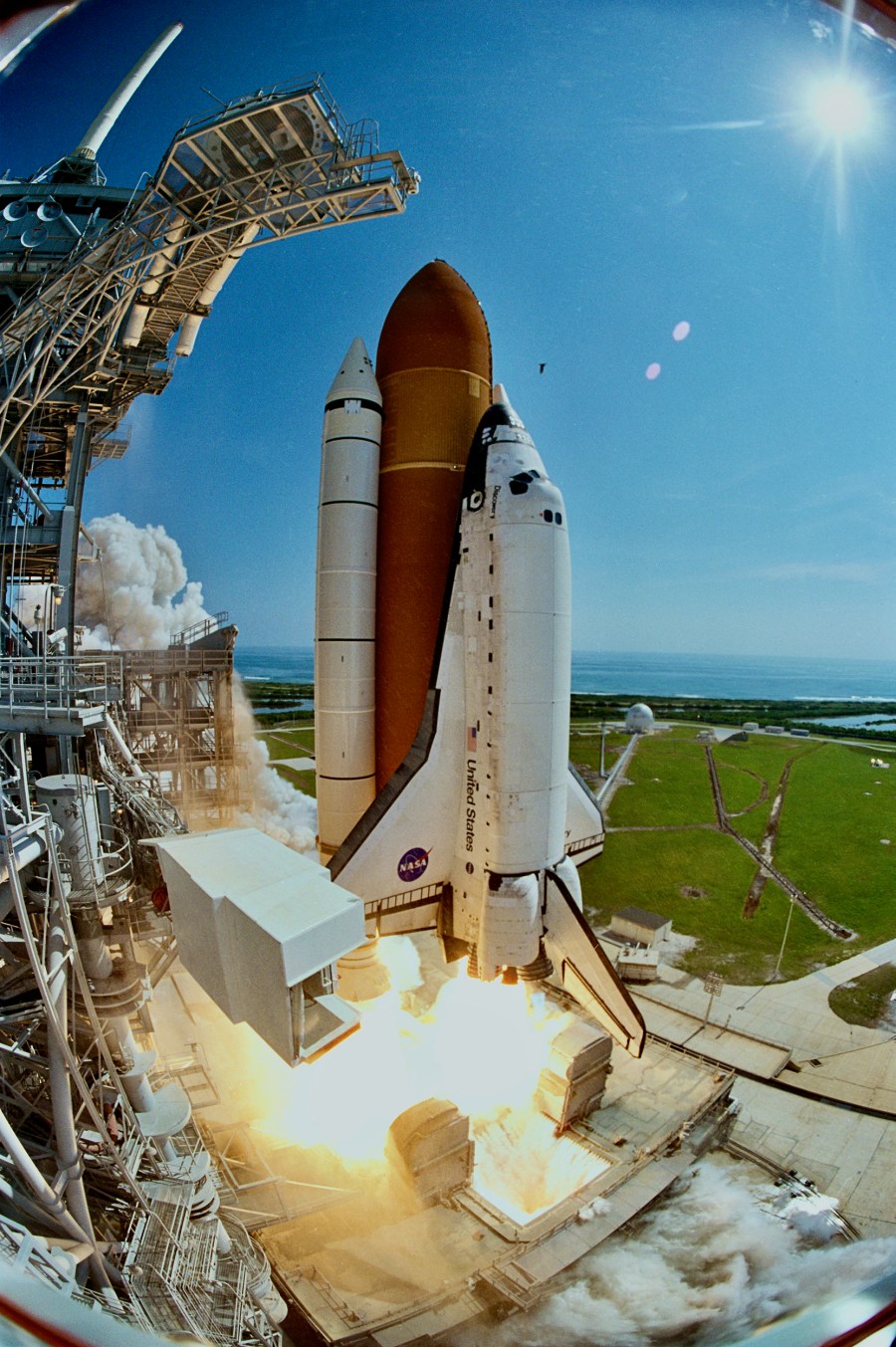 Launch of STS – 114, the return to flight mission after the tragic loss of Columbia. NASA
The people that watch it will be inspired by the missions that I flew, the missions that NASA flew, and the fact that those missions were not perfect. But we handled the problems, and we overcame them to complete the mission.
I also want to add the family problems that I had with my dad’s drinking. My mom had problems, my parents separated and the fact that we relied on government assistance. That can happen to you, but in the United States, growing up in this country, you can overcome those types of problems because of the opportunities that we have here. For me, it was the military and then NASA. For your listeners and those that watch “Spacewoman”, it might be something else. But I think the story will still apply to them…

© 2026 Versant Media, LLC
