
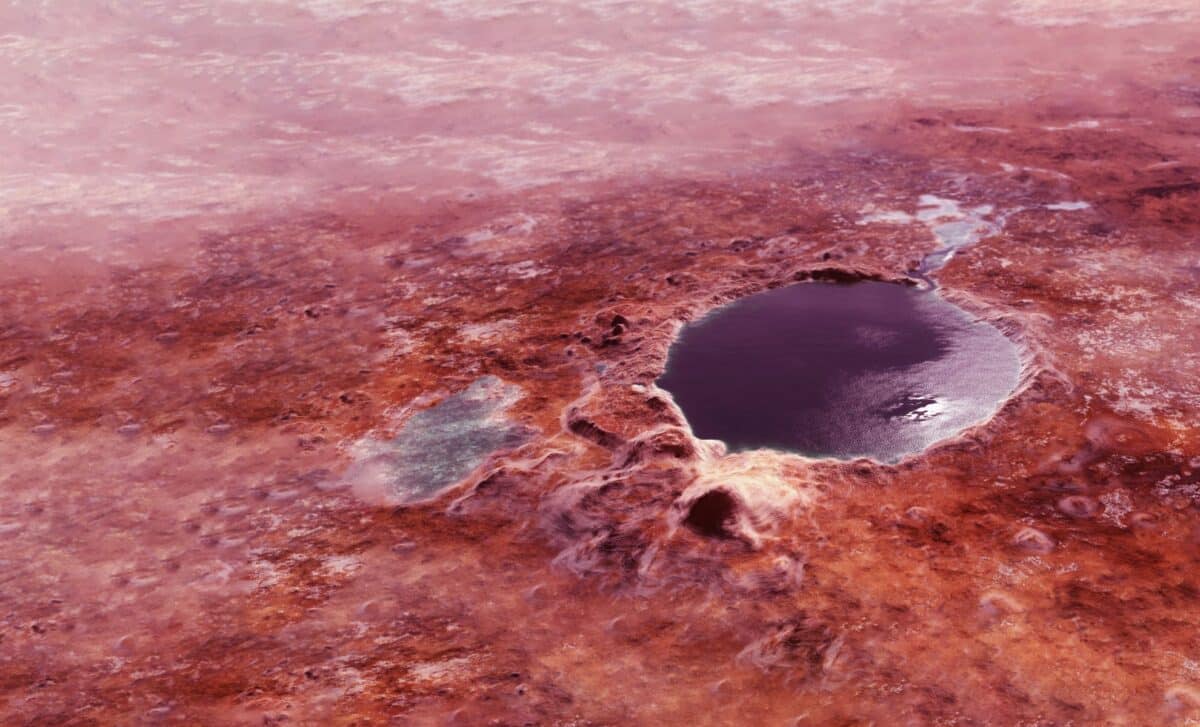
Mars was once far wetter than it appears today, and new research suggests much of that water did not disappear but migrated beneath the surface. Evidence from deep crater basins points to a planet-wide groundwater system that may have persisted long after surface conditions declined.
Scientists have been debating for years just how much water Mars had and how long it lasted. By looking at specific geological features, a new study in the Journal of Geophysical Research: Planets showed solid proof of how water evolved across the planet over billions of years.
Deep Craters Show Clear Signs of Ancient Water Activity
The research, led by Dr. Francesco Salese of Utrecht University, analyzed 24 enclosed craters in the Martian northern hemisphere. These basins lie about 2.5 miles (4 km) below Martian “sea level,” where distinct geological features were identified.
According to the findings, the craterschannels carved into walls, groundwater-formed valleys, delta-like deposits, and terraced structures. Each of these features indicates the sustained presence of water. Many formations occur at similar depths, between 4 and 4.5 km, suggesting a stable water table across multiple sites.
As stated by Salese, this consistency supports the existence of a widespread groundwater system rather than isolated water pockets.
“We traced this water in our study, as its scale and role is a matter of debate, and we found the first geological evidence of a planet-wide groundwater system on Mars.”
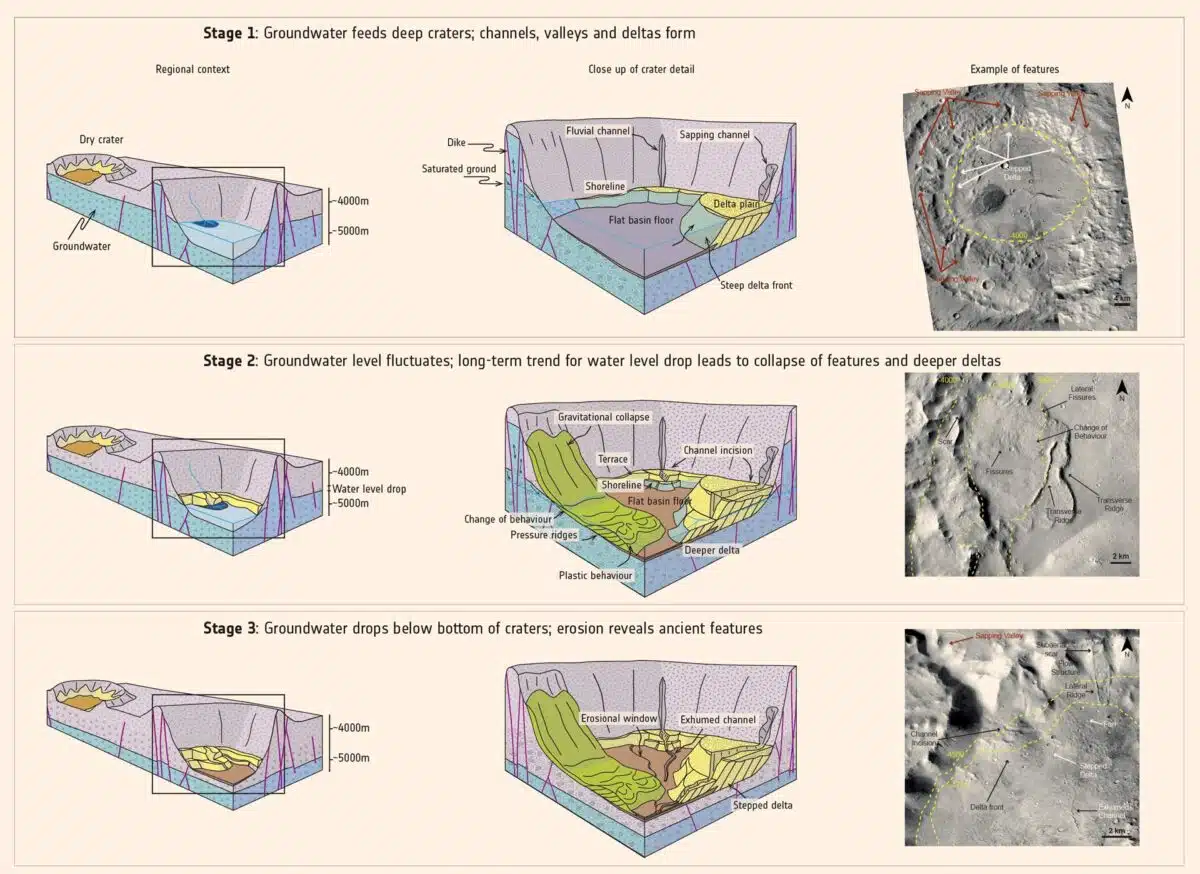 Three-stage evolution of groundwater-fed craters on Mars, from flooding to erosion. Credit: NASA / JPL-Caltech / MSSS / F. Salese & al.
Evidence of Mars’ Watery Past
The uniform depth of water-related formations indicates the existence of a global water table beneath the Martian surface. Dr. Gian Gabriele Ori, co-author of the study, stated that this system may have been connected to a large ocean thought to have existed around 3 to 4 billion years ago.
“We think that this ocean may have connected to a system of underground lakes that spread across the entire planet,” Ori explained.
These subsurface lakes likely formed a vast, interconnected hydrological network during a period when Mars was more geologically active. The proposed model suggests that as surface water diminished, it migrated downward, stabilizing within the crust and feeding these underground reservoirs over long timescales.
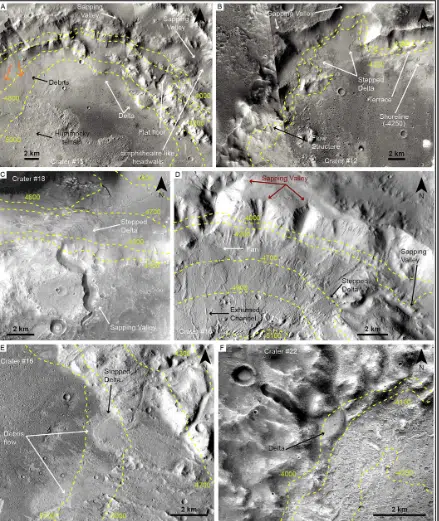 Surface structures identified across several basins. Credit: Journal of Geophysical Research: Planets
Signs of Life-Friendly Conditions in Minerals
In five of the analyzed craters, researchers identified clays, carbonates, and silicates, minerals associated with water-rich environments and, on Earth, with life-supporting conditions. The study found that, these basins were deep enough to intersect water-saturated regions of the Martian crust for long periods. This increases the possibility that traces of past life could still be preserved within buried sediments.
Dr. Dmitri Titov, project scientist for ESA’s Mars Express mission, noted that such findings help identify the most promising targets in the search for past life.
“Findings like this are hugely important; they help us to identify the regions of Mars that are the most promising for finding signs of past life.”