
Sign up for the Slatest to get the most insightful analysis, criticism, and advice out there, delivered to your inbox daily.
I’ve been a little unwell lately. Over the past six months or so I’ve seen upward of five medical specialists, received more bills from Quest Diagnostics than I have fingers to count them, undergone nonsurgical procedures, and delved deeper into medical Reddit subthreads than I ever thought possible. I’ve maintained what I hope is an endearingly lighthearted attitude about it, at times relying on memes to explain away my fatigue. Referring to myself as a “hot girl with IBS” is easier than trying to relay the confusion of navigating the space between dying and healthy where chronic illnesses lie.
Still, on the eve of my 30s, and at the rock bottom of my health, my desire to satisfy my inner child has never been higher. In my 29 years, I have yet to shy away from cutesy, coquettish, or girlhood-coded urges—which includes an admiration for limited-edition pink LEGO car sets, anything PowerPuff Girls–branded, and, of course, plushies.
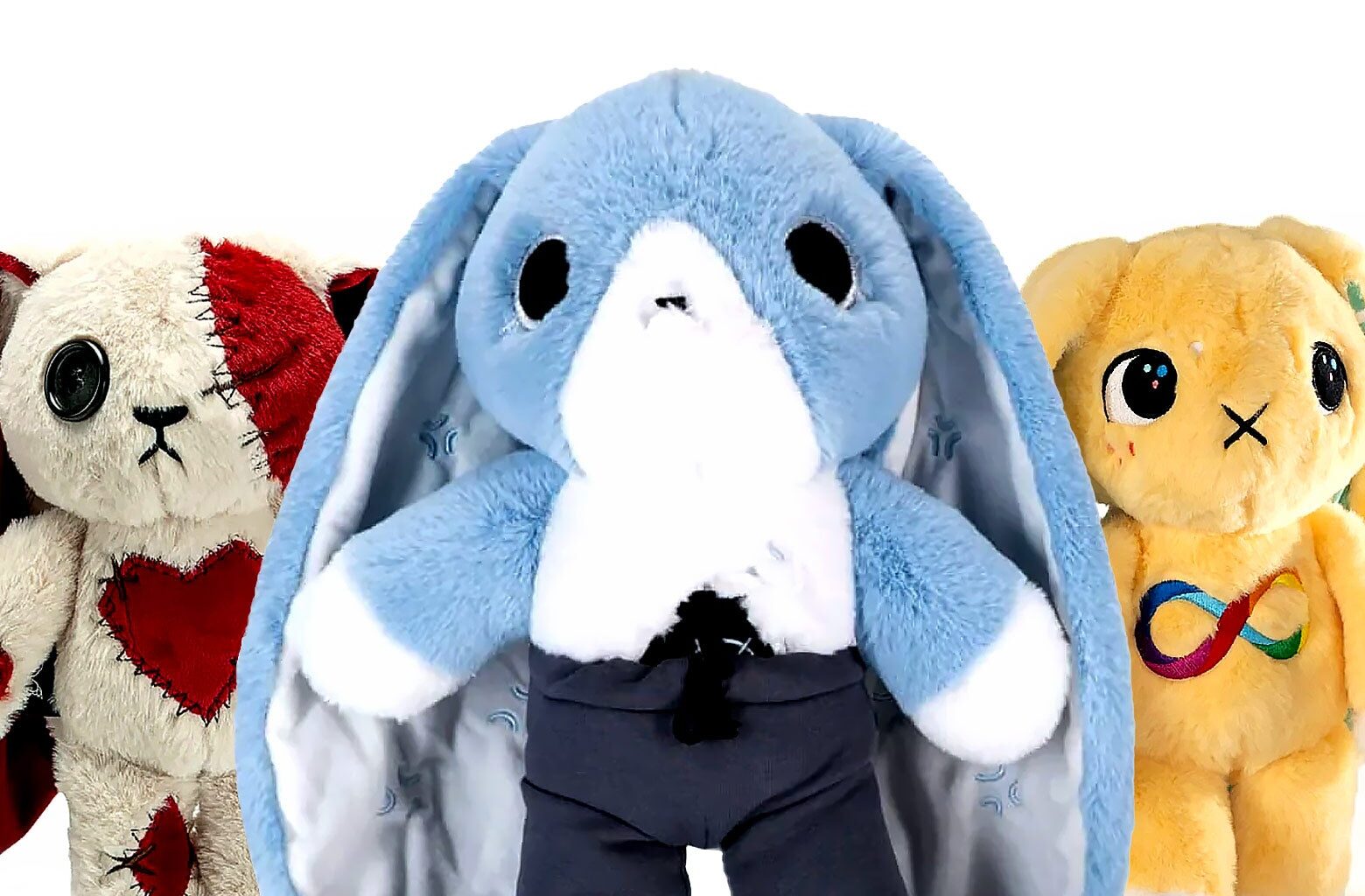
I don’t remember now when I was first served ads for Plushie Dreadfuls, but I know that they felt like the algorithmic shill that never stopped coming. My algorithm’s desperation to sell me these plushies was shocking because they are, as far as I can tell, positively grotesque. That, as it turns out, is the company’s whole schtick: Plushie Dreadfuls is a brand of macabre stuffed bunnies with various designs pertaining to a host of mental illnesses and health disorders. Their bestsellers include an ADHD rabbit with a stitched button eye, mismatched red and gray limbs, and a chaos symbol on its chest; a Love rabbit that has many stitched red patches including a red section on its head (because “love hurts”); and a PTSD bunny that is, quite literally, in shackles.
The more these sick bunnies multiplied into my feed, the more I needed to know about them. For one, are they as popular as their ads are trying to convince me they are? And, more importantly: Who the hell would want something so off-putting for comfort? The idea was unimaginable to me—cutesy, remember?—until I bit the bullet and bought one.
Mysterious, the company behind the Plushie Dreadfuls brand, was started by a man named American McGee. McGee is a former video game developer known for his contributing design work on popular games such as Doom II, and for creating the role-player game American McGee’s Alice, a dark fantasy game—we’re talking violence, cruelty, and psychological harm levels of dark—inspired by Alice in Wonderland. This makes McGee, someone with a long history of blending playful things with disturbing themes or iconography, a perfect originator of a messed-up kids toy with a lofty mission. As stated on their site, Plushie Dreadfuls seeks to provide “plush companions” that “are reflections of real experiences, symbols of resilience, and reminders that no one is truly alone,” all for the (sorta steep) price of $45.
But, despite the altruistic language on their landing page, pulling back the Plushie Dreadfuls veil—i.e., surfing through the subreddit for plushie lovers—unearths a ton of controversy, mostly due to McGee’s presence as a thorny public figure. And then there are the less acute arguments about the whole point of the thing. Some Redditors have found the bunny designs to be disrespectful and disarming (and at times, enabling, like a kleptomaniac raccoon that comes with a bag … perfect for storing stolen goods in), while some have claimed that the plushie appropriately embodies their own gravitation toward dark imagery as a way to express themselves. (Plushie Dreadfuls describes their team as diverse in gender, mental health status, and sexuality, as well as in medical diagnoses, but when they don’t have someone with personal experience with a particular condition on their team, they “assemble an external team of experts” to help “guide” the “creative process” and rely on crowdsourced feedback on the prototypes and designs.) Meanwhile, a few people have simply rejected the notion of commodifying their illnesses into, as one Redditor puts it, “a cute little marketable thing.”
How would I feel about my pain being commodified into a creepy-looking thing that I could snuggle? The only way to find out was to buy one.
The IBS bun is, admittedly, one of the site’s cuter plushies on offer. It’s a baby-blue bunny wearing high-waisted sweatpants that roll down to reveal a bomb on its tummy. The doll comes complete with a mini roll of toilet paper with a smiley face on it, fitted with an elastic loop so it can either sit separately or fit on the bunny’s hand. It’s soft, very soft. And, though I can’t imagine a need for it, my bun came in its own IBS-bun-themed bag, complete with a few keepsakes such as a sticker and pen.
When I first opened the packaging, I stared at it, instantly charmed despite myself. I showed the little smiling toilet paper roll to the people around me in the office. Did it make me feel better about the fact that my stomach has been waging a war against me and winning for years? No, not immediately. If I had to picture anthropomorphized toilet paper rolls, do I think they’d be smiling? Not particularly. But I was struck by how apt the metaphor of a bomb in your gut was, not least because of the unexpected nature with which my stomach forces me to remain horizontal. (It also has something of a wide blast radius.) My chronic pain has also changed the way I eat, the way I look at food, the way I socialize. It took me a long time to realize that choosing to eat nothing to avoid feeling pain is a byproduct of a kind of physical trauma. OK, so I did need comfort. Where better to look for it than in a smiling toilet paper roll?
I’ve long been battling an unhelpful IBS diagnosis. I’ve been trying elimination diets to figure out what foods trigger me since 2016. Over the years, though, my symptoms had only gotten worse—more consistent. My stomach hurt no matter what I ate, no matter the time of day, no matter, even, if I ate. Sometimes it was a dull ache, sometimes—as I explained to my mother once, while lying down on her couch—it felt like someone was wringing my guts out like a sopping wet towel. The only thing doctors had as an answer was a number of celiac tests that came up negative and an IBS diagnosis that told me nothing. Bombs are like this, too: solutionless once they’re set off.
That is, until about six months ago, when some routine bloodwork during my annual physical came up with something amiss. Since then, my doctors and I have been on a path to diagnose my gut issues as something else, maybe something autoimmune in origin. In this way, the bunny before me felt like I had bought myself a consolation prize, a reward for being on my way to a diagnosis that felt real—even if that reality was a chronic illness that required lifelong treatment and monitoring.
To see if I did indeed have what my doctors think I had, I was scheduled for my first endoscopy and colonoscopy (my “oscopies,” as I referred to them). I know that these are common procedures, routine once you hit a certain age. But even though I had fought for months to get to a point where one scope down my throat (or up my anus) could give me the magic answer to discomfort I have been feeling for a decade, I was more nervous than ever when the time actually came. My oscopies were technically a win after a decade of losses, but it didn’t feel that way during my colonoscopy prep, as I was hungry, at war with my toilet, and clinging to this stuffed bunny that watched me drink my fourth and fifth servings of broth and more fucking broth. I used it like a stressball, not because the experience was painful, but because I was simply so over drinking liquids that I had to squeeze something. It worked—but anything would have.
Then I brought the bunny with me to the medical center. Eventually I had to stow my belongings in a locker, but I kept it with me while I waited, while the doctor was asking me about my prior health history, while they took my vitals. I have this habit of involuntarily crying when I wake up from general anesthesia; it was not lost on me how silly I must have looked, promising the nurses: “If I cry, just know I don’t mean it!” while holding a light-blue stuffed rabbit. When I awoke, freezing but with the worst of it all behind me, the plushie was the first thing I grabbed from my belongings. I sandwiched it in the crux of my arm while I sipped the apple juice and nibbled on the graham crackers provided.

Anna Rahmanan
I Had a Strange, Unsettling Experience Breastfeeding Each of My Four Children. I Finally Figured Out Why.
Read More
It was then, and only really then, that I actually felt like I was glad to have it. I can’t say for sure why, but it felt like we had been through something together. That and I tend to be a rather touchy-feely person; I always want something or someone to hold. I know it’s stupid, but you know what? So is having a body that hates you. Since then, the plushie has had a permanent place on my desk, sometimes taking a vacation to chill with me on the couch.
The New Bachelorette Had the Type of Fame Producers Craved. Then It All Came Crashing Down.
I’m not a child with an unrealistic attachment. If it were lost or damaged I would shrug my shoulders and find something new to keep near me. But it didn’t take long to understand how simple the love for these demented-looking dolls really is. Humans like to look at things that feel like they represent them, whether that’s Barbies dressed as fans of your favorite football team, posters of your favorite films, or any graphic tee. This is the underpinning of branding, finding a way to express yourself without needing to say the words. Having that item of representation reflected back at you reminds you that you, too, are made up of opinions and problems and successes. Some of us are also made up of things that simply won’t work properly, things that do feel, in many ways, macabre.
When I carried my bun with me out of the center, another woman was getting on the elevator to go up, holding some sort of plushie of her own. Hers wasn’t designed with a winking nod to whatever was wrong with her, but it still made me smile.

Sign up for Slate’s evening newsletter.