
Decades-old canned salmon has turned into an unexpected scientific archive. What was once discarded inventory is now helping researchers track parasite populations across more than 40 years. The findings suggest these overlooked organisms may hold clues about ocean health.
The discovery, published in Ecology and Evolution, began when the Seattle Seafood Products Association handed over boxes of expired salmon cans, some dating back to the 1970s, to researchers at the University of Washington. These cans, originally stored for quality control, contained traces of marine life interactions frozen in time.
A 42-year Dataset Hidden In Plain Sight
The team analyzed 178 cans covering four salmon species, chum, coho, pink, and sockeye, caught between 1979 and 2021 in the Gulf of Alaska and Bristol Bay. Each can gave a snapshot of a specific moment in time.
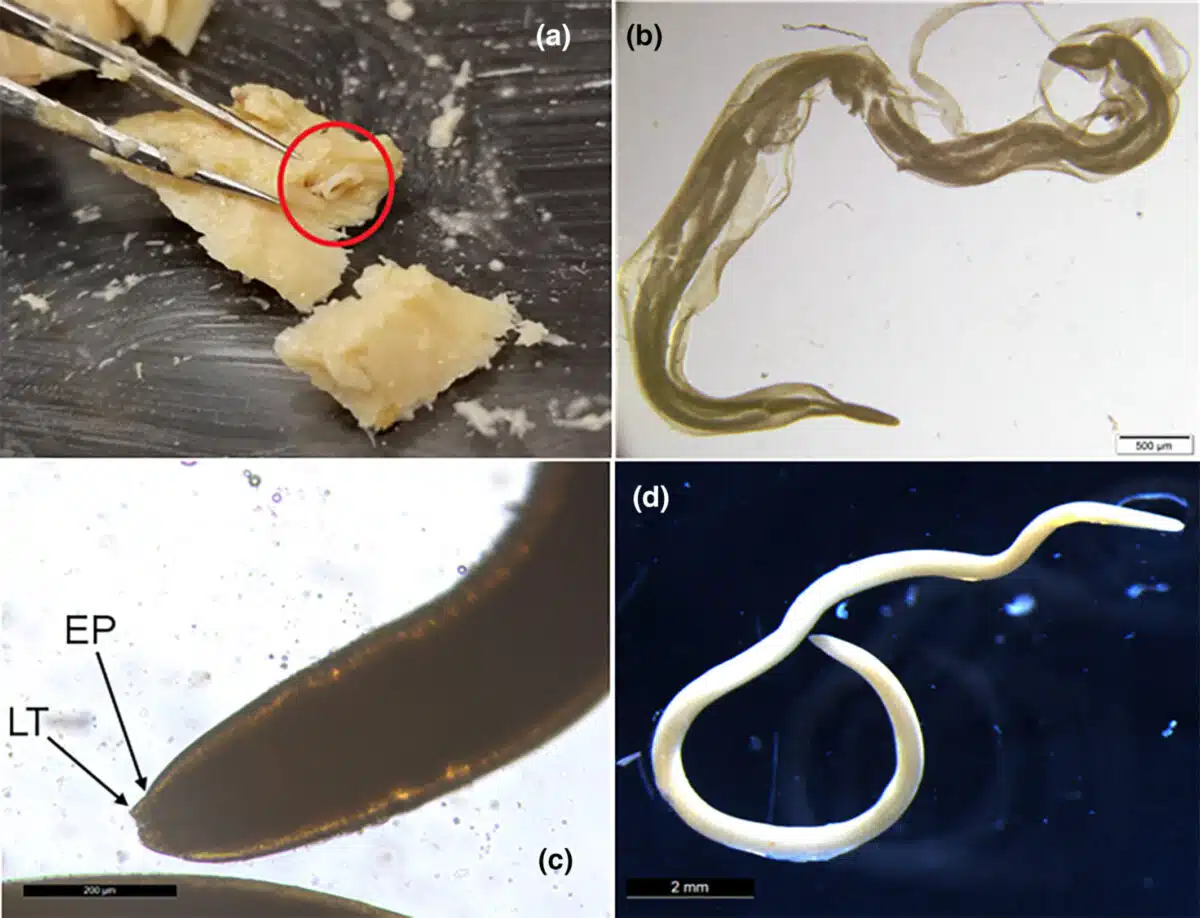 (a) Nematode in canned salmon muscle. (b) Cleared but degraded specimen. (c) Preserved anisakid nematode.
Credit: Ecology and Evolution
Even though the canning process damaged the parasites, the scientists were still able to find and count anisakid worms, marine parasites about one centimeter long.
According to findings reported in 2024, they measured how many worms appeared per gram of salmon, which made it possible to compare results across decades. The samples were not perfect, but they were good enough to build a reliable dataset.
Why Scientists Are Paying Attention to These Worms?
Anisakids move through a chain of hosts that includes krill, fish, and marine mammals. They only complete their life cycle if all these animals are present.
“But the anisakid life cycle integrates many components of the food web. I see their presence as a signal that the fish on your plate came from a healthy ecosystem,” said the parasite ecologist, Chelsea Wood, when the study came out.
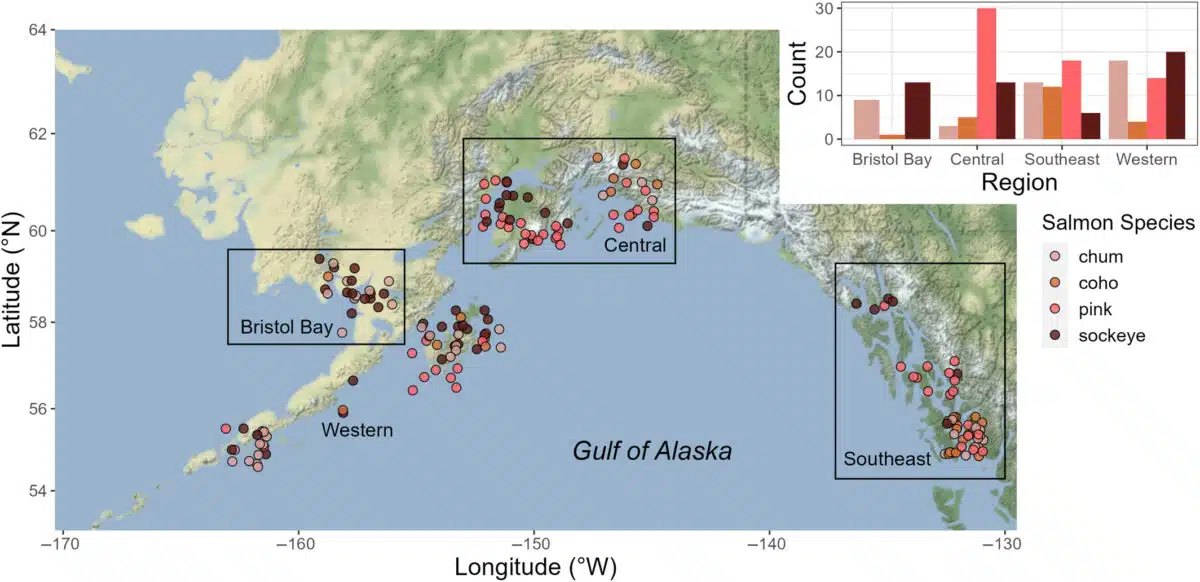 Map of sample collection and canning site.
Credit: Ecology and Evolution
The worms may not look appealing, but they are harmless to humans once the fish is processed.
Not All Salmon Follow the Same Pattern
The researchers found that parasite numbers increased over time in chum and pink salmon, while staying stable in coho and sockeye. As explained by the lead author Natalie Mastick, this increase suggests the parasites were successfully reproducing, which points to the presence of all the necessary hosts.
“Seeing their numbers rise over time, as we did with pink and chum salmon, indicates that these parasites were able to find all the right hosts and reproduce,” she added in an university statement, ” That could indicate a stable or recovering ecosystem, with enough of the right hosts for anisakids.”
But, the stable trend in the other species is less clear. Scientists could only identify the worms at the family level, not by exact species, which may hide more detailed differences. The authors noted that the different parasite species may infect different salmon, leading to these mixed results.