
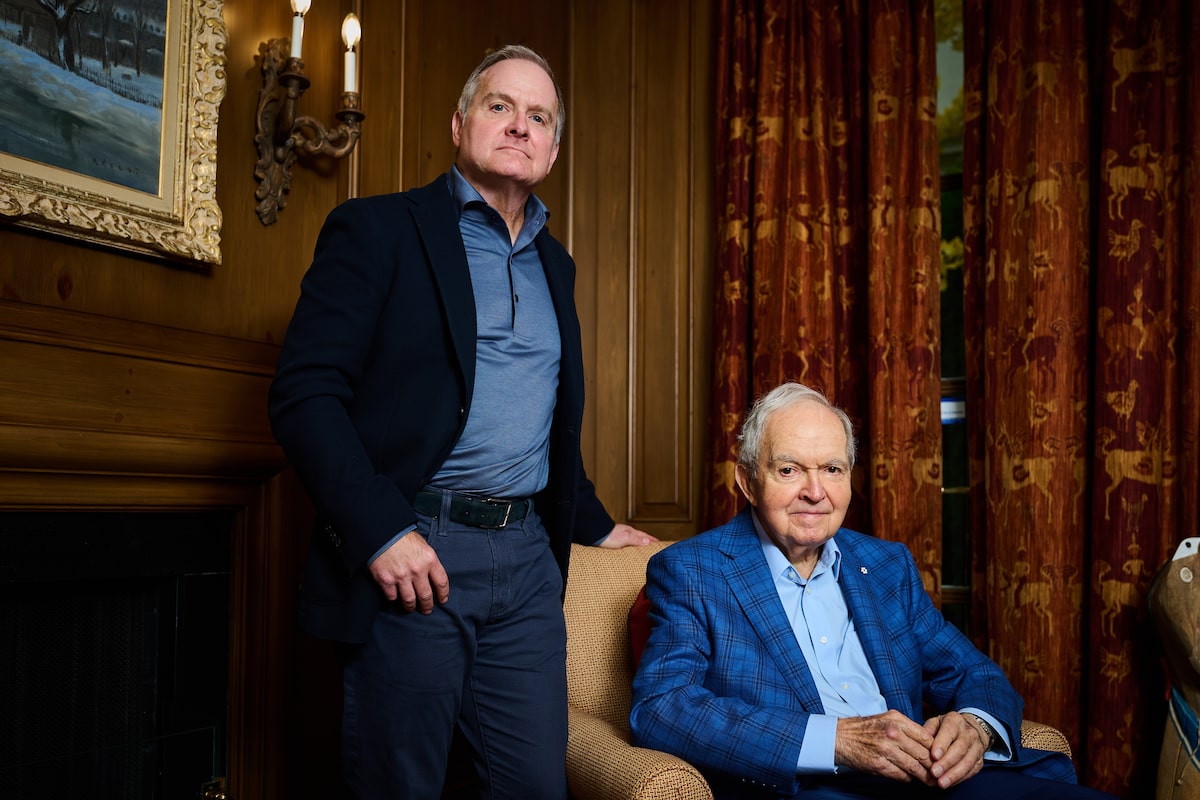
Arthur Labatt, right, and his son John Labatt, in Toronto on Nov. 5, 2025.Sammy Kogan/The Globe and Mail
This is a strange and touching human quirk: A person can give $40-million to charity and still regret that he never finished his BA.
In the case of Arthur Labatt, the 91-year-old scion of the brewing dynasty, who this week donated that sum to make mental-health services and treatment more accessible to children and teenagers, he never finished his undergraduate commerce degree at either the University of Western Ontario or McGill University, both of which he briefly attended.
“I really wasn’t applying myself, and nobody was pushing me,” he admits. He took a year off and wangled a job at establishment-friendly Clarkson Gordon, as the chartered accountancy firm was then known. When it came time to go back and get his degree, his brother asked, why bother? “Which was a shame,” Mr. Labatt says. “It has bothered me all my life that I never completed that.”
Mr. Labatt’s $40-million gift is earmarked for Thriving Minds, a mental-health program for children and adolescents run jointly by Toronto’s Hospital for Sick Children (SickKids) and the Centre for Addiction and Mental Health (CAMH). According to research gathered by SickKids, mental illness afflicts 20 per cent of young Canadians, but only one in five of them receives the treatment and services they need.
“It’s not an easy time to be young,” Mr. Labatt admits. “The world they’re growing up in is more complicated than ever.”
2019: Labatt family donates $20-million to U of T for depression research
The mental-health bureaucracy doesn’t help. Ever-growing demand, funding shortages and the daunting intake and qualification process that guards services all contribute to gaps in the system.
“This gift comes from a vision to create a seamless system across the organizations for children and youth in Toronto, because their access to services is so fragmented,” says Louise Gallagher, the chief of the Child and Youth Mental Health Collaborative at SickKids. “The services are not built to talk to each other and they’re not designed in a systemic way. And so you see these places where people just drop out of care.”
Mr. Labatt’s son John, the other principal behind the gift, speaks openly about his battle with depression. “There have been lots of people in our family who have struggled,” he says. “And we know there are not a lot of places people can go to get help.” Such challenges can affect anyone, regardless of upbringing. “My name’s John Labatt. People automatically assume that I am a certain kind of person. And then there are my parents and keeping up with their achievements. All of that can be a cause of serious anxiety.”
The Labatt endowment will fund development of a new prototype for mental-health access – ”a huge information hub,” as John Labatt describes it, “backed by people triaging what a patient’s needs are and how they can be helped.”
The still-experimental system will give young people and/or their parents a single, easy-to-use entry to the bewildering labyrinth of mental-health services. The portal will open to ever-ready medical teams that will instantly triage the patient. Meanwhile, real-time record-keeping will reach across the health care system to eliminate delays and encourage access to new research and ground-breaking treatments.
The Labatt endowment will fund development of a new prototype for mental-health access.Sammy Kogan/The Globe and Mail
It’s an ambitious plan. “There’s a five- to seven-year timeline on getting it together and testing it out,” John Labatt says. “The idea is that it could be replicated elsewhere in Canada and elsewhere in the world.”
The gift is the second approximately $40-million chunk that Arthur Labatt has donated to SickKids in varying tranches over the years.
Mr. Labatt has a personal connection to SickKids. He wasn’t two years old when he became sick while his parents were travelling in Europe. “They had left me in London, Ont., in the care of a registered nurse and my uncle Hugh and aunt Angela. But I wasn’t progressing very well,” he says.
His uncle eventually called Alan Brown (famously, one of the inventors of Pablum) at Toronto’s Hospital for Sick Children. Dr. Brown made a house call – a three-hour drive either way – and diagnosed a failure to thrive. “That’s a technical term that’s still in existence,” Mr. Labatt notes. Dr. Brown prescribed Lyle’s Golden Syrup and Kepler malt to a brewer’s child, and the patient recovered.
Mr. Labatt went on to an illustrious Bay Street career. The Labatts had sold their beer empire by the time he turned 30, eliminating, to his great disappointment, his chance to run the family business.
His 2½-decade stretch as a chartered accountant (he eventually qualified for the designation by articling at Clarkson) ended in 1981 when he founded Trimark Financial Corporation, a mutual fund company, with Michael Axford and Robert Krembil. The partners each threw in $300,000. It was not an easy go: Some of their investor meetings were attended by as few as 12 people.
The gift is the second approximately $40-million chunk that Arthur Labatt has donated to SickKids in varying tranches over the years.Sammy Kogan/The Globe and Mail
But by 1994, Trimark was on its way to becoming the second-largest fund management company in Canada – whereupon Dick Thomson, the all-powerful head of Toronto-Dominion Bank, showed up to do his famous charity stomp.
“He dropped by my office and said that he was happy to see Trimark doing so well,” Mr. Labatt remembers. “But he had also noticed that Bob Krembil and I had never given any really substantial amounts to charity.”
Mr. Thomson supported SickKids; just like that, so did Arthur Labatt. Mr. Labatt’s initial gifts were aimed at paying research scientists to stay in Canada. He later donated $25-million to establish the Labatt Family Heart Centre and $10-million to name the Arthur and Sonia Labatt Brain Tumour Research Centre, both associated with SickKids.
He first gave money to CAMH a quarter of a century ago, when fundraising for mental health was no-man’s land.
David Goldbloom, the then-head of CAMH, approached Mr. Labatt gingerly. “I was hoping they might make a gift of $100,000 to the hospital,” Dr. Goldbloom recalls. “I nervously steered the conversation to discussing the size of the gift. Arthur said, in his quiet, self-effacing way, that he and Sonia [Mr. Labatt’s wife, who died in 2022] had discussed it and decided to give $5-million. I remember trying to appear unfazed while my head exploded.”
Trimark, incidentally, was sold in 2000 to Invesco, a British (now American) investment shop, for approximately $2.7-billion. Mr. Labatt’s share of the proceeds was estimated at $400-million, not including stock he sold on the company’s way up. Not bad for a guy who never finished university.