
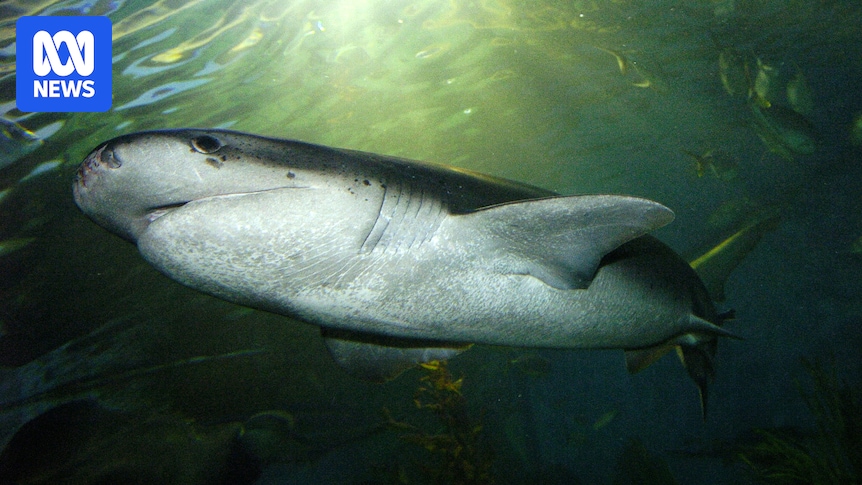
It takes three researchers to haul a two-metre, sevengill shark out of the water onto a boat in Port Phillip Bay.
Careful to keep its jaw shut while stabilising the wriggling swimmer, the scientists funnel water through its gills as they swiftly insert a tracking device under its leather-like skin and collect a blood and tissue sample before returning the animal to its home.
It is one of about 100 sharks and rays Deakin University researchers have tagged over the last two years as part of a study assessing the effect of human impacts and climate change on these species in Melbourne’s bay.
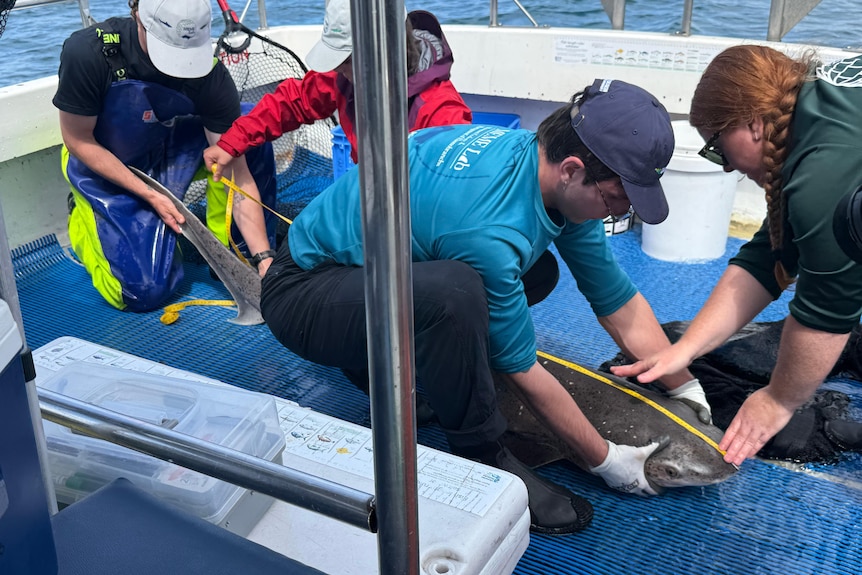
A sevengill shark is caught and tagged before being returned to the water. (ABC News: Natasha Schapova)
“We’re not just looking at fishing, we’re also looking at the shipping channels and the abalone farms and how all those stressors might affect sharks and rays,” said Samantha Sherman, a senior lecturer in fisheries.
Sharks and rays in Port Phillip Bay are not the apex predators many assume them to be, Dr Sherman said.
They are instead known as mesopredators, which eat smaller marine animals while dodging the larger sharks preying on them.
Louisa Graf has been studying banjo sharks in Port Phillip Bay for two years and has located what she believes is their nursery. (Supplied)
“We look at the [species] which are the ones in the middle of the food web, some of the smaller sharks like the Port Jackson and some of the rays like the banjo sharks and Melbourne skate,” she said.
Experts were reporting a decline in the population of sharks and rays over the last few decades, but researchers say numbers are recovering since commercial net fishing was banned in 2022.
The discovery of a likely banjo shark nursery
Close to the entrance of Port Phillip Bay is Swan Bay, near Queenscliff, which Deakin University PhD researcher Louisa Graf believes is a nursery for banjo sharks — which are also known as fiddler rays — and other species.
“What we are starting to see is that the juveniles are more resident within Swan Bay which may indicate they are using it as a nursery,” she said.
Ms Graf has been tracking 60 banjo sharks she tagged to understand how they use Swan Bay and how their behaviour changes throughout different life stages.
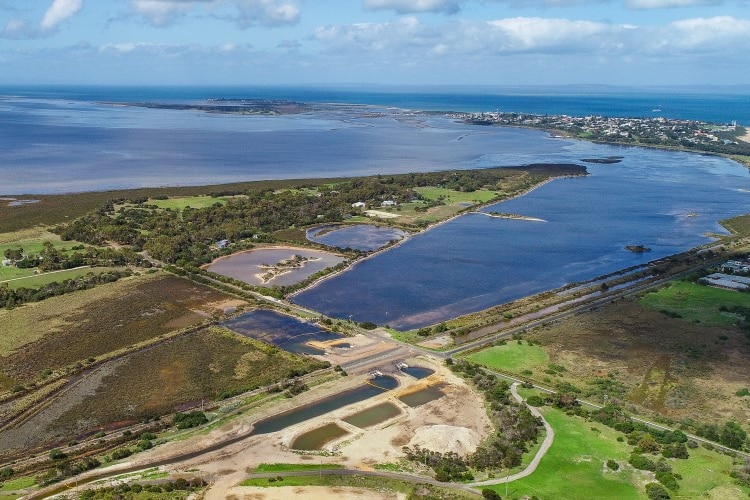
Deakin University researchers believe they have located a key nursery for banjo sharks in Swan Bay. (Source: Swan Bay Environment Association)
Seagrass meadows cover the bottom of the bay and are home to more than 250 animal species, according to the Swan Bay Environment Association.
“In order to have an important nursery we need to make sure that the marine ecosystem is working well,” Ms Graf said.
“The southern Australian coastline is really at risk — it’s a global hotspot for ocean warming so we need to make sure we understand how the sharks and rays are using this area now.
“Then we can implement management protocols to ensure they can be safe in the future.”
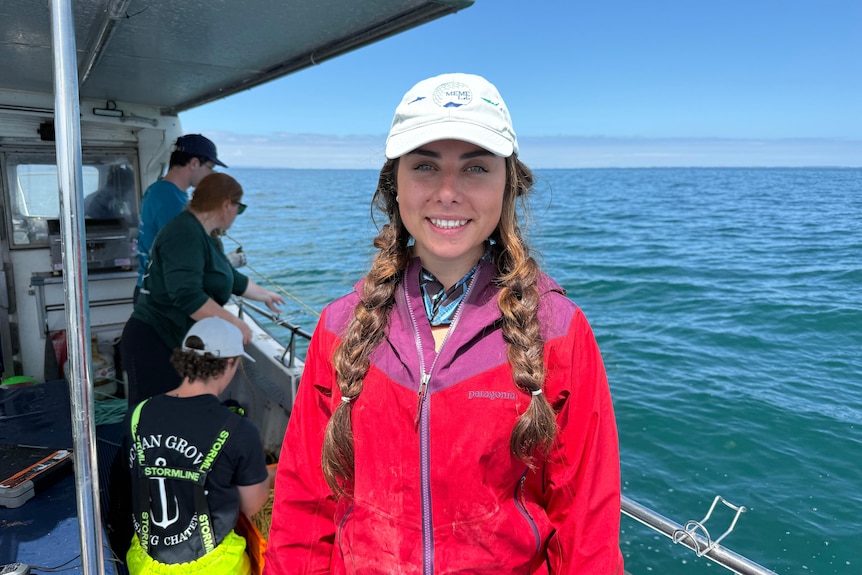
Deakin University researcher Louisa Graf says marine protected areas are an effective strategy to conserve vulnerable species. (ABC News: Natasha Schapova)
Fishing is already banned in parts of Swan Bay, which is a designated Marine Protected Area (MPA) where activity is restricted to safeguard biodiversity.
“MPAs are a brilliant management tool for sharks and rays and if we can continue to show that they are successful then maybe we can designate more along the coastline,” Ms Graf said.
But banjo sharks are one of eight species the Deakin University team have tagged in Port Phillip Bay as part of research that will provide a holistic view of the patterns of the bay’s sharks and rays.
Dr Sherman said it was important to understand the entire ecosystem rather than just individual species as the decline of one may not be detrimental if populations of other species are healthy and can substitute them.
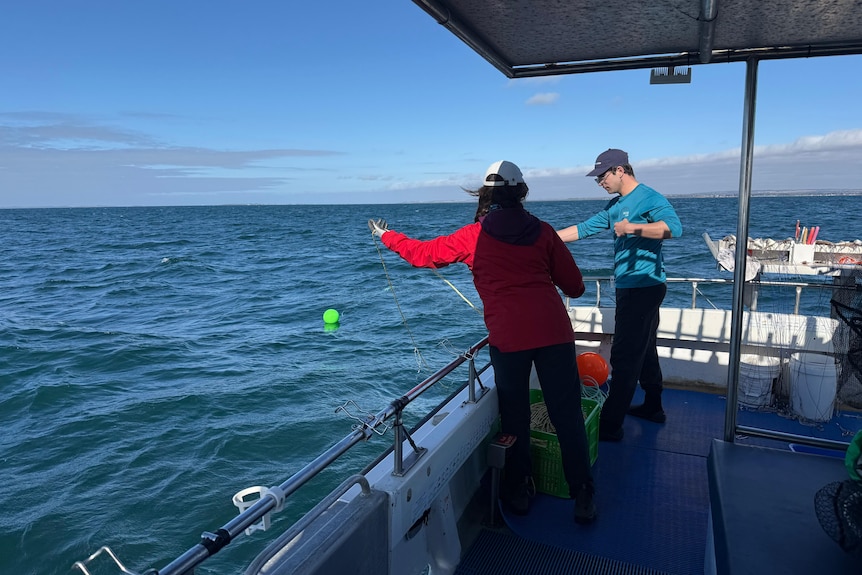
Researchers throw in a line hundreds of metres long to catch marine animals. (ABC News: Natasha Schapova)
“Sharks and rays play really important roles in our ecosystems, they’re responsible for moving nutrients around because they’re bigger than a lot of fish so they move further distances,” she said.
“They also can be prey to some larger animals like the larger sharks, but they also consume some of the smaller animals so they can keep that balance in the ecosystem.”
Dr Sherman said the bay was distinctive due to it being large but shallow and populated along its coastline.
“It’s a system that’s unlike others in the world so we don’t have others that we can use to understand what’s going on here,” she said.
Climate change pushing marine animals into cooler waters
Climate change was forcing marine species to move towards the poles Dr Sherman said, explaining that scientists were already seeing changes to ecosystems.
Sharks seek sea change as water temperature rises
A bull shark was spotted in eastern Victoria in 2024 which Dr Sherman said was likely due to changing currents and temperatures.
“If they keep moving southward eventually, they’ll be in Port Phillip Bay and the impact they would have on the ecosystem would be massive because the species we have here would not be able to outcompete the bull sharks,” she said.
“So even though their populations are fine and not threatened by fishing, they may become threatened by other species moving further south in the future.”
The warming waters would also mean species would have to adapt within the bay, relocate or risk becoming extinct, Dr Sherman said.
But Ms Graf said the data collected when tracking the bay’s sharks and rays could be used in modelling this change in distribution over the next few decades.
“Then we can nominate hotspots or decreases in abundance along the coastline,” she said.
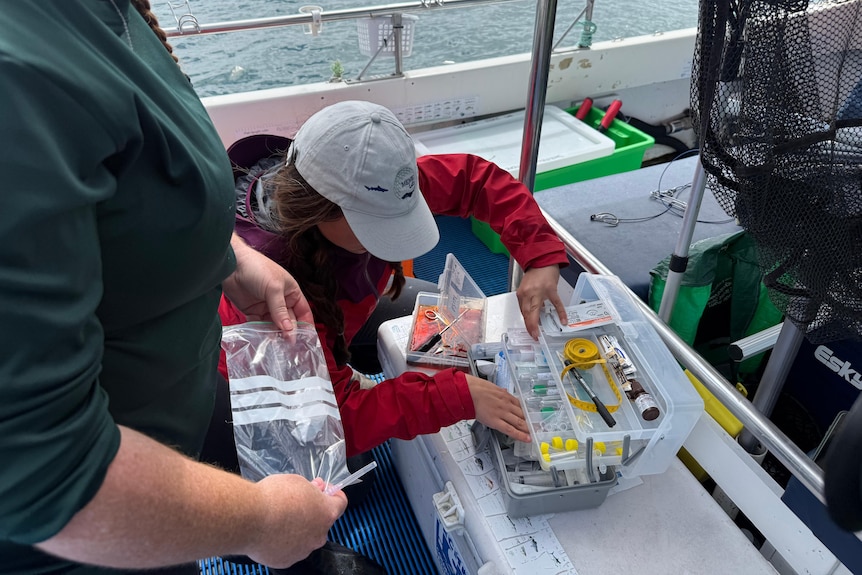
Blood and tissue samples are taken from sharks and rays before the animals are returned. (ABC News: Natasha Schapova)
“Then we can use that [data] to designate, well this is an important area for sharks and rays, this one isn’t as important, are there any MPAs in those hotspots of abundance and maybe there should be,” Ms Graf said.
But researchers said they had observed more illegal behaviour since funding for the Victorian Fishing Authority was cut.
As a result, the authority replaced legal enforcement officers with half the number of engagement officers to patrol waters around the state last year.
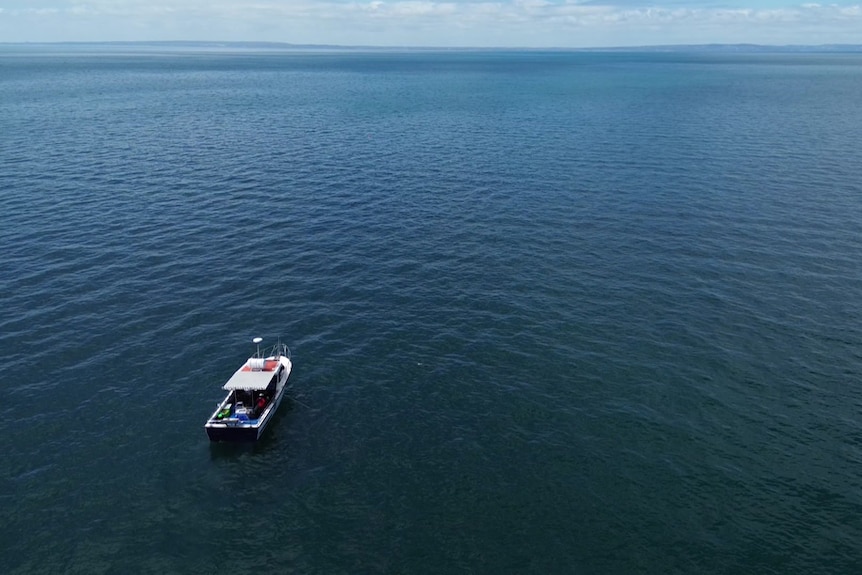
Researchers frequent the bay on a fishing vessel and say they have noticed illegal activity regularly in some areas. (Deakin University: Lily Youngsmith)
“There’s very little monitoring … we are seeing that people are poaching within the marine protected areas,” Dr Sherman said.
A Victorian government spokesperson said the Victorian Fishing Authority had launched the Major Fisheries Crime Unit to target organised illegal fishing.
“Most people in the fishing community are doing the right thing — there is 90 per cent compliance with fishing rules and regulations,” the spokesperson said.