
Before today’s announcement, housing secretary Steve Reed had already earmarked the former Tempsford airfield in Bedfordshire; Crews Hill, near Enfield; and Leeds South Bank as the locations with a chance of delivery during this parliament.
Now four more locations have been added to the list. They are: Manchester Victoria North, Thamesmead, Brabazon and the West Innovation Arc in Bristol and Milton Keynes – one of the original postwar new towns.
The news will be welcomed by a raft of architects already working on the schemes, including Maccreanor Lavington, which has roles on both the Manchester development and Thamesmead in south-east London; and Feilden Clegg Bradley Studios, which is leading on the masterplan for Brabazon, the former Filton Airfield in north Bristol.
Each of the next generation of new towns will see at least 10,000 new homes built, Reed said in an announcement of the plans. However, most will deliver at least 15,000 and up to 40,000 homes, a combined total of almost 200,000 homes.
The housing secretary said in a statement: ‘People want real change – homes they can afford, local infrastructure that works, and good jobs in thriving communities. Our next generation of new towns marks a turning point in how we build for the future.
‘From the ground up, we’re planning whole communities with homes, jobs, transport links, and green spaces designed together – so we can give families the security and opportunities they deserve.’
To support the proposals, development corporations will be set up in the style of the London Legacy Development Corporation (LLDC), which was responsible for the regeneration legacy from the London 2012 Games.
Lyn Garner, the LLDC’s former chief executive, has been appointed an interim advisor to the government’s New Towns Taskforce. So has Ian Piper, former chief executive of the Ebbsfleet Development Corporation; Emma Cariaga, chief operating officer of British Land, and David Rudlin, founding principal of Rudlin & Co and principal author of the UK Government’s National Model Design Code.
Five locations which made up the 12 strong-list of locations proposed to government by the independent New Towns Task Force last year lost out as a result of the announcement. They are: Adlington, Cheshire; Heyford Park, Oxfordshire; Marlcombe, Devon; South Barking, London; Wychavon Town, Worcestershire; and Plymouth, Devon.
Plymouth only recently unveiled Mae architects’ designs for 10,000 new homes as part of a major city-centre regeneration project involving new housing, ‘green streets’ and public spaces. It remains unclear what impact, if any, the government’s announcement will have on these ambitions.
The government previously said an estimated 300,000 new homes could be delivered ‘over decades’ from development of at least 12 new towns, which it said would help the delivery 1.5 million homes in this parliament – a number the government looks increasingly unlikely to meet.
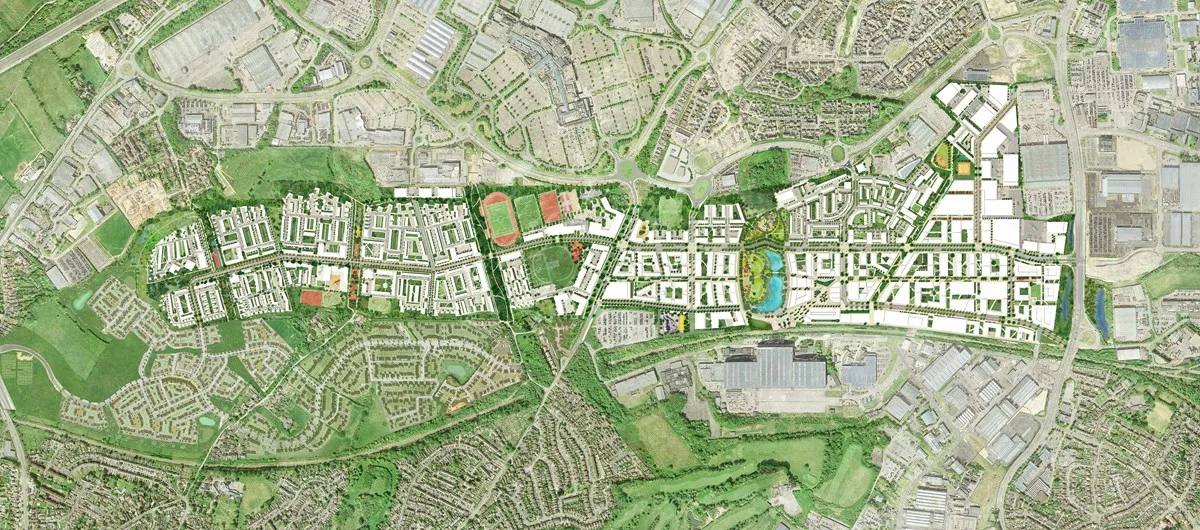
‘Brabazon is part of the West Innovation Arc, and will be a new town at an urban scale. This is a new bit of city, with ambitious density and a vibrant mix of uses, which will help to turbo-charge the economy of the region as well as provide much needed new homes,’ Andy Macintosh, senior associate, Feilden Clegg Bradley Studios.
Comment
Paul Rickard, chief executive, Pocket Living
Confirmation of the location for the proposed seven new towns is a welcome next step in the government’s overall plan for delivering the new homes Britain needs. As well as providing short, medium, and long-term opportunities for the delivery of new homes, this is also a generational opportunity to support SME developers, scaling back up our depleted SME housebuilding industry.
As integrated parts of the wider regional economy within which they sit it is also an opportunity to rethink housing needs and deliver a range of new housing best placed to support economic growth. It is an opportunity to provide a broad range of new and innovative rental tenures such as shared renting and discounted full ownership, an optimal housing strategy designed to aid industry recruitment and retention, as well as key public service provision.
Victoria Du Croz, head of planning and partner, Forsters law firm
While clear direction over the locations that can support thousands of new homes is helpful, it is hard to see a situation where these homes come out the ground fast enough to make a material difference to housing supply. Planning reform is starting to trickle through to projects coming forward but there is a big difference between submitting planning applications and getting spades in the ground. There is every chance that a second planning bill will be coming forward in the next parliament and that could be the necessary step to truly delivering homes at speed.
Acknowledgement of the need for supporting services and infrastructure is important as communities need schools and healthcare facilities to both function and reduce tensions during the planning process, however, there continues to be a lack of reference to logistics centres which are a crucial part of modern-day life. Development corporations are a smart way to ensure strategic oversight and drive forward the new homes and infrastructure required to make new towns a success.
Mark Dewhurst, Manchester office managing partner, Ridge
It’s encouraging to see that two of the three initially identified northern New Town locations have today been shortlisted for the next stage. With housing completions running at their lowest levels in over a decade, and confidence across the construction sector still subdued, it’s a welcome signal of the role the North can play in driving the next phase of housing growth.
What really stands out is that both of the shortlisted locations – Victoria North in Manchester and Leeds South Bank – are firmly ‘urban’. Like many of the others being prioritised, they’re explicitly linked to major transport infrastructure, pointing to a clear direction of travel in how connectivity-led, high-amenity development is being prioritised nationally.
It’s especially positive to see Victoria North included. This sort of scale of development – 15,000 homes and capacity for up to 40,000 residents – is rare, especially within a city of Manchester’s size and economic status. Its inclusion in the proposals is a clear indication that housing at scale is what’s needed to continue the city’s recent momentum, and accelerate the next phase.
In shortlisting these types of schemes, the government is also increasing the likelihood that infrastructure funding, delivery vehicles and wider policy support will be brought forward in a co-ordinated way. That type of early alignment is still one of the main factors in determining whether schemes ultimately succeed.
Melanie Leech chief executive, British Property Federation
Today’s announcement is a welcome next step for this 21st century new towns programme. The sites identified will only be delivered with a combination of public and private sector expertise and given the current viability crisis, will require a laser focus on creating the right conditions to deliver housing at scale and unlock the full economic benefits that will flow from this.
We call on the Government to work with all key partners and representatives to identify and remove barriers to delivery, including infrastructure provision and connectivity, and actively promote those housing tenures, such as Build to Rent and Single-Family Housing, which will accelerate delivery.