
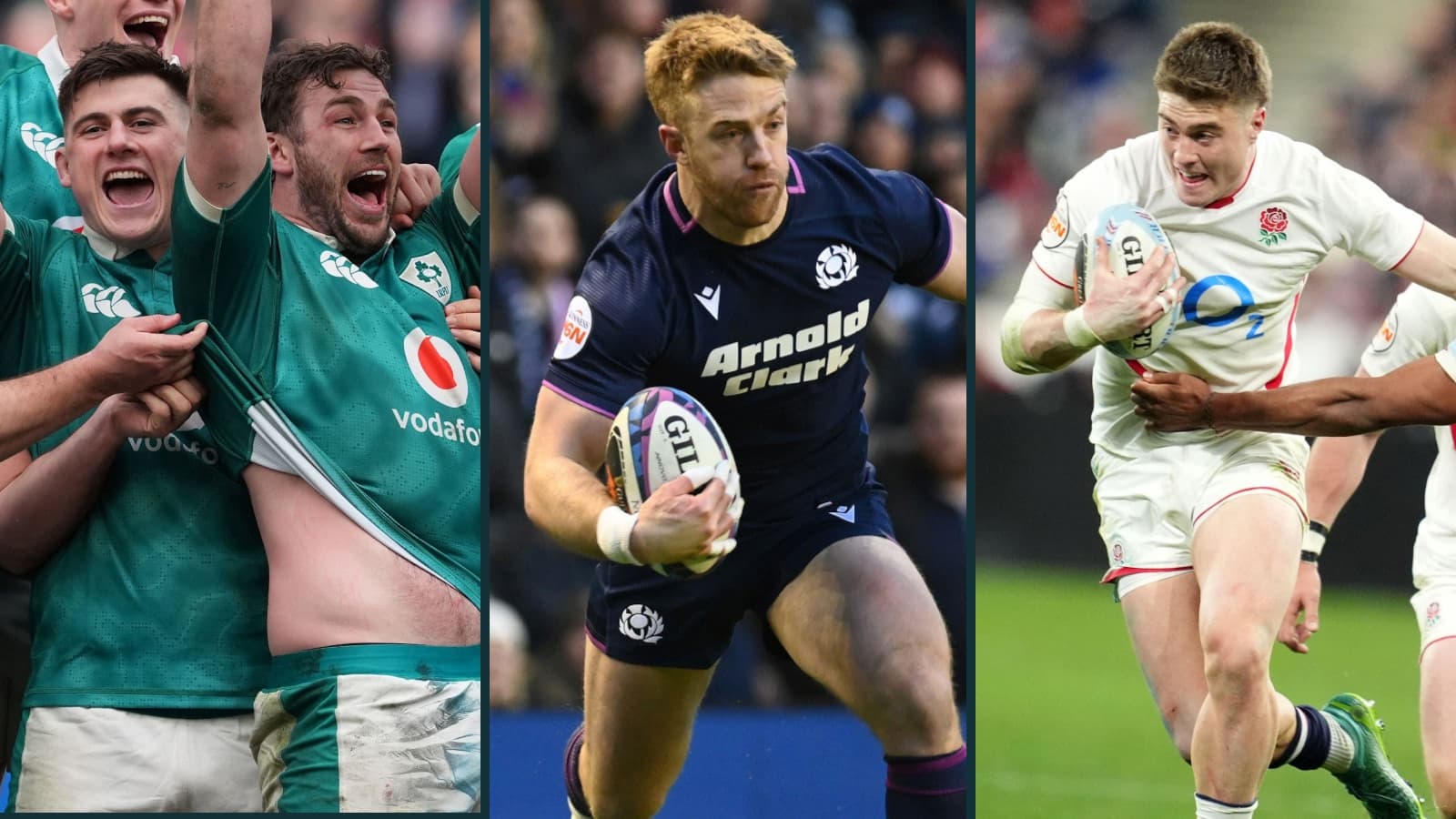
Built from the 2026 Six Nations — and the British and Irish Lions captain doesn’t make the side. This is a bar room argument dressed in a team sheet. Pull up a stool.
Before you remind us, yes, we know the Lions do not tour until 2029. Nobody is being named in any squad, no jersey is being awarded, and Andy Farrell is almost certainly not sitting in a selection meeting right now debating the merits of Aaron Wainwright. This is the kind of conversation that starts in a pub somewhere around Round 3, gets louder after Round 4, and by the final weekend has everyone convinced they could run the Lions better than the actual Lions management. We are entirely here for it.
The rules are simple: Lions-eligible players only, 2026 Six Nations form only, no sentiment, no reputation shopping, no allowances for what a player did in 2023 or 2024. What happened between February and March 2026 is the only evidence that counts. On that basis, this is our considered XV and the eight replacements. The case for each is made and the argument starts now.
2029 Lions team
15 Jamie Osborne (Ireland)
Osborne arrived at this tournament as the injury replacement for Hugo Keenan and left it as one of its defining performers. Four tries across five games, 49 carries, an aerial game that grew in authority with every round, and a command of Ireland’s attacking shape from deep that never looked like borrowed time. Blair Kinghorn pressed his case with energy and Scotland’s revival owed much to his back-three threat, but Osborne’s all-round contribution across a full championship earns him the jersey.
14 Kyle Steyn (Scotland)
The doubts about Steyn over Duhan van der Merwe were answered with considerable authority. His 26 defenders beaten was a joint championship record. His 363 metres carried placed him fourth across all positions and all nations. Three tries. Seven dominant tackles, the only back in the top 16 for that metric. His performance at Murrayfield against France defined his selection case, though it was the consistency across every round that confirmed it. Rob Baloucoune’s power and directness make him a very strong runner-up, but Steyn’s complete package across five rounds earns him the 14 shirt.
13 Huw Jones (Scotland)
With his try in the final round, Jones became Scotland’s all-time leading Six Nations try scorer with 18. That number is not sentiment. Jones has operated across multiple tournament cycles, refined his game considerably, and arrived at the 2026 championship as one of the most intelligent readers of space in the Northern Hemisphere. Garry Ringrose’s class is never in question and his form grew across the tournament, but Jones’s contribution as both finisher and link in Scotland’s attacking structure was marginally the more decisive across five rounds.
12 Stuart McCloskey (Ireland)
At 33, McCloskey produced the inside centre performance of the championship. Six try assists, joint first. 74 carries, third across all positions. 18 dominant contacts, ranked first at a 31% dominant rate. Eight turnovers won, joint first and highest of any back in the tournament. Oval performance rating of 8.6, ranked first across the entire championship. The looping 20-metre left-hand pass to send Baloucoune over against England captured something coaches have understood for years: McCloskey’s skill set extends considerably beyond the physical presence casual observers identify him by. Sione Tuipulotu’s vision and composure are exceptional and he will have a Lions career. On 2026 evidence, McCloskey is the player of the championship.
Ranked: Six Nations teams as kicking is up in 2026 with England’s making ‘striking retreat’
11 Tommy Freeman (England)
Freeman’s selection here requires a word of context. He spent a significant portion of his tournament operating at centre, covering England’s injury and selection chaos in midfield with a composure that belied the circumstances. That he ends up in this Lions XV on the wing is a reflection of where his finishing instinct, his footwork in the final third, and his ability to produce in the moments that matter place him when the positions are sorted out properly. Lowe was sharp throughout and his carry-based threat was consistent. Freeman’s try-scoring contribution and his versatility across the backline across five rounds edges it.
10 Finn Russell (Scotland)
The one-handed pass to Jones against England. The quickly-taken kick-off that created the try against Wales. The orchestration of the 50-40 at Murrayfield that dismantled France. Russell kicked at 87%, landing 20 from 23. When he runs a game on his terms, no Lions-eligible fly-half operates at his level. Fin Smith had an excellent tournament, his accuracy and composure in Rome showed what he offers, and he will figure prominently in Lions conversations as this cycle develops, but Russell’s championship was decisive.
9 Jamison Gibson-Park (Ireland)
His 50th cap. The tempo he sets at the base of the ruck, the distance he covers in defence, the precision of his decision-making under pressure, all of it present across five rounds. Tomos Williams showed genuine Lions quality for Wales in difficult circumstances. Ben White’s form in the back half of the tournament was excellent but Gibson-Park’s combination of experience, accuracy, and intensity places him first.
8 Caelan Doris (Ireland, captain)
The only forward to play every minute of the 2026 championship. 81 tackles, with only two players in the entire tournament recording more. His captaincy of Ireland to the Triple Crown added a cerebral dimension to what was already a talismanic carrying and defensive contribution. Jack Dempsey’s two enormous performances in Scotland’s wins over England and France make him an entirely legitimate runner-up. Doris at eight is the Lions starting point and we would give him the captaincy too. There is a certain symmetry in that. Doris was the frontrunner to captain the 2025 Lions before injury ruled him out of the tour entirely. The armband that should have been his then would be his now.
7 Rory Darge (Scotland)
Five jackal penalties won. More ruck arrivals than any other player in the championship, 209 entries across five rounds. His footwork and running lines in attack surprised opponents who had prepared specifically for his breakdown threat. Darge came into this tournament with questions about whether the form of his early international career had been fully recaptured. Josh van der Flier’s breakdown work remained of the highest order and he will contest this jersey.
6 Aaron Wainwright (Wales)
In a tournament Wales would collectively prefer to forget, Wainwright’s individual contributions were a reminder that Lions selectors watch the player, not the jersey. The most consistent carrier Wales produced across the championship. His defensive line speed and physical presence at the breakdown were a constant threat regardless of the quality around him. His ability to shift between six and eight gives Farrell tactical options the Lions bench requires – whilst both locks can play at six if required. Wainwright earns his starting place on 2026 form.
5 Tadhg Beirne (Ireland)
Selected across every credible team of the tournament from every outlet that ran one. His ability to cover six or either lock position, to compete at the breakdown and in the lineout simultaneously, combined with his consistency across every round makes him irreplaceable in this squad. Chessum’s carrying aggression and lineout physicality alongside Beirne’s breakdown intelligence and lineout timing gives the Lions a second-row pairing of entirely different profiles.
4 Ollie Chessum (England)
A breakaway intercept try in Paris. Lineout and maul dominance that opposition coaches planned specifically for. A carrying game that nearly won England the Rome fixture single-handedly. Chessum was below his standard against Ireland and inconsistent in patches. At his best, he was the most complete lock in the championship. Joe McCarthy pushed his case for Ireland, Scott Cummings was outstanding for Scotland, but Chessum’s ceiling, when reached, is the highest of any available Lions tighthead lock.
3 Joe Heyes (England)
His scrum dominance and the capacity to maintain that physicality into the final quarter of Test matches placed him narrowly ahead of Tadhg Furlong, whose tournament was disrupted by the inconsistency around him in the Ireland set-piece. Tomas Francis’s re-emergence for Wales was one of the tournament’s more compelling late narratives and he added a lot to Wales’ turnaround efforts. But Heyes across five rounds is the evidence-based selection.
Want more from Planet Rugby? Add us as a preferred source on Google to your favourites list for world-class coverage you can trust.
2 Dan Sheehan (Ireland)
Metronomic lineout work and real carrying threat sustained across five rounds. The capacity to operate at full intensity across a full 80. Jamie George’s leadership contribution to England and his emotional authority in the jersey cannot be dismissed lightly and George Turner was a standout for the Scots. But again, on 2026 tournament evidence, Sheehan starts.
1 Ellis Genge (England)
In a tournament where England’s collective performances were frequently difficult to defend, Genge was a consistent physical presence. His scrummaging confrontations against France were notably abrasive and his carrying intent never wavered regardless of the scoreboard. On this evidence, you take 50 minutes of Genge and then you unleash Carre the Carry for 30. That is not a weakness in your squad, that is a plan. Genge’s Test experience and his ability to deliver across the opening hour gives him the loosehead start.
Replacements: Dewi Lake, Rhys Carre, Zander Fagerson, Maro Itoje, Ben Earl, Alex Mann, Ben White, Rob Baloucoune
The bench carries its own headline. Itoje, Lions captain, moves from the starting XV to the replacements on 2026 championship evidence alone. In any other Lions cycle he starts, and his experience of what tours demand on and off the pitch remains irreplaceable. The captaincy question is entirely separate from the selection question, and Farrell will weigh it accordingly. Even putting Itoje on the bench feels slightly generous given Dafydd Jenkins’ form across this championship; Wales may have been the tournament’s whipping boys collectively, but Jenkins was quietly one of its most consistent second rows, and his case for that bench lock slot is stronger than the final selection here suggests.
Baloucoune’s power and directness were outstanding across the tournament, his two-try performances against England and Scotland among the championship’s most explosive individual contributions, and he takes the back-three replacement slot ahead of Darcy Graham on the weight of that evidence. Mann’s 32 tackles against Ireland, the most by any player in a Six Nations fixture since records began in 2000, is the single most striking individual defensive statistic of the championship and it earns him his bench place ahead of several more celebrated names. Carre’s scrummaging case and the pure electric shock of what he produced against Ireland are fully justified. The grin alone was worth a Lions call-up.
As always, Lions selections are some of the most interesting hypothetical selection conversation in Northern Hemisphere rugby. Order another round. This argument has at least three more hours in it.