
In 1947, German psychologist Wolfgang Köhler discovered that people automatically associate certain sounds with certain visual stimuli. In his original study, observers consistently associated the sound Maluma with a round shape and the sound Takete with a spiky shape (Köhler, 1947). Decades later, Ramachandran and Hubbard (2001) found a similar propensity using the sounds bouba and kiki. When asked to associate each sound with one of two shapes, 95 percent of the participants picked the round shape for bouba and the spiky shape for kiki, despite never having seen those shapes before.
The ubiquity of this sound-shape mapping has led theorists to posit that there may be intrinsic associations between sounds and meaning that underlie the evolution of human language. That is, the mapping between sounds and meanings may not be arbitrary, but rather reflect the statistical co-occurrence of these stimuli in our environment. For example, if you imagine the two shapes in the figure below rolling down a hill, the smooth one on the left might make a soft rolling sound similar to bouba, while the spiky one on the right might make sharper sounds similar to kiki.
According to this theory, people pick up these associations from experience, and they end up influencing how words are created in a language.
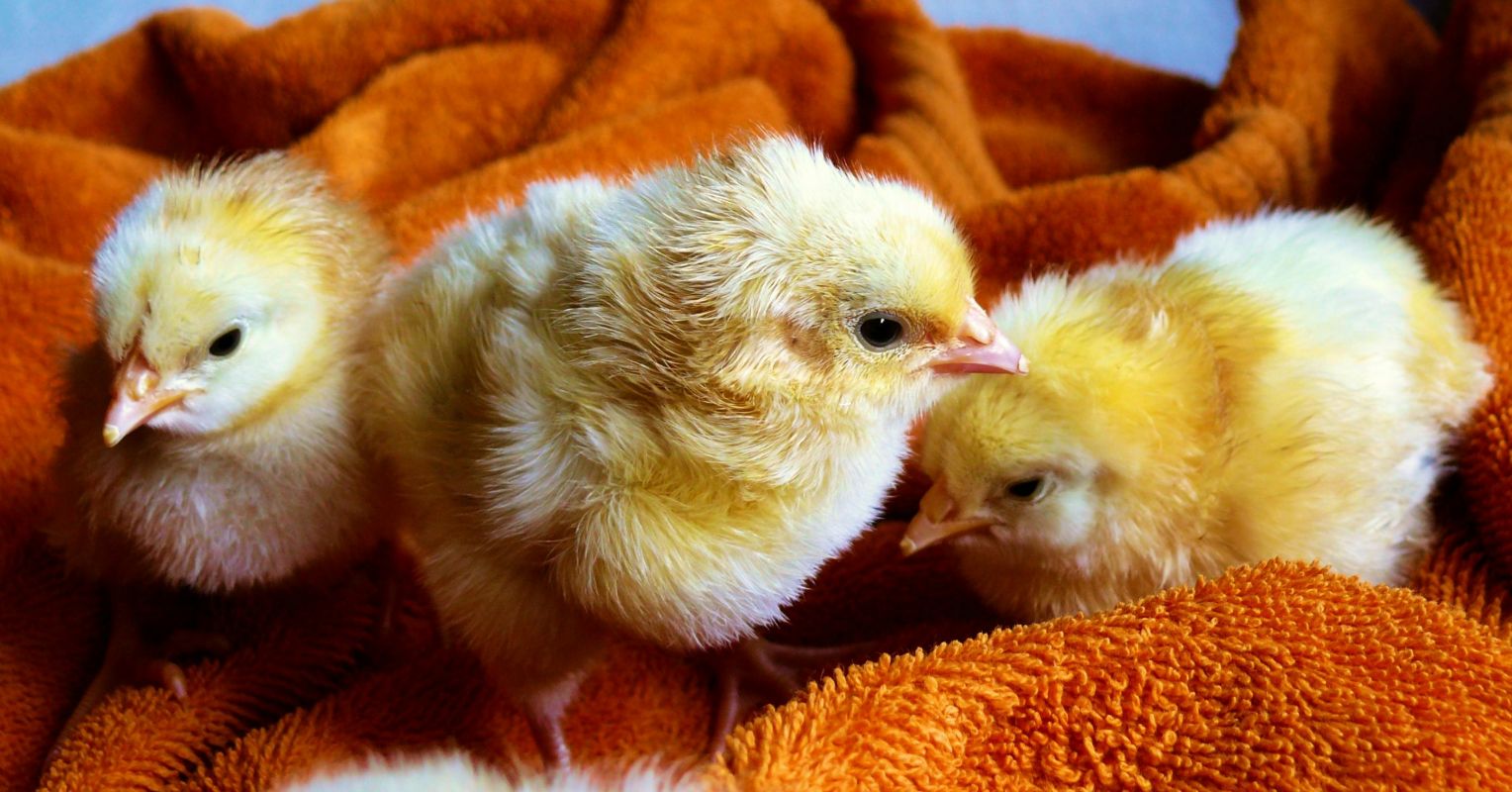
However, a new experiment examining cross-sensory associations in baby chickens challenges this view. Maria Loconsole and co-authors from the University of Padova published a new study in this month’s issue of Science in which they tested baby chickens (3-day-old chickens in study 1, and newborn chickens in study 2). In the first study, 42 baby chickens were first trained to approach a shape with both smooth and spiky parts to obtain a food reward. After training, the chickens were presented with 24 trials in which two shapes appeared side by side (one smooth and one spiky) while the sound of either bouba or kiki was played through a speaker. The results showed a consistent preference among the baby chickens to approach the spiky shape when hearing kiki (56 percent) and the smooth shape when hearing bouba (66 percent).
In the second study, 40 newborn chickens (less than 24 hours after hatching) were first habituated to the same spiky-and-smooth shape as in study 1, but with no food reward. Then they were presented with the two shapes side by side while either bouba or kiki sounds played over the speakers. They found that 80 percent of the chickens in the bouba condition approached the round shape first, whereas only 25 percent of the chickens in the kiki condition did so.
Together, the results provide compelling evidence that some sound-meaning associations do not require learning and are not unique to humans. The newborn chickens in the study had never been exposed to the stimuli before, but somehow already knew to associate bouba with a round shape and kiki with a spiky shape. As impressive as these studies are, it should be noted that other studies have failed to find such associations in other animal species, including primates (see Margiotudi et al., 2019). Therefore, the specific sound-meaning associations studied here are not necessarily universal across all animal species. Future research will need to delineate which cross-sensory associations are universal, which are learned, and which are innately present from the time we are born.