
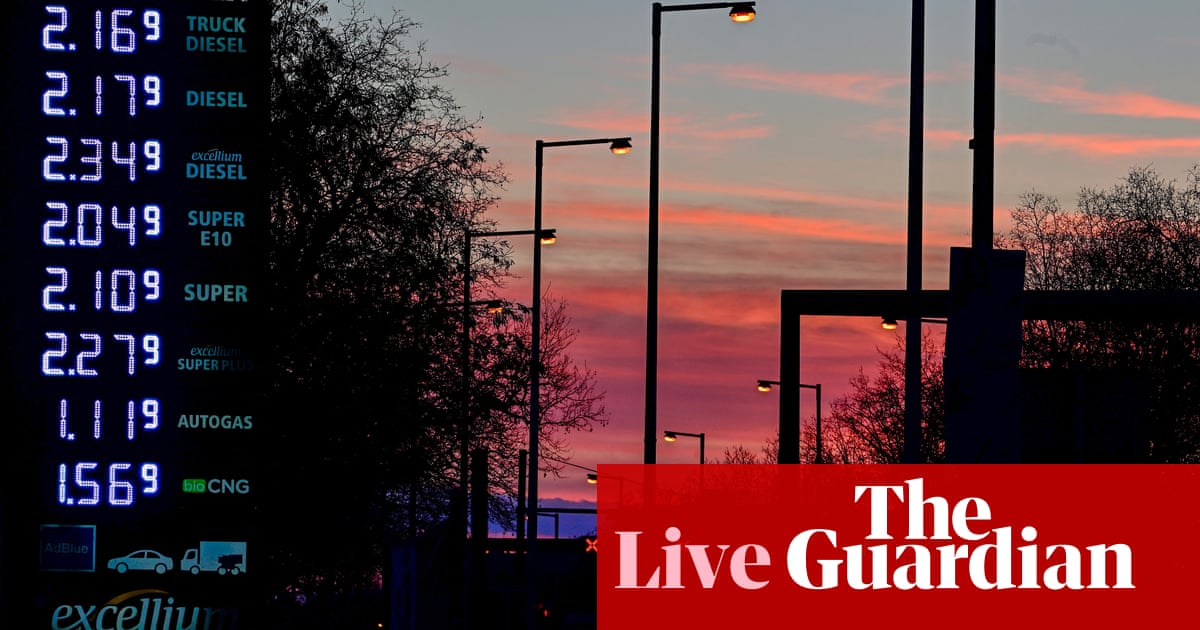
Introduction: Brent crude oil back over $100
Good morning, and welcome to our rolling coverage of business, the financial markets and the world economy.
The dust is settling in the markets after a classic roller-coaster session yesterday, when hopes of de-escalation in the Middle East drove up shares and hit oil.
Yesterday’s equity rally was driven by Donald Trump appearing to blink first in the Iranian war, by claiming “very good” talks had taken place with Tehran and postponing any attacks on Iran’s energy infrastructure for five days.
That was enough to pull European markets out of a nosedive, while the US Dow Jones Industrial Average recorded its strongest daily rise in six weeks. Oil slumped 10%,
But…that optimism may fade, as Iran dismisses Trump’s claim of talks; the Islamic Revolutionary Guards Corps (IRGC) called Trump’s words “psychological operations” that had no impact on Tehran’s fight, while parliamentary speaker Mohammad Baqer Qalibaf said it was “fake news … used to manipulate the financial and oil markets”.
And today, oil is rising again, back over the $100 mark. Brent crude has risen by 2.5% to $102.51 a barrel, as the conflict continues.
Although Trump’s claims have defused some tension, the underlying situation remains “incredibly fragile”, points out Tony Sycamore, market analyst at IG:
double quotation markIran initially denied any knowledge of the talks, although reports suggest the US administration may have identified a potential new negotiating partner open to a ceasefire. However, some of this optimism has been overshadowed this morning by fresh reports of US and Israeli strikes on energy-related buildings in Iran’s Isfahan region, which has seen [US] crude oil bounce 3% to $91.53.
Presumably, these latest strikes are designed to get all of Iran’s new leadership group on the same ceasefire page ahead of Trump’s revised deadline for Iran to reopen the Strait of Hormuz, which is now set for Friday. Crucially, this deadline coincides with the expected arrival of 2,200 Marines of the 31st Marine Expeditionary Unit in the Gulf Region, along with the USS Tripoli and USS New Orleans.
So far today, Asia-Pacific stock markets have risen – recovering some of their losses before Trump’s claims hit the wires. European markets are expected to drop, though, when trading begins.
New surveys of purchasing managers around the world will also show the impact of the conflict, and the surge in energy prices, on the global economy.
The agenda
9am GMT: Eurozone flash PMI report for March
9.30am GMT: UK PMI report for March
9.30am GMT: The Science, Innovation and Technology Committee will question senior representatives of Google, TikTok, X and Meta
1.30pm: Bank of England chief economist Huw Pill speech at central banking conference in North Macedonia
2.30pm GMT: Business and Trade committee hearing on Royal Mail
2.45pm GMT: US PMI report for March
Updated at 03.49 EDT
Key events
Show key events only
Please turn on JavaScript to use this feature
Eurozone growth hit by Middle East crisis as stagflation risks rise
Newsflash: Growth across the eurozone has almost stalled this month, as the Middle East crisis drives up inflation and risks triggering an economic downturn.
The latest poll of purchasing managers across euro area companies has found that output growth has slowed due to a drop in new orders, while input cost inflation has “accelerated sharply” to a three-year high.
The latest ‘flash eurozone PMI report’, from S&P Global, also found that the war has disrupted supply chains, and hurt companies’ optimism over the outlook.
This pulled the Flash Eurozone PMI Composite Output Index down to 50.5, from 51.9 in February, a 10-month low, and close to the 50-point mark showing stagnation.
Chris Williamson, chief business economist at S&P Global Market Intelligence, says the survey shows that eurozone economic growth slowed this month, with a rising risk of a downturn later this year:
double quotation mark“The flash Eurozone PMI is ringing stagflation alarm bells as the war in the Middle East drives prices sharply higher while stifling growth. Firms’ costs are rising at the fastest rate for over three years amid the surge in energy prices and choking of supply chains resulting from the war.
Supplier delays have jumped to their highest since mid-2022, largely linked to shipping issues. “Output growth has meanwhile slowed to nearstagnation thanks to a slump in business confidence and deterioration of new orders. The drop in future output expectations was the largest recorded since Russia’s invasion of Ukraine in 2022.
“The survey data are indicative of eurozone GDP growth slowing to a quarterly rate of just below 0.1% in March with the forward-looking indicators pointing to a heightened risk of a downturn the coming months. The survey’s price gauge is meanwhile indicative of consumer price inflation accelerating close to 3%, with cost pressure likely to add still further to selling price inflation in the coming months.
ShareGrowth in Japan and India hit by Iran war
Evidence is coming in this morning that the Iran war has hurt the global economy.
Surveys of purchasing managers in Japan found that private sector growth has slowed this month, to a three month low.
Data provider S&P Global found that Japanese firms recorded weaker increases in new orders and employment, while confidence around the year-ahead slipped to the lowest for nearly a year amid concerns around the war in the Middle East.
Th war also drive up inflation, with Japanese input costs rising to the greatest extent for 11 months in March.
This left the Flash Japan Composite PMI Output Index at 52.5 points, down from 53.9 in February. Any reading over 50 shows growth.
In India, private sector growth has slowed to its lowest rate since late-2022 as cost inflation climbs to near four-year high.
S&P Global reports:
double quotation markCompanies indicated that the Middle East war, unstable market conditions and inflationary pressures all dampened growth. Input costs and selling charges increased at the fastest rates in 45 and seven months respectively.
The HSBC Flash India Composite PMI Output Index dropped to 56.5 points this month, down from February’s 58.9.
The Iran crisis has not, yet, hit consumer behaviour in the UK, according to DIY chain Kingfisher.
Kingfisher’s chief executive, Thierry Garnier, told reporters that the company “have not seen up to now direct impact” on its customers.
Garnier was speaking after Kingfisher released its latest full-year financial results, which showed a 1.1% rise in like-for-like sales, with pre-tax profits up 23% to £378m.
ShareEuropean markets mixed
European stock markets are a mixed bag this morning.
Germany’s DAX is lagging, down 0.36%, pulled lower by software firm SAP (-3.4%) and pharmaceuticals group Bayer (-1.9%). Italy’s FTSE Mib is down 0.2%.
But France’s CAC 40 is up 0.13%, with luxury goods makers Kering (+1.75%) and Hermes (+1.2%) leading the risers.
ShareUK bond yields dip for second day
UK sovereign debt is strengthening this morning, pushing down the government’s cost of borrowing.
The yield, or interest rate, on two-year UK gilts has dipped by three basis points (0.03 percentage points) to 4.41%.
Ten-year gilt yields are down just 1bp at 4.92%.
Yields fall when price rise, and show the rate of return which bond investors will receive.
Updated at 04.27 EDT
FTSE 100 opens higher
Britain’s stock market has opened higher this morning, as investors try to keep yesterday’s Iran relief rally running.
The FTSE 100 share index is up 39 points, or 0.4%, at 9,933 points this morning, a day after it recovered from an early 2.5% tumble.
But mining companies, housebuilders, and defence companies are lower.
ShareUK crackdown on late payments Phillip Inman
Small businesses can appeal against clients that refuse to pay their bills on time under new rules being brought in by the UK business minister, as part of a package of measures to support faster payments across the economy.
Business minister Peter Kyle said he was implementing “the largest set of reforms in over a generation” by giving powers to the small business commissioner to intervene in disputes and issue millions of pounds worth of fines against the worst offenders.
Reasearch carried out last year by the department of business and trade found that while 8% of businesses said late payments were a “big problem” costing UK firms directly about £7bn a year, 15% of businesses said they avoided doing business with specific customers due to poor payment practices in the previous year.
The department has put the overall cost to the economy at £11bn a year.
Kyle will speak in London this afternoon at the Fast Payer Code awards, which will reward companies for making timely payments for goods and services.
He will describe the measures as the toughest in the G7 in an effort to prevent about 38 businesses from shutting their doors each day – the equivalent of 266 a week.
The rules will include a new 60-day cap on payment terms on all large firms when paying smaller suppliers. Mandatory interest on late payments will also be introduced, with a requirement for all commercial contracts to include statutory interest set at 8% above the Bank of England base rate.
Emma Jones, the small business commissioner will be in the front line, investigating and judging wrongdoing. She said:
double quotation mark“These reforms will reduce the hours spent chasing debt allowing small businesses to focus on more productive and enjoyable growth.”
ShareUK energy minister urges drivers not to change behaviour
The UK’s energy minister has urged motorists not to drive slower nor buy fuel differently because of the Iran oil crisis, insisting there was no need to change their behaviour.
Michael Shanks was asked by Times Radio if drivers should change their habits as a result of the oil restrictions caused by the conflict in the Middle East.
He told the broadcaster:
double quotation mark“They should do everything as absolutely normal because there is no shortage of fuel anywhere in the country at the moment. We monitor this every single day, I look at the numbers personally. There’s no issue at all with that.”
Mr Shanks added thatpeople shouldn’t change their behaviour or their habits in the slightest, saying:
double quotation mark“People should go about their business as normal. That’s what the RAC and the AA have said. It’s really important people do that.
“There’s no shortage of fuel and everything is working as normal.”
ShareAsia-Pacific markets post gains despite Iranian denialsThe foreign exchange dealing room of the Hana Bank headquarters in Seoul, South Korea, today Photograph: Ahn Young-joon/AP
Despite Iran disputing Donald Trump’s claims about constructive talks taking place, most Asia-Pacific markets have posted gains today.
After days of mounting fear and dispair about the Middle East conflict, investors in Tokyo, Seoul and Shanghai are in more hopeful mood today.
Japan’s Nikkei has risen by 2.1%, while South Korea’s Kospi is up 2.8% and China’s CSI 300 gained 1.3%.
Emma Wall, chief investment strategist, Hargreaves Lansdown:
double quotation mark“According to President Donald Trump, preliminary truce talks have begun with Iran. According to Iran, he’s living in la-la-land and the talks never happened. But the markets love hope, and the prospect of a ceasefire was enough to push Brent crude oil down 11% yesterday to below $100 a barrel for the first time in weeks. But the Iran denial, and a report that the UAE and Saudi Arabia are considering entering the war, has sent oil back up to $103.
It’s foreign-policy-by-soundbite, but it is President Trump’s speciality. Announcing plans to extend the previous 48-hour deadline to open the Strait of Hormuz, or else, by five days, he sent a clear signal to the market that the US is ready to make a deal. Just a couple of days earlier, Trump had outlined plans to target Iran’s power plants, and Iran in turn had threatened energy and water infrastructure across the Middle East.
ShareDeutsche Bank: some nervousness has crept back into the market
“Some nervousness” has crept back into the markets today, after yesterday’s relief rally, reports Jim Reid of Deutsche Bank.
He points out that the interest rate on US government debt (10-year Treasury bonds) has risen, while stock market futures in the US and Europe are lower:
double quotation markObviously much now depends on the progress of any talks, and whether the more optimistic rhetoric is followed up by concrete action. Indeed, Iranian officials have repeatedly denied that talks with the US were even happening, which had contributed to markets reversing some of the initial risk-on reaction late yesterday and overnight.
Brent crude has edged back up nearly 4 percent to $103.88/bbl this morning, with futures on the S&P 500 (-0.69%) and STOXX 50 (-0.84%) notably lower. 10yr USTs are +3.8bps at 4.38%. So some nervousness has crept back in.
The WSJ last night reported that Saudi Arabia and the UAE were considering joining the war against Iran which hasn’t helped sentiment.
ShareIntroduction: Brent crude oil back over $100
Good morning, and welcome to our rolling coverage of business, the financial markets and the world economy.
The dust is settling in the markets after a classic roller-coaster session yesterday, when hopes of de-escalation in the Middle East drove up shares and hit oil.
Yesterday’s equity rally was driven by Donald Trump appearing to blink first in the Iranian war, by claiming “very good” talks had taken place with Tehran and postponing any attacks on Iran’s energy infrastructure for five days.
That was enough to pull European markets out of a nosedive, while the US Dow Jones Industrial Average recorded its strongest daily rise in six weeks. Oil slumped 10%,
But…that optimism may fade, as Iran dismisses Trump’s claim of talks; the Islamic Revolutionary Guards Corps (IRGC) called Trump’s words “psychological operations” that had no impact on Tehran’s fight, while parliamentary speaker Mohammad Baqer Qalibaf said it was “fake news … used to manipulate the financial and oil markets”.
And today, oil is rising again, back over the $100 mark. Brent crude has risen by 2.5% to $102.51 a barrel, as the conflict continues.
Although Trump’s claims have defused some tension, the underlying situation remains “incredibly fragile”, points out Tony Sycamore, market analyst at IG:
double quotation markIran initially denied any knowledge of the talks, although reports suggest the US administration may have identified a potential new negotiating partner open to a ceasefire. However, some of this optimism has been overshadowed this morning by fresh reports of US and Israeli strikes on energy-related buildings in Iran’s Isfahan region, which has seen [US] crude oil bounce 3% to $91.53.
Presumably, these latest strikes are designed to get all of Iran’s new leadership group on the same ceasefire page ahead of Trump’s revised deadline for Iran to reopen the Strait of Hormuz, which is now set for Friday. Crucially, this deadline coincides with the expected arrival of 2,200 Marines of the 31st Marine Expeditionary Unit in the Gulf Region, along with the USS Tripoli and USS New Orleans.
So far today, Asia-Pacific stock markets have risen – recovering some of their losses before Trump’s claims hit the wires. European markets are expected to drop, though, when trading begins.
New surveys of purchasing managers around the world will also show the impact of the conflict, and the surge in energy prices, on the global economy.
The agenda
9am GMT: Eurozone flash PMI report for March
9.30am GMT: UK PMI report for March
9.30am GMT: The Science, Innovation and Technology Committee will question senior representatives of Google, TikTok, X and Meta
1.30pm: Bank of England chief economist Huw Pill speech at central banking conference in North Macedonia
2.30pm GMT: Business and Trade committee hearing on Royal Mail
2.45pm GMT: US PMI report for March
Updated at 03.49 EDT