
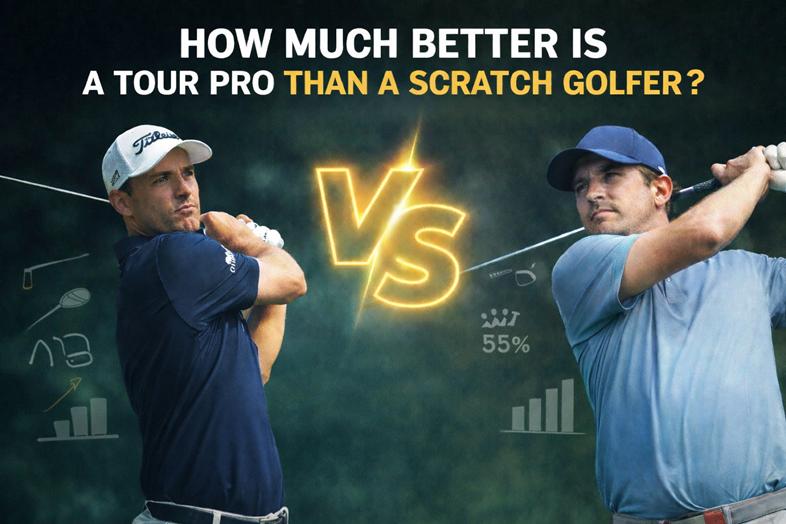
Scratch golfers are in the top fraction of players worldwide, but how big is the gap between them and a PGA Tour pro? The data reveals exactly where the biggest differences lie.
Scratch golfers sit at the top end of amateur golf. According to the data, fewer than 2% of golfers ever reach a handicap index of 0.0 or better. These are players who can consistently shoot around par, strike the ball well, and avoid the kind of mistakes that plague most club golfers.
And yet, compared with a PGA Tour professional, even a scratch golfer begins to look decidedly average.
Tour pros typically carry handicap equivalents of around +7, meaning they would have to give a scratch golfer roughly seven strokes in a head-to-head match just to make things even. Some suggest the gap is even bigger, and that a scratch player is closer to a 10- or 15-handicapper than a tour pro.
But what does the data say about how big the gap really is? And how do tour pros separate themselves?
To find out, we compared the key performance stats of the average PGA Tour player with those of a scratch golfer.
Tour numbers come from 2025 PGA Tour statistics, as the 2026 season is still too fresh to have reliable patterns, while the scratch golfer data comes from Shot Scope performance tracking, which aggregated 74 million shots recorded by amateur golfers last year.
Breaking the game down into driving, approach play, short game, putting, and scoring reveals exactly where the biggest differences lie – and where they’re surprisingly small.
Like this article? See more TG content in your feed! Click here to add Today’s Golfer as a preferred source on Google.
 Off the tee
The stereotype is that PGA Tour players simply bomb the ball miles past amateurs. There’s some truth in that, but the 400-yard drives we occasionally see on TV are the exception, not the norm.
While the very longest hitters on tour average over 320 yards, the tour average is a still-impressive but slightly more relatable 302.8 yards. That puts them roughly 27 yards ahead of the average scratch golfer.
Considering the average PGA Tour course is around 7,300 yards, that distance levels the playing field against scratch amateurs, most of whom are playing considerably shorter layouts.
Driving distance
PGA Tour = 302.8 yards
Scratch golfer = 266 yards
Impressively, despite driving it substantially further, tour players are also more accurate.
The straightest drivers on tour hit nearly three-quarters of fairways, but the tour average sits at 60.64%. Scratch golfers, by comparison, find the short grass about half the time.
Over the course of a round, that works out at one or two extra fairways hit, which feeds into easier approach shots.
Fairways hit
PGA Tour = 60.64%
Scratch golfer = 50%
 Approach play
Approach play is where the gap between PGA Tour pros and scratch golfers really starts to open up.
PGA Tour players hit two-thirds of greens in regulation, while scratch golfers hit just over half.
Greens in Regulation
PGA Tour = 66.56%
Scratch golfer = 52%
That’s roughly two to three additional greens per round, which immediately creates more birdie chances and fewer scrambling situations.
But the real difference shows up when you look at proximity to the hole.
Across all approach shots, tour players average 37 feet 5 inches, while scratch golfers average 65 feet.
Proximity to hole (all approaches)
PGA Tour = 37’5”
Scratch golfer = 65’
That’s almost half the distance, dramatically increasing birdie chances while reducing the likelihood of long two-putts.
The gap widens as the approach shots get longer.
Proximity to hole (75-100y)
PGA Tour = 17’8”
Scratch golfer = 27’
Proximity to hole (100-125y)
PGA Tour = 19’9”
Scratch golfer = 34’
Proximity to hole (125-150y)
PGA Tour = 23’6”
Scratch golfer = 41’
Proximity to hole (150-175y)
PGA Tour = 28’1”
Scratch golfer = 47’
Proximity to hole (175-200y)
PGA Tour = 33’9”
Scratch golfer = 65’
Proximity to hole (200-225y)
PGA Tour = 41’4”
Scratch golfer = 102’
By the time you get into longer irons, the difference becomes dramatic. From 200 yards, a tour pro is often putting for birdie. A scratch golfer is usually just hoping to find the green.
 Short game
If you’ve ever been told that the main thing separating tour pros from amateurs is their short game, the numbers tell a slightly different story.
Tour pros do have the edge – but the gap is smaller than in most other areas of the game.
Up and down percentage
PGA Tour = 58.52%
Scratch golfer = 54%
That works out at roughly one extra successful scramble every couple of rounds.
Of course, you could argue that tour players often face more difficult recovery shots – thicker rough, tighter lies, faster greens, and less accessible pin positions – but the comparison still shows that elite amateurs are already extremely competent around the greens.
Where the difference becomes much clearer is in bunker play.
Tour professionals get up and down from sand more than half the time, while scratch golfers manage it just over a third of the time.
Sand save
PGA Tour = 56.52%
Scratch golfer = 37%
You could make the counterargument that PGA Tour bunkers tend to be more consistent than those at most amateur courses. But realistically, there’s probably no substitute for the sheer number of practice hours tour players devote to bunker shots.
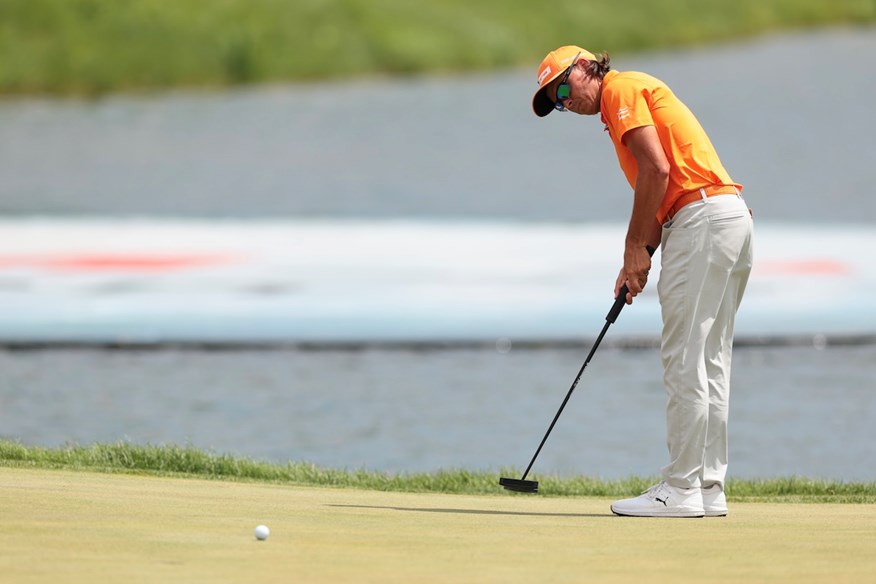 Putting
Putting is probably the most misunderstood area of the game.
Broadcasters know that watching players two-putt from 20’ isn’t scintillating viewing, so you see a disproportionate number of long ones holed when watching live coverage of tour golf.
In reality, the difference between a tour pro and a scratch golfer on the greens is smaller than many people think.
Putts per round
PGA Tour = 29.05
Scratch golfer = 29.9
That’s less than one putt per round difference between a scratch golfer and a PGA Tour pro.
From very short range, both groups are almost automatic.
0-3 feet
PGA Tour = 99.51%
Scratch golfer = 98%
The margins widen slightly as distances increase, but the biggest difference isn’t necessarily holing more putts – it’s avoiding costly mistakes.
Scratch golfers average a three-putt roughly once every 20 holes, while the average tour pro has one every 35 holes.
3-putts per round
PGA Tour = 0.52
Scratch golfer = 0.9
The very best putters on the PGA Tour are even more efficient, sometimes averaging a three-putt only once every 60-70 holes.
 Scoring
Ultimately, all of these differences show up in the statistic that matters most: score.
A golfer can maintain a scratch handicap while averaging a couple of shots over par. On the PGA Tour, however, that wouldn’t come close to keeping a card.
Average score
PGA Tour = -0.921
Scratch golfer = +2.01
That’s nearly three shots per round difference, despite tour players competing on longer and significantly tougher courses.
Both groups average over par on par-3 holes and par-4 holes, and under par on par-5 holes.
PlayerPar 3Par 4Par 5PGA Tour3.064.034.61Scratch3.24.24.8
Where tour pros really separate themselves is in birdies and mistake avoidance.
Birdies per round
PGA Tour = 3.8
Scratch golfer = 2.34
Bogeys or worse per round
PGA Tour = 2.92
Scratch golfer = 4.14
In other words, tour players make more birdies and significantly fewer costly mistakes – a combination that quickly adds up over four rounds of tournament golf.
The bottom line
Scratch golfers are exceptional players. They typically hit a decent number of greens and scramble well when they miss.
But the data, unsurprisingly, puts their skill level into perspective. PGA Tour professionals are better in every measurable category – and by some margin, in most.
There are significant gaps in driving distance, approach play, sand saves, and fewer putting mistakes. Tour players hit their irons closer, more often – which leads to more birdie chances and fewer stressful par saves.
That’s the difference between someone who can shoot level par or slightly better at a normal course and someone who can shoot 62 against the best players in the world on the toughest layouts known to man.