
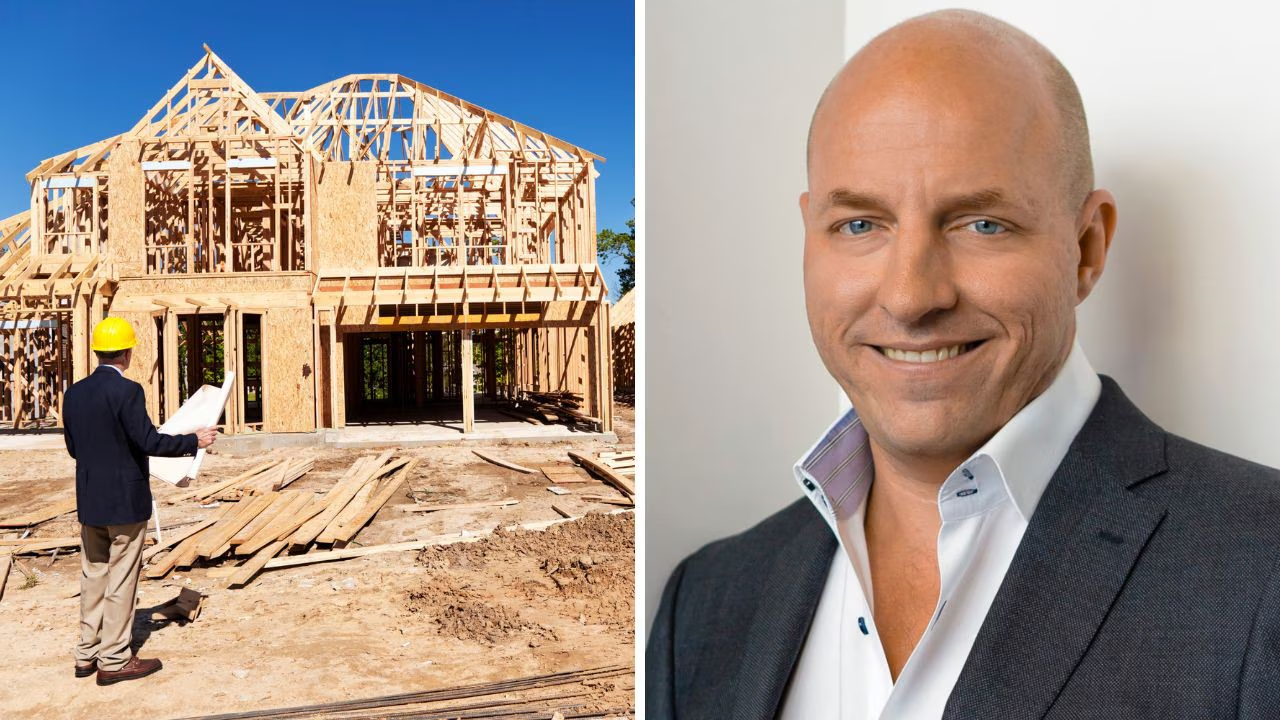
Key building materials are soaring in price by as much as 36 per cent as war in the Middle East threatens to bring Aussie construction projects to a standstill.
Fuel surcharges, supply train disruptions and financing pressure from the recent cash rate hike are biting down on a sector that had barely recovered from similar chaos during Covid.
Reece Group, the country’s biggest supplier of plumbing materials, has informed customers of massive price increases taking effect from April 18.
Prices for HDPE pipe and fittings – used in civil infrastructure – will increase by up to 36 per cent.
Twinwall Corrugated Stormwater Pipe and Fittings – used in stormwater drainage – will increase by up to 31 per cent, while PVC Pipe and Fittings, the most common material for residential plumbing, will be hiked by up to 28.5 per cent.
MORE:Why constuction costs are about to boom
Oil is used in the manufacturing process for plastics, and Australia also imports most of its plastic products from overseas, meaning higher fuel prices impact the cost of getting them to our shores.
“This issue affects our entire industry, and things are changing daily,” a Reece Group spokesperson told news.com.au.
“Like we always do, we’re focusing on helping our long term customers who want to understand and plan for what the impact on their business might be.”
Master Builders CEO Denita Wawn said builders were also reporting price increases for cement, ceramics and glass.
“Due to fixed price contract arrangements, most builders are being forced to absorb these cost increases,” Ms Wawn told news.com.au.
“This could flip many homebuilding projects from profitability to being loss-making for the builders concerned. Where costs could go is hard to predict, with the situation continuing to move.”
‘There goes Australian residential construction’
Executive chairman of online freight marketplace Loadshift, Matt Barrie, said both the cost of building materials, and the price for moving them around the country, had skyrocketed.
“We import everything, we don’t refine fuels — we’re completely reliant as a price taker on everything,” Mr Barrie told news.com.au.
“There goes Australian residential construction,” was Mr Barrie’s comment on the letter from Reece Group to customers.
Australia’s construction costs were already surging before the Iran war, but now they’re facing even more upward pressure — threatening the federal government’s pledge to build 1.2 million homes over 5 years.
The result could be cost increases of a similar to magnitude to the pandemic, which saw a 30.8 per cent total increase in house-building costs, driven by timber (up 40 per cent) and steel (up 42 per cent).
Ms Wawn pointed out that even before the current crisis, the cost of building a new house was 47 per cent higher than it was just before Covid.
“Builders are now looking for alternative routes for product coming particularly out of Europe,” she told the ABC.
“In one instance, we’ve heard of a tenfold increase in the freight costs between shipping and air freight. So it feels like Covid.”
MORE: How petrol price spike could hit home values
Mr Barrie said Australia was uniquely exposed to the geopolitical shockwaves emanating from the Middle East because it had allowed its manufacturing sector to “disintegrate” and lacked the infrastructure to refine enough diesel.
“You’d expect that across the board, construction materials will see at least a 30 per cent rise,” he said.
“Construction’s a big one, simply because the banks are so exposed to it… But then from a survival perspective you’ve got to get meat into the local Woolies.
“We’re a country that’s completely reliant on trucking to get anything done, and trucking relies on diesel.”
He said heavy haulage carriers had imposed a 40 per cent fuel levy this week, up from 30 per cent last week.
In addition to the high cost of diesel, which had doubled, truckers were also forking out massive amounts to cover the federal government’s diesel excise at the bowser.
The average load in Australia travels 1,450 kilometres, which currently requires up to $2,500 of diesel, Mr Barrie said, with the diesel excise making up $635 of that cost.
“Anthony Albanese should immediately suspend the fuel excise on diesel, because diesel is what powers the nation.”