
Nature Notes | Bob Jarman looks at the history of the species in the county and beyond.
The legend of ravens in the Tower of London says that if they leave, the tower will fall and the kingdom will fall.
 A raven at the Tower of London. Picture: Paul Brackley
Some claim the legend comes from the reign of King Charles II (1660-85) while others claim it was invented in the Victorian era. The last time wild ravens bred in London was in 1826 and the earliest reference to captive bred ravens in the Tower of London was in an illustration in 1883.
Ravens in the Tower of London survived the bombing in the Second World War and were increased to six birds and enlisted as soldiers of the kingdom. Numbers were increased to eight to mark Queen Elizabeth’s Diamond Jubilee in 2012.
The raven used to be a bird only of uplands, moors and coastal cliffs but that has all changed. It was once heavily persecuted, like the common buzzard, and accused of killing newborn lambs or, even worse, pecking out their eyes. It is now accepted that these rumours were not true and they are mainly carrion feeders that may feed on still-born lambs and afterbirths. The raven is a protected species under the Wildlife and Countryside Act (1981).
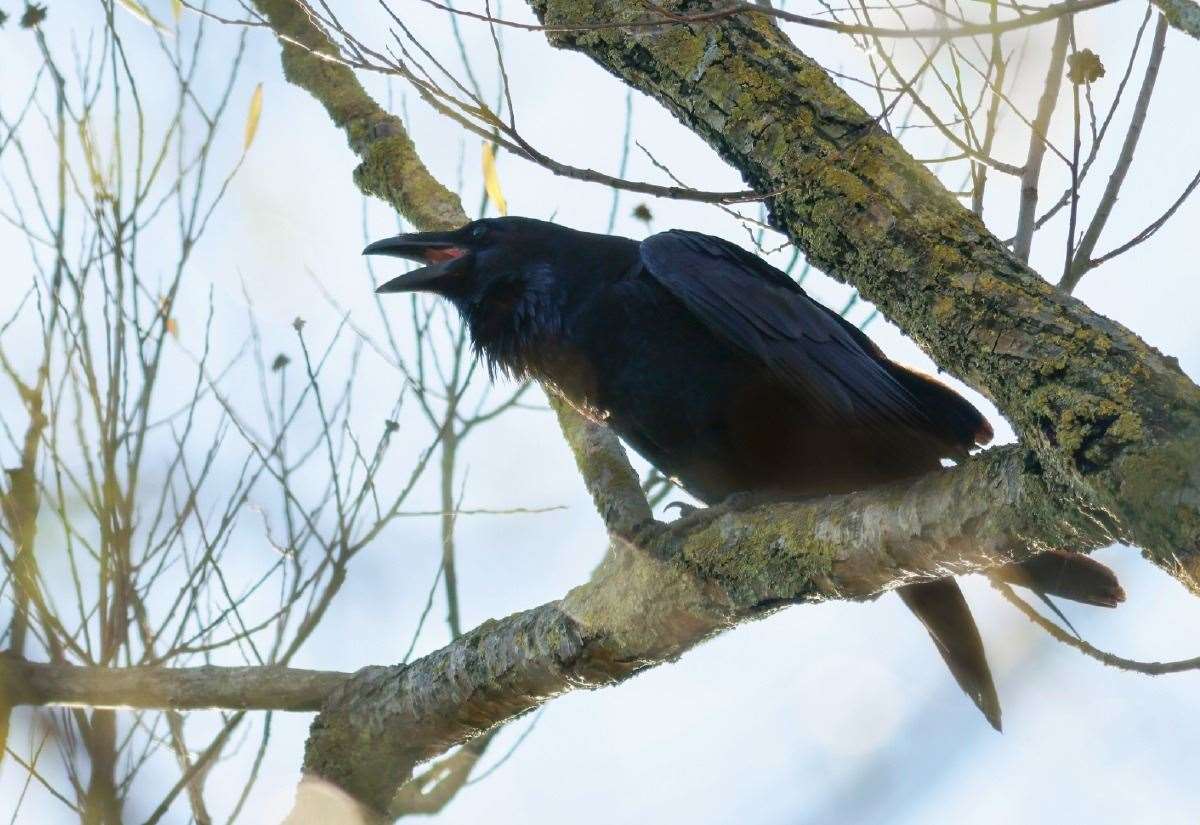
A raven at Milton Country Park. Picture: Jon Heath
Ravens have now spread east and have become birds of mixed lowland farmland and isolated woods. The latest atlas of bird distribution says that only the raven and common buzzard share this pattern of eastern range expansion in Britain.
Ravens were first recorded in Cambridgeshire in 1828 and there were no further county records until 1962.
The sighting in 1962 was followed over 30 years later by sightings of single birds in 1997 and 2002 in the west of the county at Elsworth. In 2004, there were two sightings in Cambridgeshire and a breeding record from neighbouring Bedfordshire: the first breeding record there since the 19th century. From 2005 to 2013 there were from two to six county records each year of just two to three birds.
Ravens in flight. Picture: Jon Heath
From 2014 everything changed: there were 12 records totalling 24 birds. The first Cambridgeshire breeding record since 1828 was in 2015 at Kimbolton, and in 2016 two pairs bred at two secret sites in the west of the county. Ravens breed at three years old, pair for life and have an estimated lifespan of 18 years. By 2017 and 2018 seven pairs were breeding at six sites, including Wimpole Park.
County breeding records are probably an underestimate. Ravens are very early breeders often nesting in late February/early March mostly in parklands and woods away from regular birdwatching sites. In 2023, breeding was confirmed at seven sites including Northstowe and Wilburton and suspected at three more.
In 2022, a pre-roost gathering of 49 was counted in pig fields at Heydon which increased to 65 in June 2023. Ravens have since been reported at 525 sites across the county.
A jackdaw. Picture: Bob Jarman
I have seen pairs displaying over Madingley Wood and Impington with their characteristic “tumbling” display flight and very distinctive deep “cronking” call. Recent sightings in the city include single birds over Churchill College and Robinson College, Nuttings Road, Wandlebury, the Backs, Ditton Meadows, Granchester Meadows and Hobson’s Park.
Further afield in the county ravens have been reported recently from Chrishall, Cottenham Long Drove, Fowlmere RSPB reserve, Grafham Water, Great Chishill, Hardwick Wood, Nene Washes RSPB reserve, Ouse Fen RSPB reserve, Smithey Fen, Southey Wood, Wicken Fen and, most recently, a pair at Milton Country Park.
A rook. Picture: Bob Jarman
Ravens are not always easy to tell apart from carrion crows, rooks and jackdaws – all of which are smaller, though size can be hard to judge at distance. They are the largest of the crow family, even larger than common buzzards, and in flight have longer, more angular wings, a wedge-shaped tail, a heavy thick black bill and a very distinct deep “cronking” flight call. This time of year they have a distinctive tumbling and twisting display flight very different from carrion crows and rooks.
A carrion crow. Picture: Bob Jarman
There are now about 10 breeding pairs of ravens in the county and one of the best places to see and hear them is Wimpole Park.