
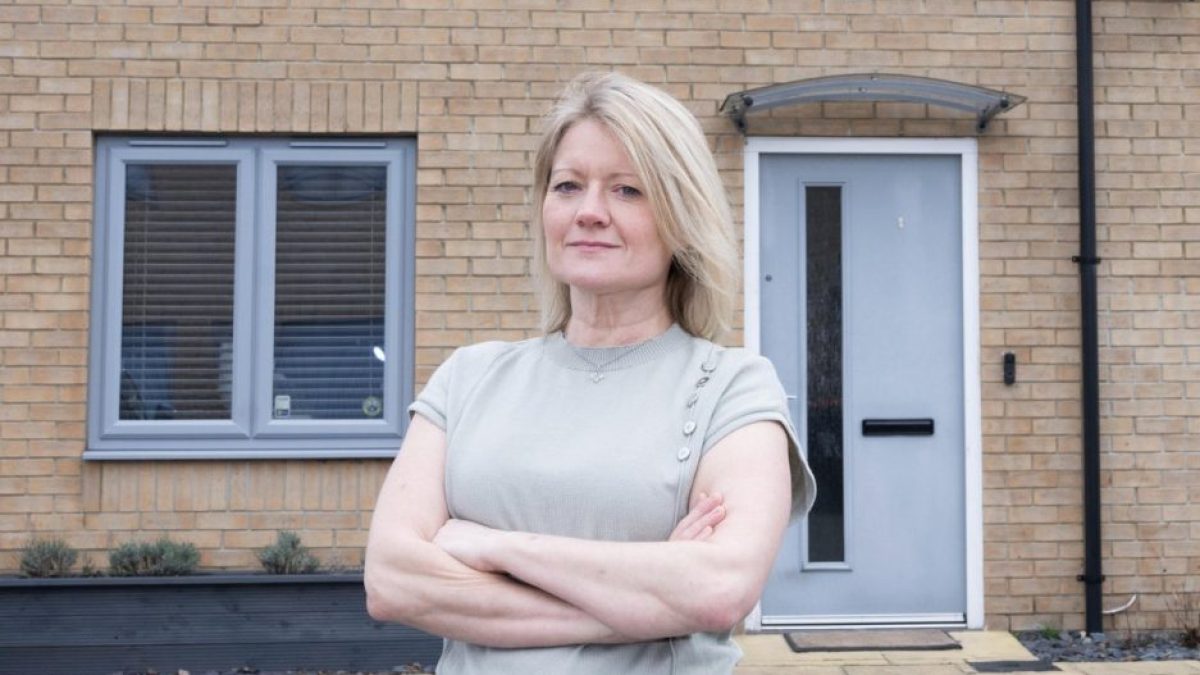
It was 2am on a cold January night when Christina Green woke up to an unusual sound. There was a loud rumbling coming from within the house. But where?
She immediately looked out her window and saw water at her doorway. Her neighbours were already outside, trying to move their cars onto higher ground. Her bathroom pipes were screaming from the strain of dirty flood water rising through the plumbing. It was too late to stop it – the pipes were now contaminated. Water was rising up through their shower.
Green, 39, and her husband’s attention went to their doorway – what could they do to stop the water from entering the house? But as they rushed downstairs and set foot on their living room carpet, they saw it was too late – the water had already seeped up through the very foundation of their new-build property.
It was immediately obvious that this six-bed new-build in Devon had been built for dry weather and dry weather only. “We were told there was a one-in-a-thousand chance of us experiencing flooding when we bought the property in 2017,” says Green. She has since discovered that the housing developer cut corners and installed cheaper airbricks instead of water-tight ones. The flood-defence airbricks would have cost just an extra £500. The damage to the house was now in the thousands, which has been covered by insurance. Green is yet to find out how much her home insurance is set to rise by as a result.
New FeatureIn ShortQuick Stories. Same trusted journalism.
Green’s garage was submerged in 20cm of water. “We are now looking to get flood defence bricks installed for £1500. But it would’ve been much cheaper to install them from the start. We paid £435,000 for the house. Why did the developers cut back on such an essential thing?”
Green and her husband are still dealing with the fallout from the severe water damage back in January. Their downstairs is unliveable, but their kitchen is still functioning, which means their insurance company haven’t relocated them. “I haven’t been sleeping properly. Every time it rains heavily, I think: what’s going to happen?” she says wearily. “We’re going to go to bed and wake up and find something else has happened. It’s just been really horrible.”
Across the road from Green, in a field that was submerged in water just four weeks ago, more new-build houses are in the early stages of development. “Who’s responsible for giving planning permission for this?” she says, exasperated. “Who is responsible for this happening in the first place? Obviously, we can’t control the weather, but who is going to protect those houses from being flooded, too? I don’t know who to go to.”
In December 2025, the government pledged that 1.5 million new homes would be built by 2029. Applications for 335,000 homes outside London were lodged in 2025, a rise of 60 per cent on the previous year, according to Planning Portal. This is great news for a nation plagued by a housing crisis – with property and rent prices currently way above real wage inflation as more people fight for fewer homes.
But achieving these targets is already coming at a cost for those living in the new estates. In the past 20 years, overall customer satisfaction with new-build homes has fallen from 90 per cent in 2011 to 84 per cent. Just this year, Barratt Redrow, one of the UK’s largest property developers, recently reported £248m of defects across its portfolio, including £80m to fix fire safety issues.
Even when new housing standards are introduced, many new-builds are not meeting them. According to Energy Performance Certificate (EPC) data, only 40 per cent of new homes completed in England during December 2024 were built to the 2021 energy regulations. In a new report, the National House Building Council (NHBC) says this is beginning to change. “It is predicted that a sudden rise in the percentage of new homes built to the 2021 regulations will be seen towards the end of 2025, continuing to rise in 2026,” the report states. They predict that this year, we will finally see more homes built with air source heat pumps and solar photovoltaic panels.
But it might be too late for some homes. New data from Aviva has found that 11 per cent of new homes constructed in England between 2022 and 2024 have been built in areas of medium or high risk of flooding. The Guardian reports that 100,000 more homes will be built in flood risk areas in the next five years as a direct result of the new housing quotas.
The Association of British Insurers (ABI) recently warned ministers that thousands of new homes could soon be uninsurable if the government presses on with new planning rules. The new legislation will prevent building on coastal or river flood plains, but not on those affected by flash flooding or surface flooding (usually caused by overwhelmed drains). The ABI warn that buyers would struggle to get mortgages on such properties ignored in this loophole.
And yet, development in flood-prone locations continues to rise. “The impacts of climate change are bringing more intense and prolonged rainfall, significantly increasing flood risk from all sources, particularly surface water flooding, “ says Tracey Garrett, chief executive of The National Flood Forum. “It is already affecting communities that may never previously have considered themselves at risk. Without robust standards, proper oversight, and long-term maintenance arrangements, families risk being trapped in properties that flood once, twice, or repeatedly. They will be facing emotional trauma, financial loss, rising insurance costs, and homes that become difficult or impossible to sell.”
***
“Damaged doors, damaged work tops, scratched glass doors that don’t lock, cookers that don’t work”. John Cooper, the managing director of New Homes Quality Control, lists the common problems he sees when inspecting new-build homes, a job he has been doing since 2018.
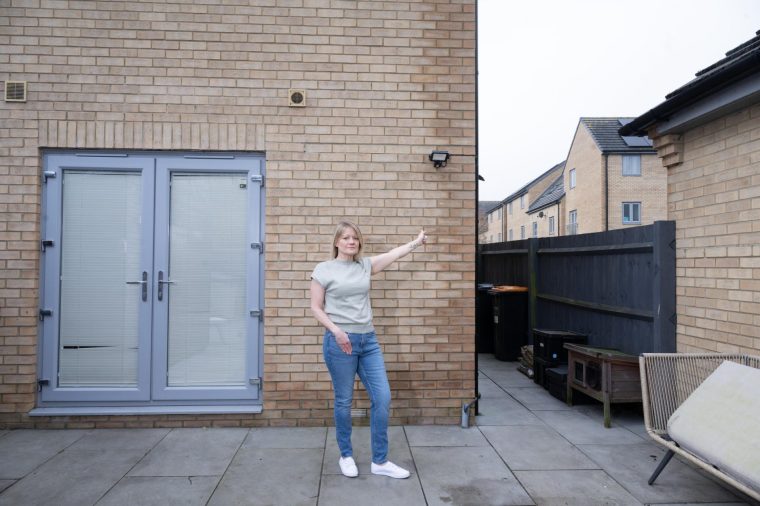 It’s been ten years since Louise O’Riordan bought her new-build. Issues – including damp and water ingress – are ongoing (Photo: Damien McFadden)
“We’re also seeing a lot of brickwork and carpentry issues with poor quality workmanship. Bricklayers are quite often left to their own devices in building sites, and nothing gets checked by anybody of managerial status,” he says. “The management of building projects is often not great. It’s just about getting it done.”
Every day, Cooper reads reports about the wrong airbricks being installed. “This is a huge issue,” he says. “We do inspections seven days a week, and out of the 15 reports or 20 reports coming daily, probably 15 of them will have a problem with the airbricks.”
In some houses, the airbricks are not the correct height, with driveways built slightly higher, so they’re not at the same level. This means the water runs under the house and seeps through the floor. “The developers we come across just seem to want to brush that off,” says Cooper.
Maya Singer Hobbs, a senior research fellow at the Institute for Public Policy Research, blames government pressure for these simple mistakes. “Successive governments have placed a priority on the number of homes built at the expense of other considerations,” she says. “This is usually done through cutting regulations in an attempt to boost planning permissions and housing numbers. And in order to maintain profit margins, housebuilders will be looking for ways to reduce costs.”
Even the super-rich are not protected from poorly built housing. One Hyde Park is home to some of the most expensive flats in the UK. Its leaseholders won a court case in February against Laing O’Rourke, the contractor that built their homes with defective pipework in 2011. “It doesn’t matter how much money goes into a development; the same tradesmen are used everywhere,” says Cooper.
Cooper believes this is a quality supply issue. “We don’t have enough quality tradesmen out there to achieve our targets,” he says. In their latest report, the NHBC predicted England would need 30 per cent more tradesmen to reach the 2029 target.
Part of the problem, he says, is that managers do not spend enough time training apprentices, resulting in sloppy work and basic errors. “Because everybody gets paid per item completed, there is no time spared to actually teach apprentices or check work.”
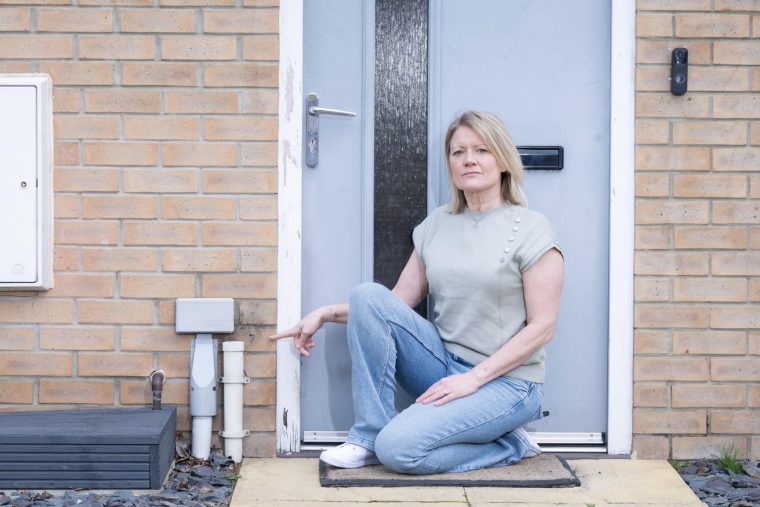 Water is getting in at every angle of new-builds on their estate, Louise explains (Photo: Damien McFadden)
Louise O’Riordan, 49, saw this firsthand. In 2016, she was thrilled to be moving into a new three-bed in Bedfordshire with her husband and daughter – a development by Linden Homes. As first-time buyers, they were excited to live somewhere stable. “We both come from difficult pasts, and this was our first secure home,” she explains. “But I regret it. I wish we hadn’t bought this house.”
Even before O’Riordan moved in, there were issues. “The flooring we paid £4,500 for was not fitted properly. It was mismatched. I had to take them to court just to get that solved, and they settled right just before the hearing,” she says. “Our heating system keeps losing pressure. There are leaks in it. And that’s been like that from day one. There have been leaks in the bathroom because the plumbing is terrible. The staircase was wobbly.”
Ten years later, the problems have worsened. O’Riordan has since taken on the unpaid role of property manager, working with residents to try to fix the many issues that plague the housing development. “The biggest issue that we have at the moment is that all of the buildings have water ingress,” she says. “So whether that’s from a lack of damp proof, or water coming down from the top of the building, it’s getting in at every angle.”
She fears that any fireproofing in her house must also now be compromised. “We have got balconies on the blocks of flats that have not been built with any drainage, so water’s running into the building. There’s black and green mould inside these buildings.” It has taken a severe toll. “We were trying to have children when we got this house. It’s the whole reason we bought a three-bed. I had miscarriage after miscarriage. I don’t know the stress caused it, but I imagine it didn’t help.”
Then there is the basic issue of poor foresight. “The housing estate doesn’t even have enough space for the number of cars, and we don’t have any nearby roads to park on,” she says. This lack of space is causing tension amongst residents. “We’re all arguing over problems we never created, we never wanted, and we are not able to resolve.”
A spokesperson from Vistry, on behalf of Linden Homes, has said they are working to tackle the issues at the development: “We have been in contact with this customer to rectify the issues raised and have worked to resolve the reported snags which have now been completed in line with the home’s NHBC warranty”.
Back in Devon, Christina Green watches the new development being built near her flood-damaged house in despair. But as the demand for housing increases and our weather continues to change, her ordeal is set to be repeated across the country.