
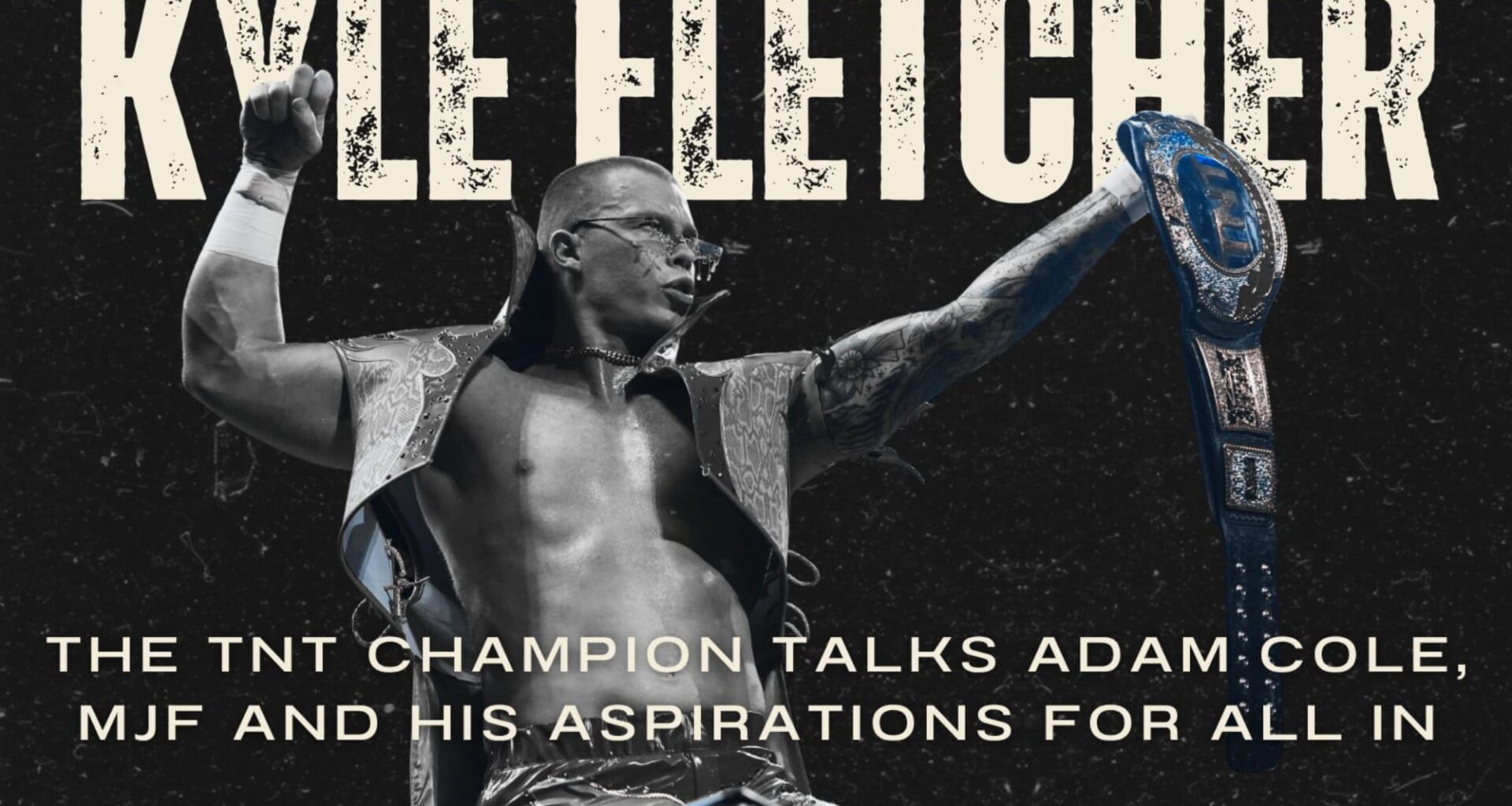
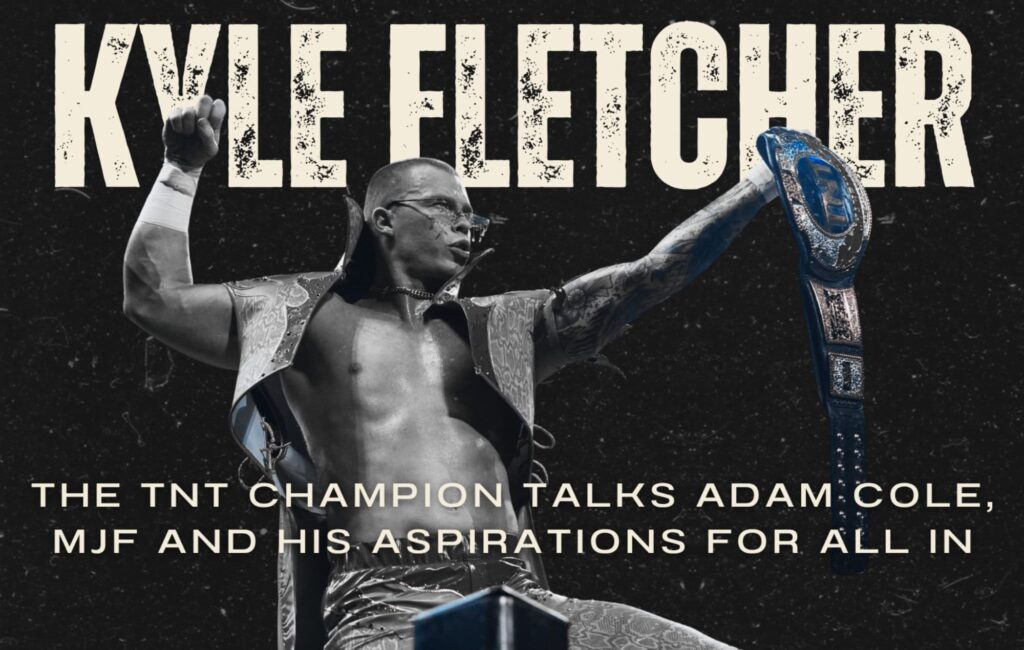
At London’s first-ever All In, Kyle Fletcher wrestled MJF in the free Zero Hour preshow. Back then, he was still a tag team wrestler with floppy hair and green gear. Full of potential, sure, but not yet the fully realised (and very pink) Protostar. He ate the pin that night and lost, while MJF went on to main event, retaining the World Championship in a shower of confetti.
Things look a bit different now.
The two briefly crossed paths on a recent Dynamite, and Fletcher towered over Max and refused to do his bidding. If anything, he looked his equal, which feels like a fitting reflection of his meteoric rise in the years since. When we speak to him at Wembley Stadium, the more tangible evidence of this rests on the table beside him, his bright pink TNT championship nestled next to a can of Monster that almost matches the shade of his opalescent tie.
When we use the MJF run in as a yardstick for his growth, he says it feels strange to talk about. “Because,” he explains, “when you’re living it and when you’re experiencing it, you see every single little incremental step. So it doesn’t feel like this massive growth and change until you see something like that, and then you can retrospectively look and go, ‘Oh my god, look how much has changed.’
“That kind of interaction was very, very telling and it reminded me of just how far I’ve come in those three years. It’s always a cool feeling to realise how much growth you’ve gone through.”
It’s hard not to argue he’d be returning to Wembley at the peak of his powers, but he does anyway. “There’s still a long way to go, for sure. I wouldn’t say I’m at my peak yet. I think everything I do now, whether or not it’s external or internal, I definitely feel a lot of pressure – I feel like I’ve kind of set that expectation at this point.
“People start to expect things from me now, which is what I want. I want people to expect greatness from me because it forces me to push myself even harder.”
Last time we spoke to him, he was insistent that the pressure was a privilege. Knowingly tapping on the shoulder he has that tattooed on, he says it’s the prevailing attitude of the entire locker room, which is why AEW is able to constantly overdeliver on pay-per-views.
“I think it comes down to the fact that every single person on the roster, every single night, but especially on pay-per-view, knows that they have to bring their absolute freaking A game. Collectively, if every single person and every single match does that, that’s when you get those pay-per-views where people come away going, ‘What have I just watched? Like that was the craziest thing ever,’ you know?”
He’s also quick to add that there’s no big meeting required to hammer this home either. Nobody, as he cartoonishly demonstrates, is marching around going, “We gotta fucking smash it, let’s go!”
According to him, it’s more simple and unspoken. “Everyone on the roster right now is so passionate, not just about pro wrestling, but AEW,” he says. “So when we get these opportunities to wrestle on pay-per-view, it’s like, alright, let’s show the world. Everyone has that same mindset, and I think that’s why our pay-per-views are so widely loved.”
It’s also the thing that made the last All In (held in Texas and not Wembley, thanks to Coldplay) even more emotionally heightened for Fletcher. He was set to wrestle Adam Cole, who would later come out and tearfully announce that he was vacating the TNT Championship. While stopping short of an official retirement, he made it clear he would be “gone for a while” because of undisclosed health issues, and hasn’t returned to AEW since.
Fletcher starts to pick at his nails at the mention of it. “Wow,” he sighs. “This is the first time I’ve actually really spoken about that day. It was one of the worst days of my whole life.”
He’d had an early call time, so he was planning to get up around six am to get ready and head to the Globe Life Field. Instead, he woke up around five to a message from Cole. He doesn’t go into the specifics of what was said, but the match was off.
“When you have so much built up anxiety and you’ve put that pressure on yourself…,” he trails off and shakes his head. “You know, I’d been dieting for two, three months leading up to that show. Every single day, I’d been thinking about this moment, this match, all of it. And then the rug gets pulled five hours before.
“You can’t really put into words what that kind of feels like.”
When he did show up to the venue, he spent a few silent hours digesting the news. “I was just in this weird limbo. I had no idea what was gonna happen, and I had flown my mum out for that show. It was obviously a huge day for me, and then it just all went to shit.”
He’s also at great pains to point out that whatever he felt that day paled in comparison to what Cole did.
“Obviously, this is my perspective. It’s very hard for me to complain about it, because I don’t feel like I have the right to complain about it. But yeah, it was very emotional in a lot of different ways, and not how you want a big day like that to go. So I think, especially this year, I just want to make sure it’s a day to remember and a much more positive one.”
(Happily, on the same day we spoke, Matt Jackson gave fans an update on Cole’s recovery in an episode of Being The Elite, saying he was “improving and getting better” day by day.)
 Fletcher lights up once again when conversation turns to his recent match with fellow Aussie and former mentor Robbie Eagles. Given Fletcher’s early career was so indebted to his time in England, he says coming up in Australia felt like an “insurmountable climb”, and moving over here felt like an almost inevitable move to progress his career.
“At that time, the UK felt like the next step for me, and I think the things I learned whilst being here go past just wrestling,” he says. “I did so much growing, personally and professionally whilst I was here, and I think it’s why I’m so grateful that I followed the path I did. Wrestling on the independents and making your way through the world of pro wrestling, you learn so much, not just about wrestling, but about yourself.”
Again, this comes with a caveat. He’s been incredibly measured throughout our entire conversation, and doesn’t seem to like talking on behalf of other people. “Obviously,” he stresses, “not everyone has the same path, not everyone has the same story, but for me personally, I think it was the best thing I could have possibly done.
“I think for any Australian pro wrestler – for any pro wrestler anywhere around the world – the UK is somewhere that I would absolutely recommend people try and hone their craft in. The things that I learned here, I still carry with me today, and they’re part of the reason that I’m at the level I am today for sure.”
He seems almost surprised when we ask what some of those things are. “Oh, I really had to learn how to speak up for myself. I had to learn to not just be passive and to just go with the flow.” Up to that point, he says he’d been more prone to taking the path of least resistance, a habit he quickly shook off.
“I really had to change that,” he nods. “I really had to put my foot down and figure out what was best for me, and to learn how to speak up about that. And I don’t think I would have had that if I didn’t have the experiences here.”
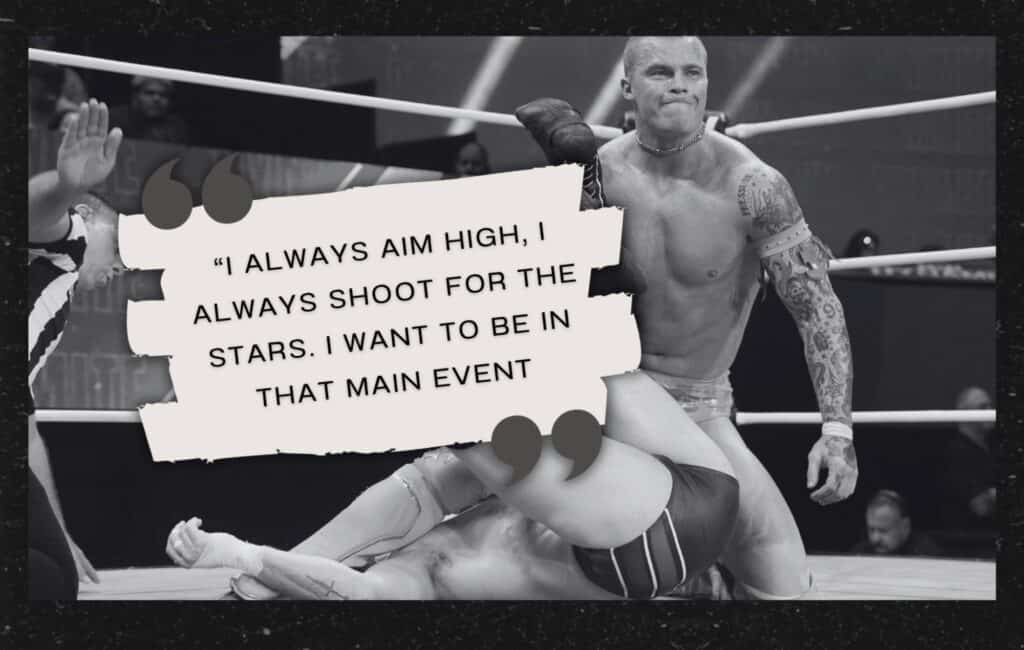
The culmination of those years will come later this summer, back at Wembley once again. “I always aim high, I always shoot for the stars,” he says. “I want to be in that main event, I want to be wrestling for the world title. Right now, MJF is the World Champion. If he still is when Wembley comes around, that is what I have my eye on.”
Naturally, there are other people in his periphery too. “I could go up and down the whole roster,” he says, before singling out Swerve Strickland, Kenny Omega and Andrade.
“I plan on being the greatest TNT champion of all time,” he declares. “In that regard, I’d love to wrestle Christian Cage [and] Darby Allin, to cement myself as the greatest TNT champion ever.” His vision for himself is clearly singular and focused, but the spectre of the Don Callis Family always looms just a step behind.
Does he ever see himself breaking away from them, becoming a great on his own, completely independently? “I think so, but I already do consider myself that,” he reasons. “I don’t look at myself and think, ‘I am this great wrestler because of other people.’ You’re always gonna have people in your orbit. I think that’s just part of human nature.”
With a little self-assured grin, he concludes: “I mean, unless you’re MJF and everybody hates your guts, you’re never going to be standing on your own with no support system whatsoever.”
Tickets for AEW All In London at Wembley Stadium on 30th August are available from LiveNation.co.uk