
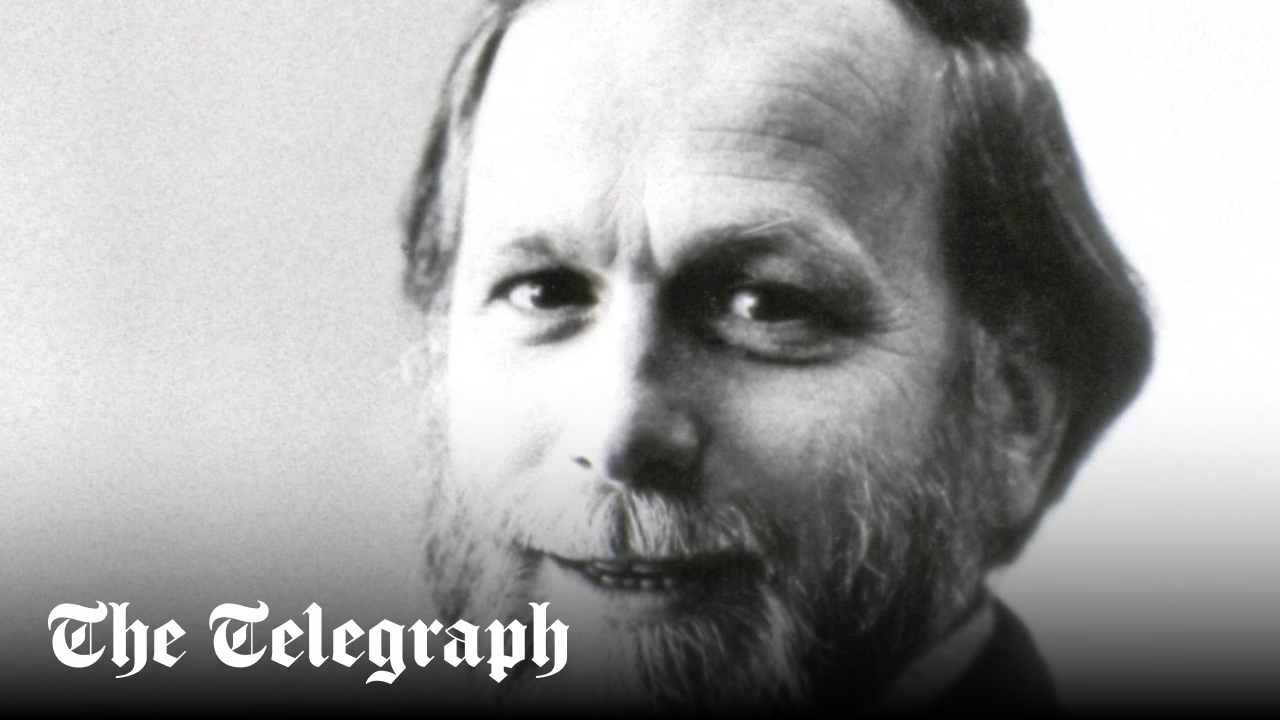
Michael Bishop, who has died aged 90, shared the 1989 Nobel Prize in Physiology or Medicine with Harold Varmus for proving that a loss of genetic control in normal cells can cause them to become cancerous.
In 1976 Bishop and Varmus, microbiologists at the University of California School of Medicine in San Francisco ( UCSF), were studying the Rous sarcoma virus, an agent known as a retrovirus linked to tumours in chickens, when they discovered that it was acting as a carrier for a gene that it had picked up from a cell of ordinary tissue.
They isolated the gene (known as a proto-oncogene as it has the potential to become cancerous) from healthy chickens, and found that when the virus infected other cells with the gene it mutated, causing the cell to divide relentlessly. In other words, mutations cause cancer not by inserting “foreign” genes into cells but by activating normal genes.
Since a single cancer cell has about 20,000 genes, searching for a specific cancer-causing gene might seem an impossible task. Yet dozens of such proto-oncogenes were soon identified in humans, and by 1986 the first gene-targeted drug had been developed by teams working in France and China, and was used to treat patients suffering from an acute form of leukaemia. The survival rate was spectacular.
Bishop and Varmus fundamentally changed the understanding of how tumours emerge, leading to a revolution in oncology involving a shift from treatment by non-specific chemotherapy to precision medicine that targets specific genetic mutations. The 1990s saw the emergence of Gleevec, which proved highly successful against another type of leukaemia, and Herceptin, which targeted an aggressive form of breast cancer. Since then other targeted cancer therapies have come on stream.
John Michael Bishop was born in York, Pennsylvania, on February 22 1936, the eldest of three children of a Lutheran pastor. As a child he developed passions for music and history, the latter leading to a lifelong interest in the history of infectious diseases.
He became interested in science at high school, when a family doctor took him along on house calls and taught him to read cardiograms and run laboratory tests – though as he recalled in a memoir, How to Win the Nobel Prize (2003), for many years “I imagined myself a historian, a philosopher, a novelist, occasionally a physician, but never a scientist.”
After studying chemistry at Gettysburg College he attended Harvard Medical School, where he discovered biomedical science. After graduation he pursued a fellowship in virology at the US National Institutes of Health (NIH). In 1968 he was appointed an associate professor at UCSF, becoming a full professor in 1972.
He and Varmus shared a laboratory until 1981, when Bishop became director of UCSF’s G W Hooper Research Foundation, though their alliance – based, Bishop wrote, on “a shared infatuation” with science, as well as with words and language – lasted until 1993, when Varmus left UCSF to become director of the NIH.
A slightly sour note was struck in 1989 by Dominique Stéhelin, a French researcher who had worked with Bishop and Varmus. He insisted that he deserved a share in the Nobel Prize, claiming to have done the crucial research. A UCSF spokesmen said that while Stéhelin had performed difficult experiments, the ideas and direction of the work had come from Bishop and Varmus.
As well as the Nobel, the two men shared (with other scientists) the 1982 Albert Lasker Basic Medical Research Award. They both received the US National Medal of Science. Bishop remained at UCSF, serving as chancellor from 1998 to 2009, overseeing a major expansion programme.
In 1959 he married Kathryn Putman. She died in 2016 and he is survived by two sons
Michael Bishop, born February 22 1936, died March 20 2026