
Oil prices fell and stock markets rallied in another volatile day of trading after President Trump sent a 15-point ceasefire proposal to Iran, fueling hopes for an easing of supply tensions in the region.
Brent crude, the global benchmark oil price, fell by as much as 6 per cent to less than $98 per barrel in morning trading, although rebounded to $102.22 a barrel by last night, still down 2.2 per cent, after Iran mocked the US proposal.
Iranian state television, citing an unidentified senior official, said that Iran had rejected a peace plan proposed by the US. “Iran has responded negatively to an American proposal aimed at ending the ongoing imposed war,” the official said, according to the English-language broadcaster Press TV. “The end of the war will occur when Iran decides it should end, not when Trump envisions its conclusion.”
Despite the uncertainty, the FTSE 100 rose back above 10,000, gaining 1.4 per cent to close at 10,106.84, its best session in several weeks, with shares in miners, financial companies and housebuilders offsetting a weaker showing from oil and defence companies.
The more UK-biased FTSE 250 rose 1.6 per cent to 21,475.45. Gilt yields rose and markets in Germany and France were both up by 1.4 per cent. Gold was buoyed by a weaker dollar, rising 3.4 per cent to $4,569.80 an ounce, its best gain since early February.
US markets opened up with the S&P 500 up 0.6 per cent at 6,600.02, the Dow Jones industrials up 0.6 per cent at 46,4121.20, and the Nasdaq Composite up 1 per cent at 21,990.53.
Analysts at ING said: “Despite the initial market relief, uncertainty remains high. Tehran fired a fresh wave of missiles at Israel and signalled little willingness to compromise, while Iran also reiterated that foreign ships can transit the Strait of Hormuz only if they comply with Tehran’s regulations and are not supporting acts of aggression. Earlier, the US ordered the deployment of about 2,000 troops from the 82nd Airborne Division to the region, underscoring the risk of further escalation.”
Hiroyuki Kikukawa, chief strategist of Nissan Securities Investment, said: “Expectations of a ceasefire have risen slightly, and profit-taking is leading the market. The outlook remains uncertain as to whether negotiations will succeed, limiting selling.”
Analysts at Morgan Stanley warned that the oil market was “unlikely to return to the regime that prevailed before the conflict” and raised their 2027 forecast Brent estimate to $80 a barrel.
“Whatever path events take from here, the last four weeks have changed how investors must think about the Strait of Hormuz, effective spare capacity and the value of secure oil supply,” the bank said.
“The market has now learned something that it cannot easily unlearn: the flow of oil through the Strait of Hormuz can in fact be cut off. Given the volume of oil involved, that amounts to a structural repricing of geopolitical risk in oil markets.”
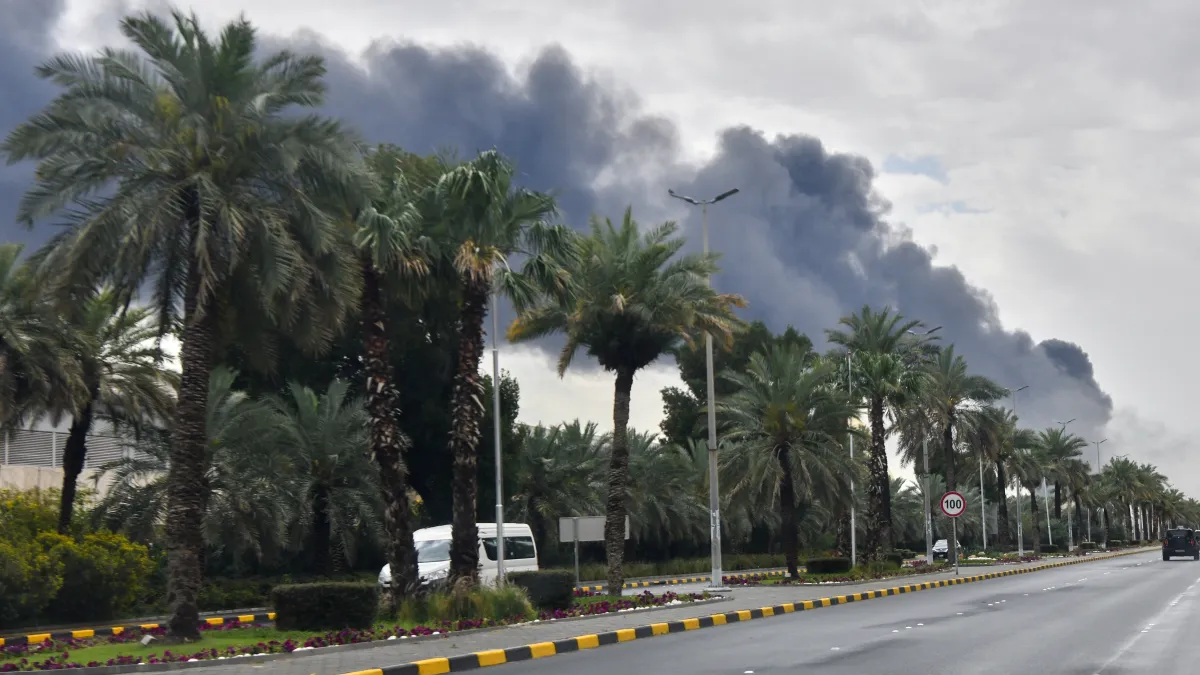
Iran kept up attacks on Gulf states and Israel overnight. A fuel tank at Kuwait international airport was hit in a drone attack, leading to a fire but no casualties.
In a video aired on state television, Lieutenant Colonel Ebrahim Zolfaghari, a spokesperson for the Iranian military’s Khatam al-Anbiya Central Headquarters, said: “The strategic power you used to talk about has turned into a strategic failure … Don’t dress up your defeat as an agreement.”
Late on Tuesday, Iran claimed to have reopened the Strait of Hormuz to “non-hostile vessels” if they co-ordinate with Iranian authorities. Tehran has effectively closed the key waterway, which carries about a fifth of the world’s oil and gas, since the war with the US and Israel began at the end of last month.
At the energy industry’s annual Cera conference in Houston on Tuesday, Wael Sawan, the boss of Shell, warned that Europe risks fuel shortages as soon as next month as supplies dwindle and Gulf exports remain severely limited.
Fatih Birol, the head of the International Energy Agency, said on Wednesday he was “ready to move forward” with an additional release of oil reserves “if and when necessary”. Earlier this month, the IEA and members announced plans to release a record 400 million barrels to stem the rise in energy prices.
Birol’s comments in Tokyo came after Japan’s prime minister, Sanae Takaichi, asked the agency “to prepare to implement an additional release in case the situation drags on” with the war in the Middle East.
Birol has described the current near-total blockage of the Strait of Hormuz as a “major threat” to the global economy, surpassing the impact of the 1970s oil shocks.
BlackRock boss Larry Fink, who leads the world’s largest asset manager, told the BBC that if the price of oil hits $150 a barrel, it will trigger a global recession.