
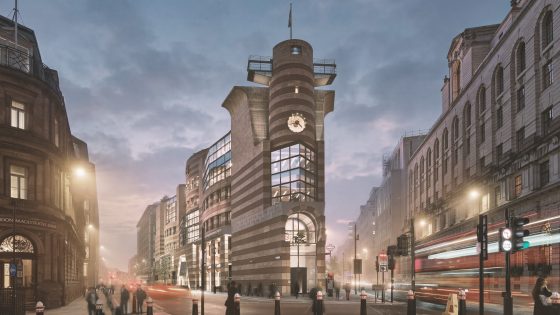
The practice was handed consent yesterday (25 March) by the City of London Corporation for proposals to improve the accessibility and energy efficiency of the 28-year-old Grade II*-listed office building.
Councillors voted by nine to six in favour of the application, despite a strongly worded objection from the family of the building’s original developer and former peer Peter Palumbo, who said the JRA scheme was a ‘mutilation’ which threatened its Grade II* listing.
‘The overarching problem with the proposals is that they meddle to the point of mutilation with the design of the late Sir James Stirling, who was widely acclaimed as amongst our country’s foremost architects,’ said the Palumbo family in a letter.
‘These proposed changes are disrespectful to Sir James Stirling. We strongly urge that the work of Sir James Stirling is not tampered with but respected for future generations.’
City of London planning officers had earlier recommended approval of the scheme.
The project team said its proposals ‘set out a model for intelligent decarbonisation’ and warned that No 1 Poultry could become a ‘stranded asset’ without ‘significant’ intervention. JRA added at planning that the building had become ‘increasingly misaligned with contemporary workplace expectations’.
‘These proposed changes are disrespectful to Sir James Stirling’
Plans include all-electric energy systems supported by heat pumps, insulation improvements and new technology to ‘improve performance without intrusive structural intervention’.
The vision includes reinstating free public access to the building’s Apex Garden roof terrace with ‘durable materials, enhanced biodiversity and layered landscaping’.
Meanwhile, the Prow entrance at Bank junction will be reopened to the public for the first time in more than 25 years with a ‘procession from street to roof’ restoring a ‘ceremonial sequence shaped by Stirling’s scala regia’.
At planning, the project team added: ‘These changes address long-standing accessibility challenges and reinforce the building’s civic contribution, supporting the City of London’s Destination City objectives.’
Improved amenities, overhauled thermal performance and enhanced arrival spaces are also proposed, along with a re-engineered interior that supports ‘modern patterns of work and wellbeing’.
Flexible floorplates, improved daylighting and a network of more than 200 sensors are designed to support adaptable, low-carbon operation, while ‘retaining the rigour of the original plan’.
Completed in 1997, No 1 Poultry was the final project by the late James Stirling with James Stirling Michael Wilford and Associates.
Korean giant IGIS Asset Management appointed West London outfit Fore Partnership last year to manage the refurbishment, which is being carried out in partnership with former Morris+Company architect Ben Cross. John Robertson Architects was commissioned as lead architect and has submitted the applications for planning and listed building consent.
Ben Cross, project co-lead, said: ‘From the outset, our focus at No 1 Poultry has been clear: to respect the building’s significance while carefully preparing it for the next chapter of its life. This result follows extensive consultation with our neighbours, the custodians of its architectural legacy and policy makers.
‘We are grateful to the City and Historic England for recognising our commitment to honouring Stirling and Wilford’s intent, while significantly reducing energy use and creating a more inclusive, future-ready workplace. It is a powerful example of London at its best – protecting what matters, while adapting with purpose for a more sustainable future.’
Fore Partnership founder Basil Demeroutis added: ‘Every building will need to decarbonise over the coming decades, and historic buildings are often seen as the hardest challenge. Our view is the opposite: when you treat them as innovation platforms, they can lead the transition. If a Grade II Stirling building at Bank can decarbonise, anything can.
‘No 1 Poultry is becoming a lighthouse project that shows even the most complex buildings can be updated for a radically different, low-carbon urban landscape. By bringing together new technologies and research alongside investment discipline, we’re pushing the building as far as we can into the future of real estate — ensuring it continues to serve the City for decades to come and delivers financial outperformance for our investors.’
The revamp is aiming for EPC A and BREEAM Outstanding ratings, as well as net zero operation.
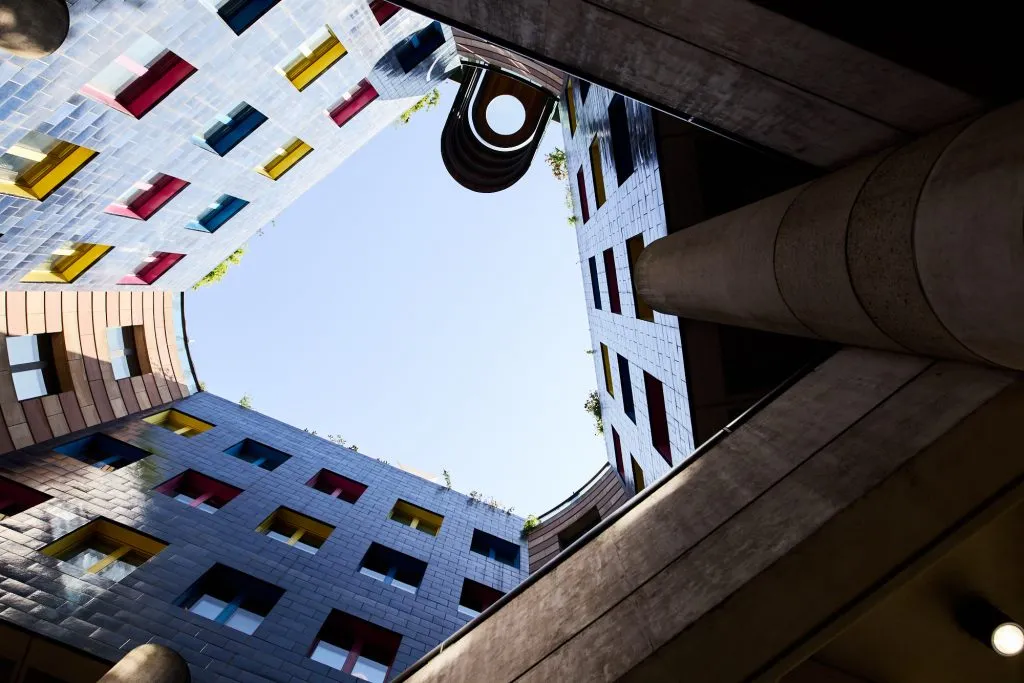
No 1 Poultry