
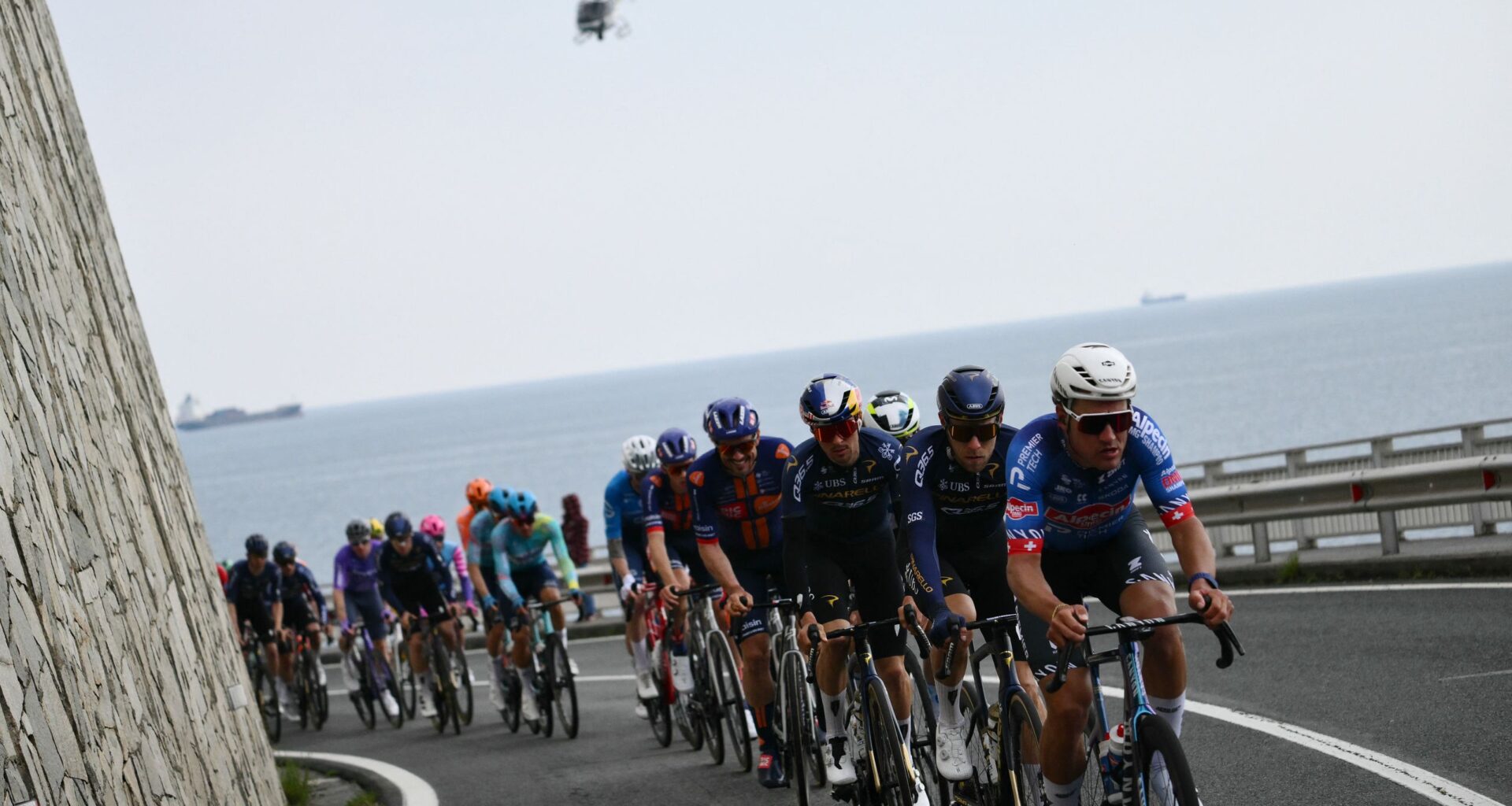
I forget who said it, but there’s a saying that goes something along the lines of ‘professional cycling is an individual sport, practised in teams’. Only one man or woman can win the race, but they cannot do it without the help of their teammates.
As such, a professional team is made up of different roles. The leaders, of which there is usually just one per team but sometimes two or three, and the support riders, known as domestiques, who come in dozens of different guises.
Article continues below
You may like
What to read next
What goes through his head?
Dillier, who estimates his FTP sits around 400-420 watts, confirmed he eats 120 grams of carbs per hour to fuel this role, and that remembering to eat is pretty much the only thing that goes through his mind.
“I try to think about nothing, kind of meditating on the bike. I definitely try to stay positive in my thoughts, but the easiest way do this is just think about nothing.
“I try to break down my whole effort into smaller pieces, I had these 15 minute markers where I would eat something or drink something. And then, yeah, after a couple of these, when you really start to get into your rhythm and flow, 15 minutes actually passes by pretty quickly. “
I jokingly asked if he didn’t have a song stuck in his head going round on repeat, which was laughed off with a no, but the opening lyric to Taylor Swift’s Shake It Off – Got nothin’ in my brain – seems equally apt.
Given the task at hand, knowing the time gap to the breakaway seems important, but rather than get this info from his team via the radio, he prefers to rely on the race motorbikes, who provide the gaps on a board at semi-regular intervals.
Instead, the radio chatter tends to be more logistical info from his team, such as if riders are heading back to the car for bottles or stopping for a toilet break.
During the race, much was said about other teams’ refusal to contribute to the chase. Alongside Van der Poel, UAE Team Emirates XRG’s Tadej Pogačar was the other hot favourite to win the race, so it was widely assumed one of his teammates would help Dillier.
The fact that they didn’t was a surprise to Dillier and his team, but he tries to see the bright side.
“It’s surprising, because you have basically one of the biggest favorites of the race, and you’re not willing to control, it seems to be a little bit odd. But in the end, we also have one of the big favorites in our team. We have, even with Jasper [Philipsen], another good card to play. So for us, it was no question that we would control the race.
“I actually get a lot of positive feedback about my ride, which I guess I would not get if I would have shared the work. But then, if I would have somebody to help me on this task, I could maybe go longer.
“We would also control it differently, we would maybe give the breakaway more time.”
Overall, despite the obvious disappointment that Van der Poel was unable to win the race for a third time, following his crash, Dillier doesn’t feel an extra layer of disappointment having put in such a shift. In fact, he looks at it from an opposing perspective, allowing the pride of a good personal performance to soften the blow.
And he firmly believes that without the crash, Alpecin would have taken its fourth Milan-San Remo on the bounce.
“My belief, I think without the crash, without the problem of his hand, he would still be able to win it. Win it a third time himself and a fourth in a row for the team.”
Dillier has already flown to Belgium ahead of a Classics block, starting this Friday at E3 Saxo Classic. He is quick to reassure that despite the hand injury, Van der Poel will lead the team.
Get unlimited access to our unrivalled 2026 Spring Classics coverage with a Cyclingnews subscription. We’ll bring you breaking news, reports, and analysis from some of the biggest races on the calendar, including Milan-San Remo, Paris-Roubaix and the Tour of Flanders. Find out more.